Sign in
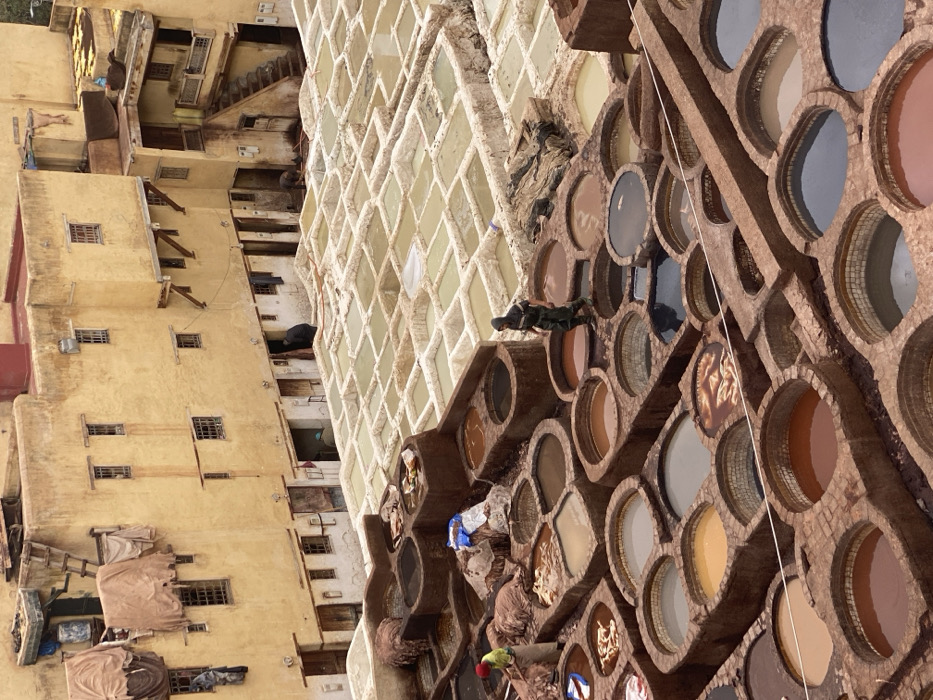
This image captures a high-angle view of the Chouara Tannery located in Fes el Bali, Fez, Morocco. The scene is dominated by an extensive open-air complex of stone vats used for leather processing.

In the foreground and midground, a dense arrangement of circular and irregularly shaped masonry pits filled with liquids of various colors—brown, ochre, grey, blue, and reddish-brown—is visible. These pits are interconnected by narrow ledges and pathways. To the upper right, a larger section consists of numerous square, light-colored pits, mostly filled with a pale, milky liquid, indicating a different stage of treatment, likely for liming or softening hides.

Two individuals are actively present within the tannery area. On the left side, a worker dressed in a light green top and light-colored trousers stands next to a cluster of circular pits containing hides. This individual appears to be manipulating hides or liquids with a long pole or tool. Towards the center-right, a second worker, wearing a dark hooded garment and dark trousers, walks carefully along the narrow ledges between the circular dyeing pits.

Surrounding the tannery pits are multi-story buildings constructed of yellowish-tan stucco or mud-brick, featuring numerous small, gridded windows and wooden doors at ground level. Some buildings have small balconies or extensions supported by wooden beams. On the upper levels and rooftops of these buildings, various animal hides and fabric pieces are draped over ledges and ropes, presumably for drying. In the background, further urban architecture, including staircases and additional building complexes, extends upwards, typical of a dense medina environment. The overall impression is one of a traditional, labor-intensive industrial process within a historic urban setting.
number one

Mar 4, 2026

Fez, Morocco

Stake attention in this memory

Industry
Labor
Curiosity
Nostalgia
Unease

This image captures a high-angle view of the Chouara Tannery located in Fes el Bali, Fez, Morocco. The scene is dominated by an extensive open-air complex of stone vats used for leather processing. In the foreground and midground, a dense arrangement of circular and irregularly shaped masonry pits filled with liquids of various colors—brown, ochre, grey, blue, and reddish-brown—is visible. These pits are interconnected by narrow ledges and pathways. To the upper right, a larger section consists of numerous square, light-colored pits, mostly filled with a pale, milky liquid, indicating a different stage of treatment, likely for liming or softening hides. Two individuals are actively present within the tannery area. On the left side, a worker dressed in a light green top and light-colored trousers stands next to a cluster of circular pits containing hides. This individual appears to be manipulating hides or liquids with a long pole or tool. Towards the center-right, a second worker, wearing a dark hooded garment and dark trousers, walks carefully along the narrow ledges between the circular dyeing pits. Surrounding the tannery pits are multi-story buildings constructed of yellowish-tan stucco or mud-brick, featuring numerous small, gridded windows and wooden doors at ground level. Some buildings have small balconies or extensions supported by wooden beams. On the upper levels and rooftops of these buildings, various animal hides and fabric pieces are draped over ledges and ropes, presumably for drying. In the background, further urban architecture, including staircases and additional building complexes, extends upwards, typical of a dense medina environment. The overall impression is one of a traditional, labor-intensive industrial process within a historic urban setting.

transactions
revenues
stakers
Earliest
Latest
Highest stake

No transactions found

More from this user

More from Fez

number one

Mar 4, 2026

Fez, Morocco

Licensed under Creative Commons Attribution 4.0 International License. You are free to share and adapt this content with proper attribution.