
Sign in
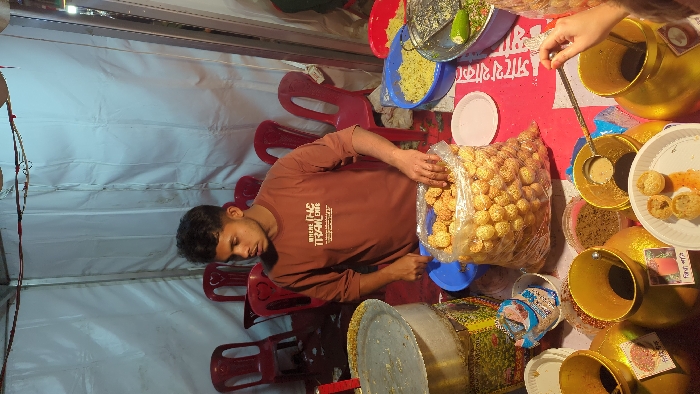
This image captures a vibrant scene at a food stall, likely at a market or festival, dedicated to preparing and serving a popular South Asian street food, similar to Fuchka or Pani Puri. The entire image is oriented sideways, with the top of the scene on the left side of the frame.

In the foreground and center, a man, presumably the vendor, is actively engaged in the food preparation. He is wearing a brown long-sleeved shirt with some stylized text on it, which appears to read "WHERE THE TRAIN ENDS". He has short, dark hair and is looking down at his work. His hands are near a large, transparent plastic bag filled with numerous small, round, golden-brown fried crispy shells, which are characteristic of Fuchka or Pani Puri. He appears to be either taking out shells or preparing them for filling.

To the right of the man (which is the bottom in the image's orientation), there is a bustling array of ingredients and serving items. A hand is visible, holding a ladle and scooping a light-colored liquid or paste from one of several golden-colored pots or containers. These pots appear to hold different flavored liquids or chutneys, essential components of the dish. One golden pot in the upper right (actual top) shows a dark liquid inside. Another white plate displays a few prepared Fuchka shells, some already filled and garnished with what looks like a reddish sauce or chutney.

Other ingredients and tools are also visible on the red tablecloth-covered surface. There are blue bowls filled with various fillings, possibly mashed potatoes, chickpeas, or other ingredients, ready to be stuffed into the fried shells. Small containers with dry spices or toppings are also present. A metal strainer and a green lime or lemon can be seen on the upper left side (actual top left). Disposable white plates are stacked and scattered around the preparation area. A large metal pot, possibly holding more ingredients or mixing components, is situated towards the lower left.

The setting appears to be a temporary setup, indicated by the white tent-like walls or tarpaulins forming the background. Several red plastic chairs are visible, some stacked, suggesting a seating area or part of the stall's infrastructure. The overall impression is one of a busy, casual food stall, likely operating in the evening or under artificial light, given the illumination.

Visible text includes the stylized lettering on the vendor's shirt: "WHERE THE TRAIN ENDS". On the red tablecloth, there is text in Bengali script; one prominent part seems to be "সালাম শাহ" (Salam Shah), possibly indicating a name or brand. Small square labels with images and Bengali text are also affixed to some of the golden pots, though the text on these labels is too small to decipher clearly.
Azim

Jan 29, 2026, 4:09 PM

Dhaka, Bangladesh

Stake attention in this memory

nostalgia
community
busy
satisfaction
anticipation

This image captures a vibrant scene at a food stall, likely at a market or festival, dedicated to preparing and serving a popular South Asian street food, similar to Fuchka or Pani Puri. The entire image is oriented sideways, with the top of the scene on the left side of the frame. In the foreground and center, a man, presumably the vendor, is actively engaged in the food preparation. He is wearing a brown long-sleeved shirt with some stylized text on it, which appears to read "WHERE THE TRAIN ENDS". He has short, dark hair and is looking down at his work. His hands are near a large, transparent plastic bag filled with numerous small, round, golden-brown fried crispy shells, which are characteristic of Fuchka or Pani Puri. He appears to be either taking out shells or preparing them for filling. To the right of the man (which is the bottom in the image's orientation), there is a bustling array of ingredients and serving items. A hand is visible, holding a ladle and scooping a light-colored liquid or paste from one of several golden-colored pots or containers. These pots appear to hold different flavored liquids or chutneys, essential components of the dish. One golden pot in the upper right (actual top) shows a dark liquid inside. Another white plate displays a few prepared Fuchka shells, some already filled and garnished with what looks like a reddish sauce or chutney. Other ingredients and tools are also visible on the red tablecloth-covered surface. There are blue bowls filled with various fillings, possibly mashed potatoes, chickpeas, or other ingredients, ready to be stuffed into the fried shells. Small containers with dry spices or toppings are also present. A metal strainer and a green lime or lemon can be seen on the upper left side (actual top left). Disposable white plates are stacked and scattered around the preparation area. A large metal pot, possibly holding more ingredients or mixing components, is situated towards the lower left. The setting appears to be a temporary setup, indicated by the white tent-like walls or tarpaulins forming the background. Several red plastic chairs are visible, some stacked, suggesting a seating area or part of the stall's infrastructure. The overall impression is one of a busy, casual food stall, likely operating in the evening or under artificial light, given the illumination. Visible text includes the stylized lettering on the vendor's shirt: "WHERE THE TRAIN ENDS". On the red tablecloth, there is text in Bengali script; one prominent part seems to be "সালাম শাহ" (Salam Shah), possibly indicating a name or brand. Small square labels with images and Bengali text are also affixed to some of the golden pots, though the text on these labels is too small to decipher clearly.

Loading AttnAds…

transactions
revenues
stakers
Earliest
Latest
Highest stake

No transactions found

More from this user

More from Dhaka

Azim

Jan 29, 2026, 4:09 PM

Dhaka, Bangladesh

Licensed under Creative Commons Attribution 4.0 International License. You are free to share and adapt this content with proper attribution.