
Sign in
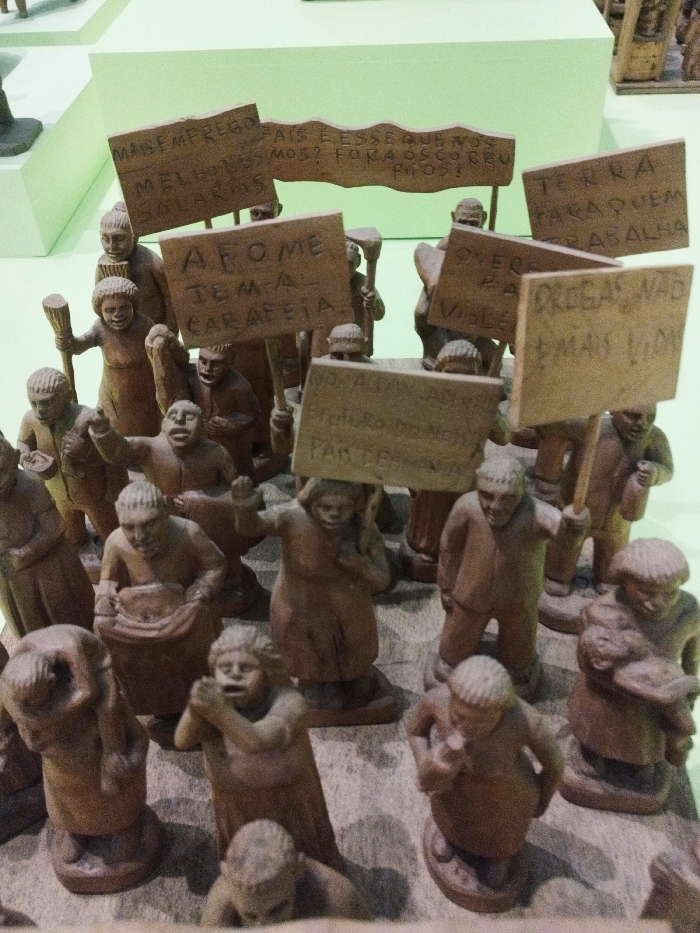
The image displays a detailed folk art sculpture arrangement consisting of approximately two dozen stylized figures crafted from unpainted, reddish-brown clay or wood. The figures are arranged on a textured light brown base, depicting a miniature street protest or social demonstration.

Each figure exhibits a simple, blocky form with minimal detail, representing individuals in various states of action and emotion. Several figures hold small, rectangular signs or banners with handwritten Portuguese text. Legible messages include: "MAIS EMPREGO MELHORES SALARIOS" (More Employment Better Wages), "QUE PAÍS É ESSE QUE NÓS VIVEMOS? FORA OS CORRUPTOS!" (What country is this that we live in? Out with the corrupt!), "A FOME TEM-A CARA FEIA" (Hunger has an ugly face), "TERRA PARA QUEM TRABALHA" (Land for those who work), and "DROGAS NÃO É MAIS VIDA" (Drugs are no longer life). Other partially visible signs mention "A VIOLÊNCIA SÓ GERA VIOLÊNCIA" (Violence only generates violence).

The figures are posed to convey collective action, with some raising fists, pointing, or carrying symbolic items such as brooms or pickaxes. One figure in the foreground is depicted kneeling with an open mouth, suggesting anguish, while another carries a small child. The overall composition creates a dense and dynamic scene of social commentary.

The sculpture is displayed indoors, against a plain, light green wall, characteristic of a museum or gallery exhibit, under even artificial lighting. This exhibit, given its thematic focus on Brazilian social issues and its folk art style, is located in São Paulo, Brazil, most likely within the **Museu Afro Brasil** in Ibirapuera Park.
Mrv

Aug 27, 2025, 6:22 PM

São Paulo, Brazil

Stake attention in this memory

Protest
Poverty
Despair
Frustration
Solidarity

The image displays a detailed folk art sculpture arrangement consisting of approximately two dozen stylized figures crafted from unpainted, reddish-brown clay or wood. The figures are arranged on a textured light brown base, depicting a miniature street protest or social demonstration. Each figure exhibits a simple, blocky form with minimal detail, representing individuals in various states of action and emotion. Several figures hold small, rectangular signs or banners with handwritten Portuguese text. Legible messages include: "MAIS EMPREGO MELHORES SALARIOS" (More Employment Better Wages), "QUE PAÍS É ESSE QUE NÓS VIVEMOS? FORA OS CORRUPTOS!" (What country is this that we live in? Out with the corrupt!), "A FOME TEM-A CARA FEIA" (Hunger has an ugly face), "TERRA PARA QUEM TRABALHA" (Land for those who work), and "DROGAS NÃO É MAIS VIDA" (Drugs are no longer life). Other partially visible signs mention "A VIOLÊNCIA SÓ GERA VIOLÊNCIA" (Violence only generates violence). The figures are posed to convey collective action, with some raising fists, pointing, or carrying symbolic items such as brooms or pickaxes. One figure in the foreground is depicted kneeling with an open mouth, suggesting anguish, while another carries a small child. The overall composition creates a dense and dynamic scene of social commentary. The sculpture is displayed indoors, against a plain, light green wall, characteristic of a museum or gallery exhibit, under even artificial lighting. This exhibit, given its thematic focus on Brazilian social issues and its folk art style, is located in São Paulo, Brazil, most likely within the **Museu Afro Brasil** in Ibirapuera Park.

Loading AttnAds…

transactions
revenues
stakers
Earliest
Latest
Highest stake

No transactions found

More from this user

More from São Paulo

Mrv

Aug 27, 2025, 6:22 PM

São Paulo, Brazil

Licensed under Creative Commons Attribution 4.0 International License. You are free to share and adapt this content with proper attribution.