
Stake attention in this memory
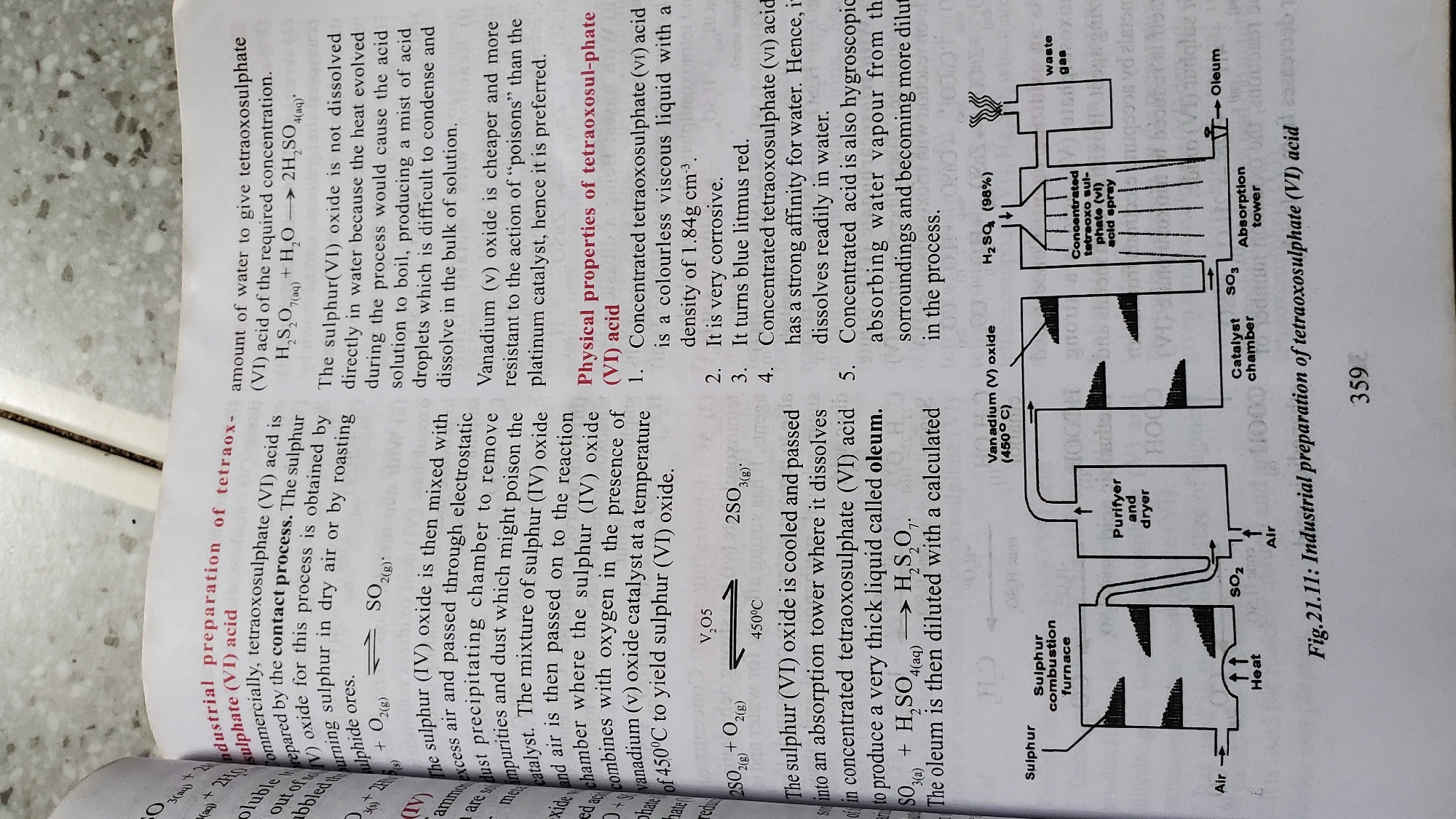
The image displays a page from a textbook, likely a chemistry textbook, featuring an illustration and accompanying text related to the industrial preparation of tetraoxosulphate (VI) acid, also known as sulfuric acid. The illustration is a diagram depicting the Contact Process for the manufacture of sulfuric acid. It shows a series of interconnected chambers and towers labeled with their functions: "Sulphur combustion furnace," "Purifier and dryer," "Catalyst chamber," and "Absorption tower." Arrows indicate the flow of materials such as "Sulphur," "Air," "SO2," "Heat," "Vanadium (V) oxide (450°C)," "H2SO4 (98%)," "SO3," and "Oleum." The diagram illustrates the chemical reactions and physical processes involved in converting sulfur into concentrated sulfuric acid and oleum. The accompanying text provides a detailed explanation of the Contact Process. It describes the raw materials, the chemical reactions that occur at each stage, the role of the catalyst (vanadium (V) oxide), and the physical properties of concentrated sulfuric acid and oleum. Key chemical equations are presented, such as the formation of sulfur dioxide and its subsequent oxidation to sulfur trioxide, and the reaction of sulfur trioxide with water to form sulfuric acid. The text also highlights the importance of removing impurities to prevent poisoning of the catalyst. The physical properties of tetraoxosulphate (VI) acid are listed, including its corrosive nature, its effect on litmus paper, and its hygroscopic property. The page includes a figure number, "Fig. 21.11," and a page number, "359," indicating its place within a larger publication. The text is primarily in English, with some chemical formulas and abbreviations. There are no people or specific time-of-day or weather cues visible. The setting is clearly an academic or educational context, focused on chemistry education.
Loading AttnAds…
No transactions found