
Sign in
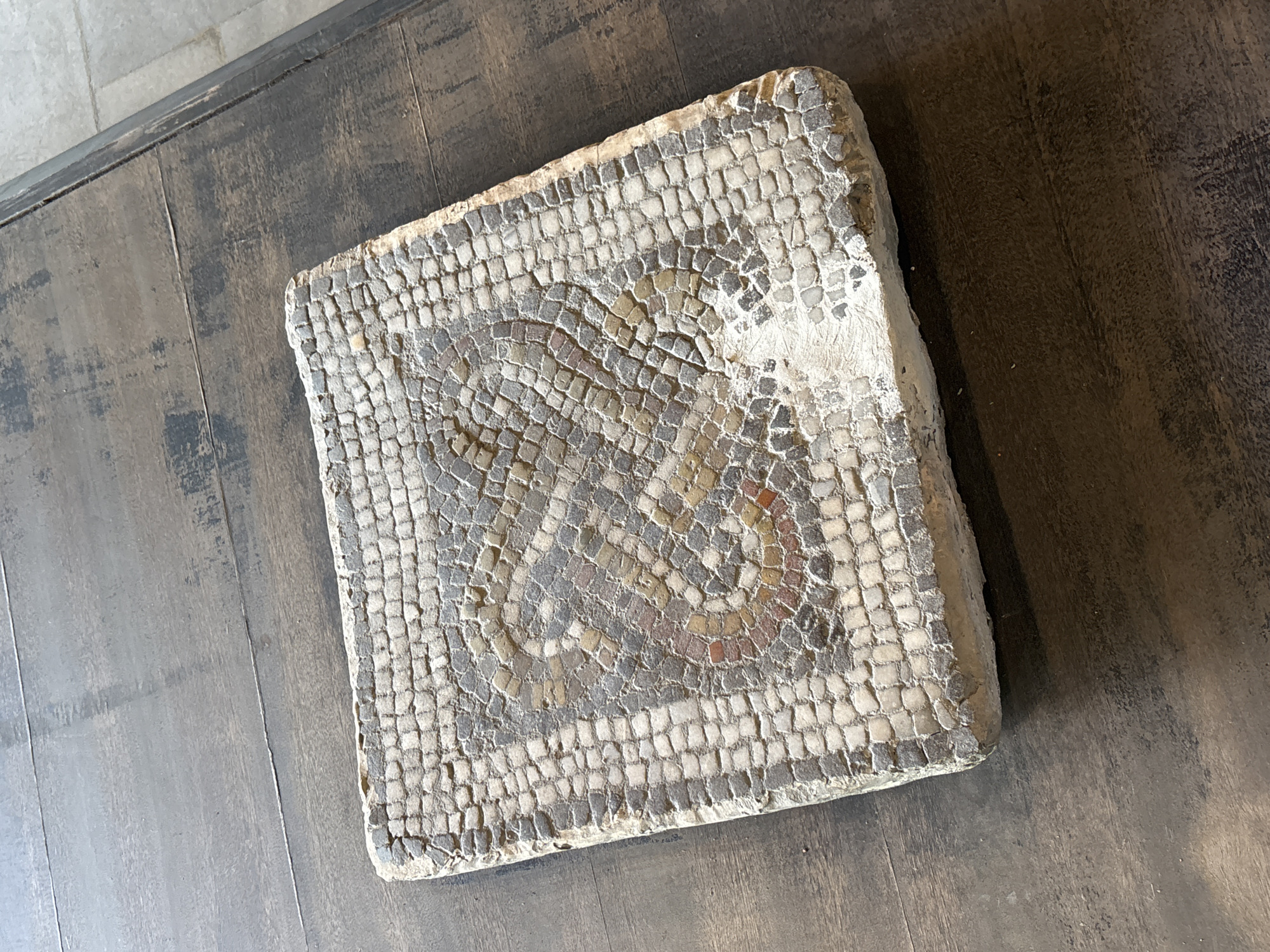
The image captures an ancient mosaic fragment displayed indoors. The primary subject is a rectangular piece of a mosaic, featuring a geometric pattern composed of numerous small, irregularly shaped tesserae. These individual stones, or tesserae, vary in color, primarily consisting of shades of grey, white, beige, and dark brown, with some lighter brown and reddish-orange hues used to create parts of the central design.

The central motif of the mosaic appears to be a stylized, interlacing knot or scrollwork, formed by curved lines of tesserae. This central design is bordered by several concentric bands made of alternating light and dark tesserae, creating a framed effect. The fragment shows clear signs of age and wear; some tesserae are missing, others are chipped, and the edges of the piece are rough and irregular, with visible traces of mortar.

The mosaic fragment rests on a dark, matte brown wooden surface, which could be a table or floorboards. The wood exhibits distinct grain patterns. In the upper left background, a lighter-colored floor, possibly stone or tile, is partially visible, indicating a transition in flooring types. The lighting is soft and even, suggesting an indoor setting, likely during the daytime. No specific activity is occurring; the image is a static portrayal of the artifact. There is no visible text within the image. Given the location context of Devnya, Bulgaria, the mosaic is likely an archaeological artifact from the ancient Roman city of Marcianopolis.
k.ivnv02

Jun 3, 2026

Devnya, Bulgaria

Moment

Stake attention in this memory

nostalgic
ancient
historical
contemplative
timeless

The image captures an ancient mosaic fragment displayed indoors. The primary subject is a rectangular piece of a mosaic, featuring a geometric pattern composed of numerous small, irregularly shaped tesserae. These individual stones, or tesserae, vary in color, primarily consisting of shades of grey, white, beige, and dark brown, with some lighter brown and reddish-orange hues used to create parts of the central design. The central motif of the mosaic appears to be a stylized, interlacing knot or scrollwork, formed by curved lines of tesserae. This central design is bordered by several concentric bands made of alternating light and dark tesserae, creating a framed effect. The fragment shows clear signs of age and wear; some tesserae are missing, others are chipped, and the edges of the piece are rough and irregular, with visible traces of mortar. The mosaic fragment rests on a dark, matte brown wooden surface, which could be a table or floorboards. The wood exhibits distinct grain patterns. In the upper left background, a lighter-colored floor, possibly stone or tile, is partially visible, indicating a transition in flooring types. The lighting is soft and even, suggesting an indoor setting, likely during the daytime. No specific activity is occurring; the image is a static portrayal of the artifact. There is no visible text within the image. Given the location context of Devnya, Bulgaria, the mosaic is likely an archaeological artifact from the ancient Roman city of Marcianopolis.

transactions
revenues
stakers
Earliest
Latest
Highest stake

No transactions found

More from this user

More from Devnya

k.ivnv02

Jun 3, 2026

Devnya, Bulgaria

Licensed under Creative Commons Attribution 4.0 International License. You are free to share and adapt this content with proper attribution.