
Sign in
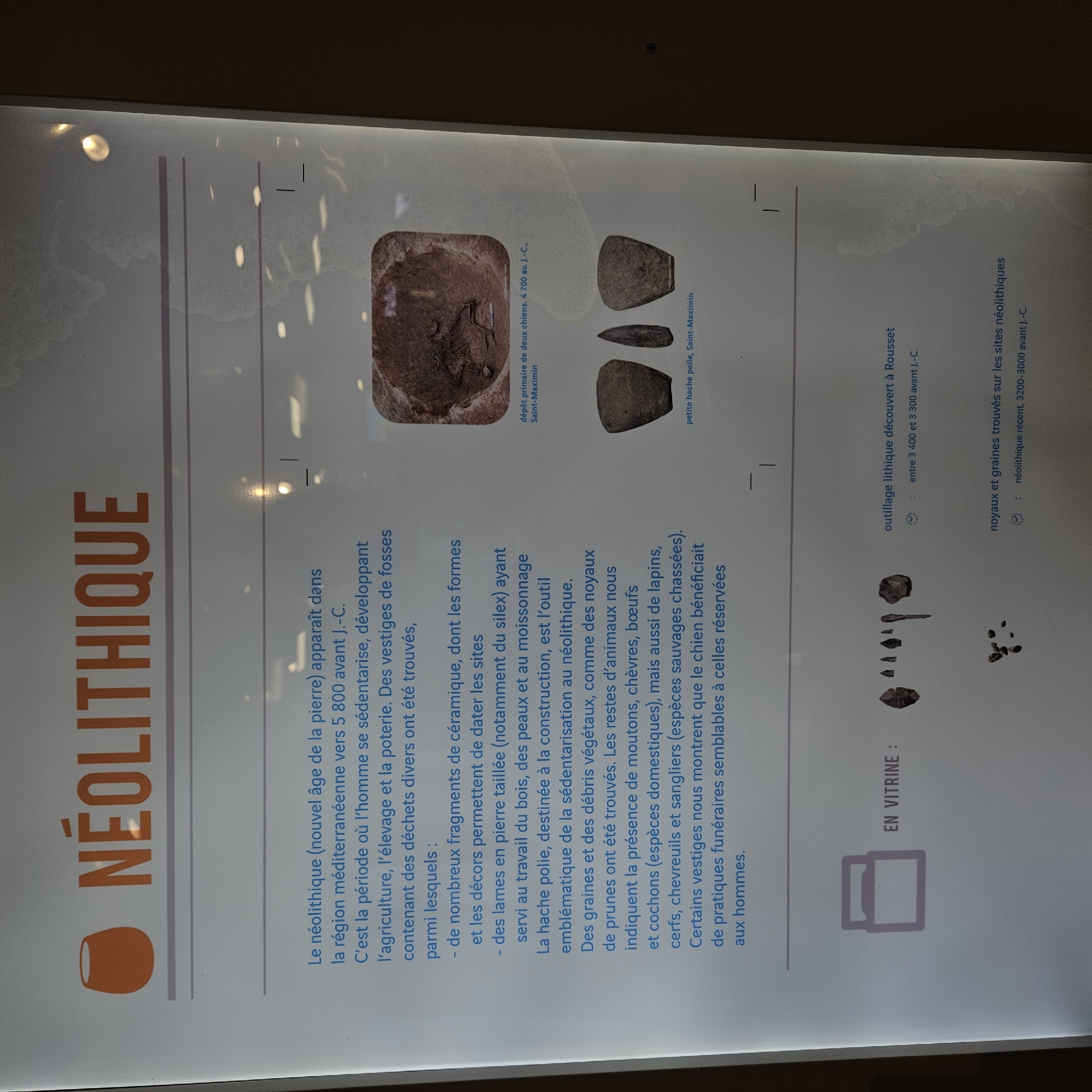
This image shows an informational display about the Neolithic period. The display is lit from behind, causing some glare and reflections on the surface. The text is in French.

The title of the display is "NÉOLITHIQUE," which translates to "Neolithic." Below the title, there is an orange icon resembling a pot.

The main body of the text describes the Neolithic period (new stone age) as appearing in the Mediterranean region around 5800 BC. It highlights that this was the period when humans became sedentary, developing agriculture, animal husbandry, and pottery. The text mentions the discovery of remains, including numerous ceramic fragments, stone tools (flint), polished axes used for construction, and animal remains (sheep, goats, cattle, pigs, deer, roe deer, and boars), indicating hunting practices. It also notes the presence of plum pits and evidence of canine remains, suggesting that dogs benefited from human practices. The text concludes by stating that certain remains suggest funeral practices similar to those reserved for humans.

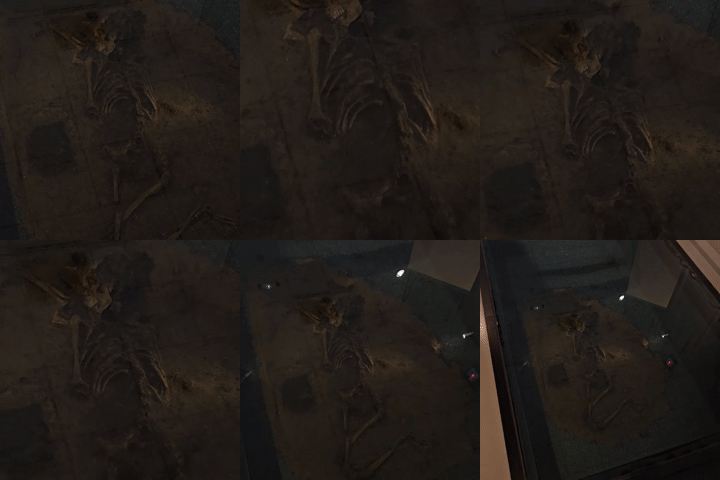
To the right of the text, there are three images of artifacts. The top image shows a pot containing what appears to be skeletal remains, labeled "dépôt primaire de deux chiens, 4 700 av. J.-C., Saint-Maximin." This translates to "primary burial of two dogs, 4700 BC, Saint-Maximin." The bottom two images display stone tools, described as "petite hache polie, Saint-Maximin," meaning "small polished axe, Saint-Maximin."

At the bottom of the display, there is a section titled "EN VITRINE:" (In the display case:). Below this, there are two sets of small images. The first set appears to be stone tools, labeled "outillage lithique découvert à Rousset : entre 3 400 et 3 300 avant J.-C." (lithic tools discovered at Rousset: between 3400 and 3300 BC). The second set shows what look like seeds or nuts, labeled "noyaux et graines trouvés sur les sites néolithiques : néolithique récent, 3200-3000 avant J.-C." (pits and seeds found on Neolithic sites: recent Neolithic, 3200-3000 BC).

The location in the city of Brignoles, France, is not explicitly mentioned in the provided text or visible in the image. However, the artifacts are attributed to Saint-Maximin and Rousset, which are towns in the Var department of Provence-Alpes-Côte d'Azur region of southeastern France. Brignoles is also located in the Var department, making it plausible that this display is from a museum or exhibition in or near Brignoles, showcasing artifacts from nearby archaeological sites.
Tihomir Angelov

Aug 5, 2026, 7:17 PM

Brignoles, France

Stake attention in this memory

ancient
historical
educational
informative
discovery

This image shows an informational display about the Neolithic period. The display is lit from behind, causing some glare and reflections on the surface. The text is in French. The title of the display is "NÉOLITHIQUE," which translates to "Neolithic." Below the title, there is an orange icon resembling a pot. The main body of the text describes the Neolithic period (new stone age) as appearing in the Mediterranean region around 5800 BC. It highlights that this was the period when humans became sedentary, developing agriculture, animal husbandry, and pottery. The text mentions the discovery of remains, including numerous ceramic fragments, stone tools (flint), polished axes used for construction, and animal remains (sheep, goats, cattle, pigs, deer, roe deer, and boars), indicating hunting practices. It also notes the presence of plum pits and evidence of canine remains, suggesting that dogs benefited from human practices. The text concludes by stating that certain remains suggest funeral practices similar to those reserved for humans. To the right of the text, there are three images of artifacts. The top image shows a pot containing what appears to be skeletal remains, labeled "dépôt primaire de deux chiens, 4 700 av. J.-C., Saint-Maximin." This translates to "primary burial of two dogs, 4700 BC, Saint-Maximin." The bottom two images display stone tools, described as "petite hache polie, Saint-Maximin," meaning "small polished axe, Saint-Maximin." At the bottom of the display, there is a section titled "EN VITRINE:" (In the display case:). Below this, there are two sets of small images. The first set appears to be stone tools, labeled "outillage lithique découvert à Rousset : entre 3 400 et 3 300 avant J.-C." (lithic tools discovered at Rousset: between 3400 and 3300 BC). The second set shows what look like seeds or nuts, labeled "noyaux et graines trouvés sur les sites néolithiques : néolithique récent, 3200-3000 avant J.-C." (pits and seeds found on Neolithic sites: recent Neolithic, 3200-3000 BC). The location in the city of Brignoles, France, is not explicitly mentioned in the provided text or visible in the image. However, the artifacts are attributed to Saint-Maximin and Rousset, which are towns in the Var department of Provence-Alpes-Côte d'Azur region of southeastern France. Brignoles is also located in the Var department, making it plausible that this display is from a museum or exhibition in or near Brignoles, showcasing artifacts from nearby archaeological sites.

Loading AttnAds…

transactions
revenues
stakers
Earliest
Latest
Highest stake

No transactions found

More from this user

More from Brignoles

Tihomir Angelov

Aug 5, 2026, 7:17 PM

Brignoles, France

Licensed under Creative Commons Attribution 4.0 International License. You are free to share and adapt this content with proper attribution.