
Sign in
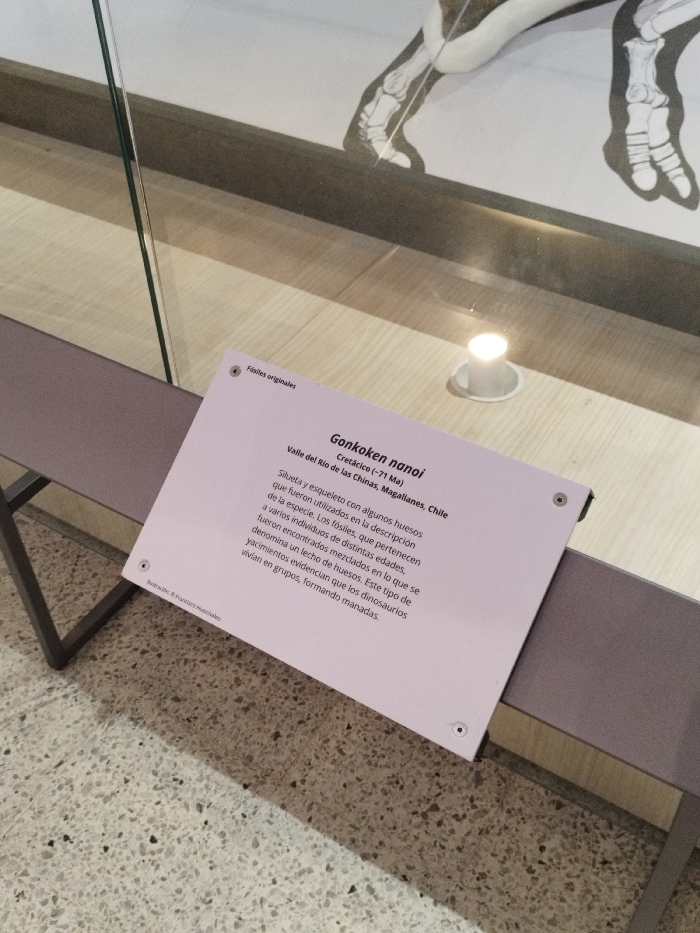
This image captures a close-up of a museum exhibit, likely located in Santiago, Chile, as indicated by the context. The primary focus is a light purple informational sign displayed at an angle, providing details in Spanish about a dinosaur. The sign identifies the species as "Gonkoken nanoi," dating it to the Cretaceous period (-71 Ma) and noting its discovery in the Valle del Río de las Chinas, Magallanes, Chile.

The text on the sign explains that the exhibit features a silhouette and skeleton incorporating some original bones that were used to describe the species. It further specifies that the fossils belong to several individuals of different ages, found mixed together in what is termed a "bone bed." This type of paleontological site suggests that these dinosaurs lived in groups, forming herds.

Behind the informational sign, a glass display case is visible. Through the glass, a partial illustration or skeletal representation of dinosaur legs and feet can be seen, rendered in black and white against a light background. An embedded spotlight on the base of the display case illuminates the exhibit area. The flooring outside the case is a speckled, light-colored terrazzo, and a dark metal stand supports the display elements. The overall scene conveys an educational and scientific environment, characteristic of a natural history museum.
Mrv

Jan 7, 2025

Santiago, Chile

Stake attention in this memory

This image captures a close-up of a museum exhibit, likely located in Santiago, Chile, as indicated by the context. The primary focus is a light purple informational sign displayed at an angle, providing details in Spanish about a dinosaur. The sign identifies the species as "Gonkoken nanoi," dating it to the Cretaceous period (-71 Ma) and noting its discovery in the Valle del Río de las Chinas, Magallanes, Chile. The text on the sign explains that the exhibit features a silhouette and skeleton incorporating some original bones that were used to describe the species. It further specifies that the fossils belong to several individuals of different ages, found mixed together in what is termed a "bone bed." This type of paleontological site suggests that these dinosaurs lived in groups, forming herds. Behind the informational sign, a glass display case is visible. Through the glass, a partial illustration or skeletal representation of dinosaur legs and feet can be seen, rendered in black and white against a light background. An embedded spotlight on the base of the display case illuminates the exhibit area. The flooring outside the case is a speckled, light-colored terrazzo, and a dark metal stand supports the display elements. The overall scene conveys an educational and scientific environment, characteristic of a natural history museum.

transactions
revenues
stakers
Earliest
Latest
Highest stake

No transactions found

More from this user

More from Santiago

Mrv

Jan 7, 2025

Santiago, Chile

Licensed under Creative Commons Attribution 4.0 International License. You are free to share and adapt this content with proper attribution.