
Stake attention in this memory
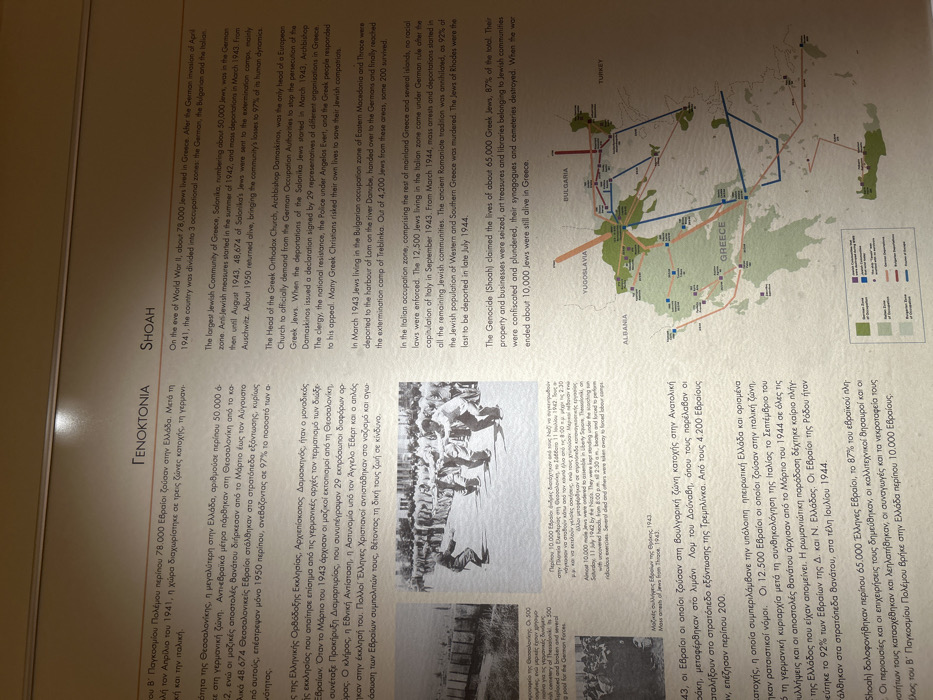
This image captures an informational display board, likely from a museum or exhibition in Athina, Greece, focusing on the Shoah (Holocaust) in Greece. The display features a combination of historical text, black-and-white photographs, and a color-coded map. The main text is presented in both Greek and English, detailing the division of Greece into German, Italian, and Bulgarian occupation zones after April 1941. It outlines the persecution and deportation of Jewish communities from each zone to extermination camps like Auschwitz and Treblinka, highlighting the overwhelming loss of life (87% of Greek Jews, about 65,000 people). Notable details include the resistance of Archbishop Damaskinos and other Greek citizens, and the destruction of Jewish property and heritage. Three black-and-white photographs are embedded within the display: 1. One image shows a group of men, possibly forced laborers, engaged in manual work in an open field, some using shovels. This visually corresponds to the text describing the humiliation and forced labor of Jews in Salonika's Liberty Square in July 1942. 2. Another photograph depicts a group of men, some in military uniform, during what appears to be a street gathering or arrest, with an adjacent caption mentioning "Mass arrests of Jews from Thrace, 1943." 3. A third image, partially cropped on the bottom left, shows people near what seems to be a damaged area or ruins, related to the destruction of the Jewish cemetery in Thessaloniki. A prominent map of Greece and its neighboring countries (Yugoslavia, Albania, Bulgaria, Turkey) illustrates the territorial divisions and deportation routes. Different colors represent the German, Italian, and Bulgarian occupation zones, while various colored lines indicate deportation routes from different regions to extermination camps (marked with red bars). A legend clarifies these symbols, including the locations of Jewish communities. The display conveys a somber and educational tone, detailing the tragic events of the Holocaust in Greece through factual accounts, visual evidence, and geographical context.
No transactions found