Stake attention in this memory
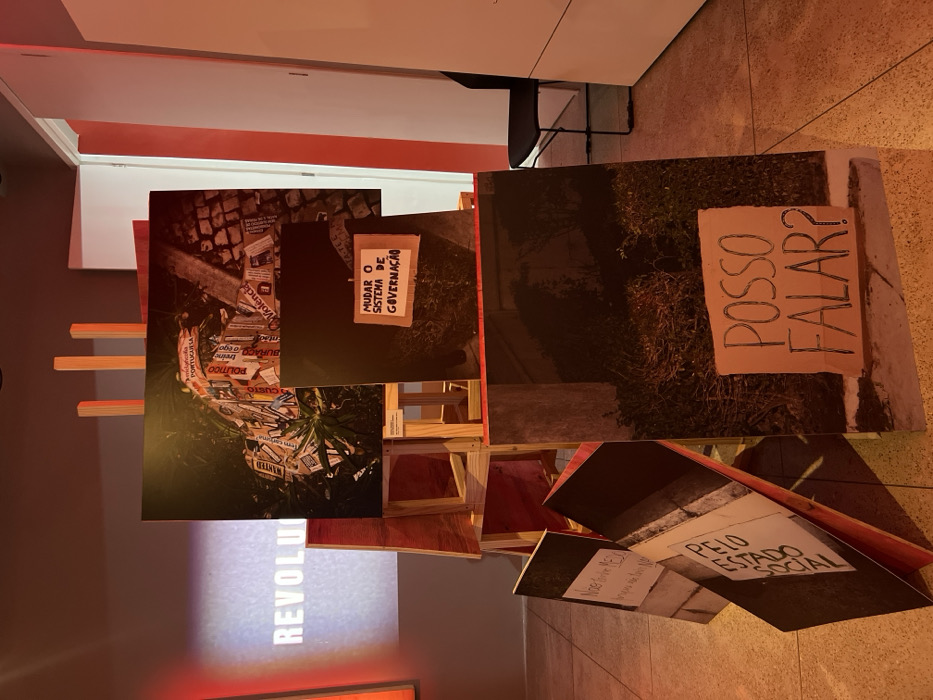
The image captures a detailed view of a multi-layered art installation displayed indoors, likely within a gallery or exhibition space. The setting features light-colored walls, with a prominent red strip running horizontally along the bottom of one wall in the background, and a light-colored floor that appears to be tiled or concrete. The lighting is artificial, casting a warm, reddish glow that enhances the dramatic effect of the artwork. The installation itself is composed of several large, printed panels arranged in a dynamic, three-dimensional manner, giving them depth rather than being flat against a wall. Some panels are propped up by visible wooden support structures, adding to their sculptural quality. Each panel features photographic imagery combined with text, evoking themes of social and political commentary. From left to right and top to bottom, visible elements include: - On the far left, partially projected onto a wall or a large screen, the word "REVOLU" is visible, suggesting it's part of "REVOLUTION" or "REVOLUÇÃO" (Portuguese for revolution). - A large central panel depicts a street scene with cobblestones and green foliage. Scattered across the ground in this image are numerous pieces of paper or torn posters. Visible words on these papers include "WANTED," "margume" (possibly part of a longer word or related to "margem" meaning margin/edge), "UESA," "PORTUGAL," "CUSTO" (cost), "Então" (so/then), "POLITICO" (political), "treine" (train/practice), "Violencia" (violence), and "FA-TEE." - To the right of this large panel, a smaller, dark-colored panel or cardboard sign is featured within the imagery. It clearly displays the Portuguese text: "MUDAR O SISTEMA DE GOVERNAÇÃO," which translates to "Change the system of governance." - On the far right, another large panel shows a similar street scene with foliage, featuring a handwritten sign on a light brown background asking in Portuguese: "POSSO FALAR?" which means "Can I speak?" - At the bottom right, a tilted panel shows another street scene with a sign in white, bearing the words "PELO ESTADO SOCIAL," translating to "For the social state" or "For the welfare state." The overall impression is that of an artwork deeply engaged with contemporary social and political issues, particularly relevant to Portugal given the visible language. The arrangement of images and text creates a compelling narrative around public discourse, governance, freedom of expression, and social welfare.
No transactions found