
Stake attention in this memory
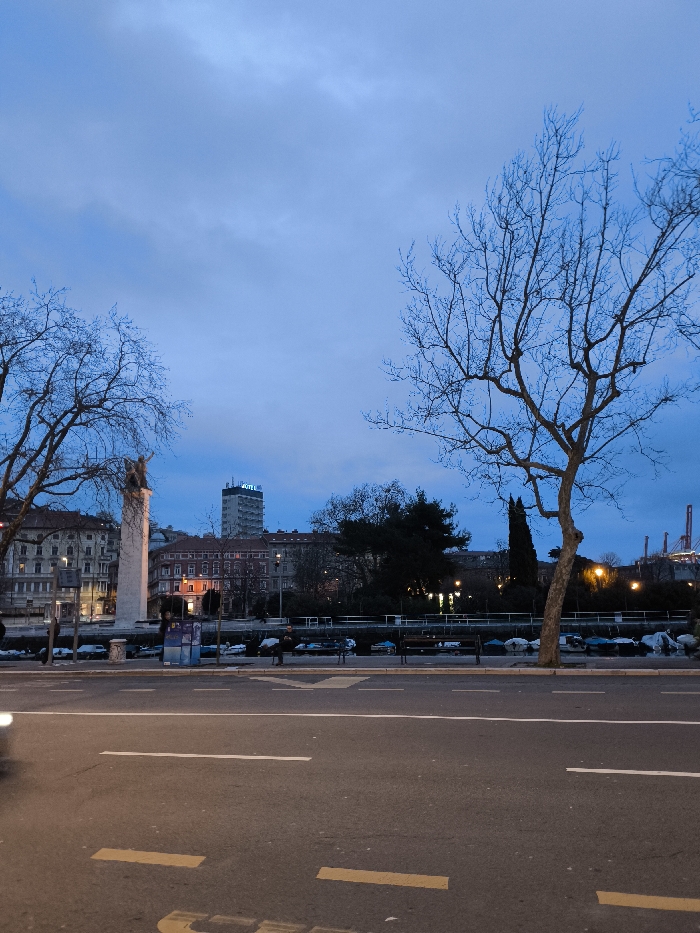
The image depicts an urban waterfront scene in Grad Rijeka, Croatia, during dusk or early evening, characterized by a deep blue, overcast sky. The viewpoint is from a street-level perspective, looking towards the city's promenade and harbor. In the immediate foreground, an asphalt road occupies the bottom third of the frame. It features a solid white lane divider and intermittent dashed yellow lines. A blurred white light, consistent with a vehicle's headlight, is visible on the far left, indicating a potential vehicle moving out of frame. The midground is dominated by architectural and natural elements. Two large, bare deciduous trees, stripped of leaves, frame the scene on the left and right, their intricate branch patterns silhouetted against the sky. To the left of center stands a tall, light-colored stone monument, identified as the Monument to King Tomislav, topped with a bronze statue of a figure with arms raised or outstretched. Behind this monument, multi-story historical buildings line the street, some displaying illuminated windows with orange light. Further to the right and set back, a taller, modern building with an illuminated "HOTEL" sign on its roof is prominent. Below the main line of buildings and trees, a promenade area is visible. It features several dark-colored public benches. To the right, a section of water or a marina holds multiple small boats, each covered with light-colored tarpaulins. Two human figures are present: one person is seated on a bench on the right side of the promenade, and another stands near the base of the monument on the left. Their individual actions or detailed features are not discernible due to distance and low light. In the far background on the right, large industrial port cranes, possibly red, are visible against the horizon, signifying the city's active port. Streetlights are illuminated throughout the scene, casting localized pools of light. The overall environment suggests a quiet, temperate urban setting in the late hours, possibly during winter or early spring due to the leafless trees.
No transactions found