Stake attention in this memory
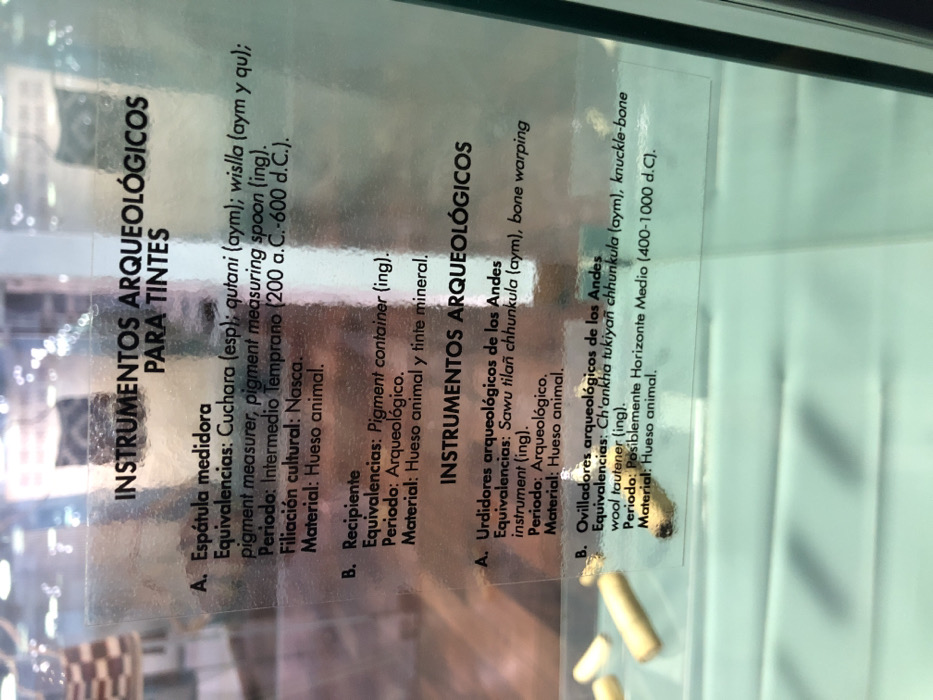
The image displays an informational label within what appears to be a museum or exhibition display case, likely in La Paz, Bolivia, given the context. The label, which is mostly translucent, presents details about archaeological instruments in both Spanish and English. The overall scene is indoors, with a light green/blue background, possibly the interior of the display or a wall behind it. Reflections on the glass surface are prominent, obscuring some parts of the text and the artifacts themselves. At the bottom right, several small, light-colored objects are visible, consistent with the description of "hueso animal" (animal bone). These are likely some of the artifacts described on the label, such as bone warping instruments or knuckle-bone wool tauteners. The visible text, categorized into two main sections of "INSTRUMENTOS ARQUEOLÓGICOS," details: 1. **Instruments for Dyes (PARA TINTES):** * **A. Measuring Spatula (Espátula medidora):** Equivalent to a pigment measurer or measuring spoon, made of animal bone. Dated to the Early Intermediate Period (200 BCE - 600 CE) and attributed to the Nasca culture. * **B. Container (Recipiente):** A pigment container made of animal bone and mineral dye, from an unspecified archaeological period. 2. **Archaeological Instruments (general section):** * **A. Archaeological Warping Instruments from the Andes (Urdidores arqueológicos de los Andes):** Equivalent to bone warping instruments, made of animal bone, from an unspecified archaeological period. * **B. Archaeological Wool Tauteners from the Andes (Ovilladores arqueológicos de los Andes):** Equivalent to knuckle-bone wool tauteners, made of animal bone. Dated to possibly the Middle Horizon (400-1000 CE). The image captures an exhibit designed to educate visitors about ancient Andean tools, specifically those used for dyeing and textile production, highlighting their materials and cultural context.
Loading AttnAds…
No transactions found