
Stake attention in this memory
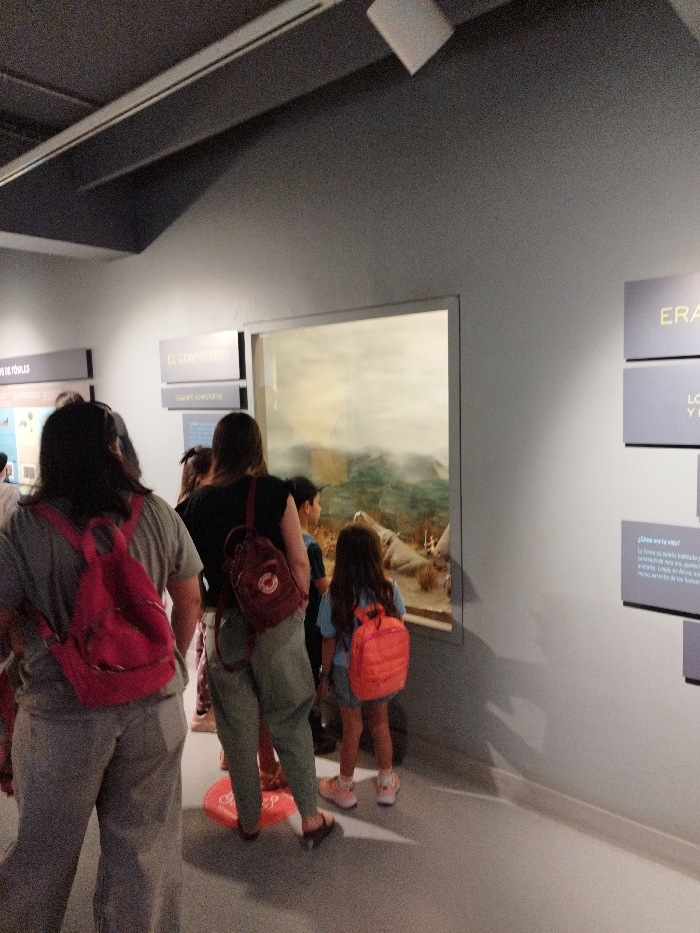
A group of museum visitors, including adults and children, are observed from behind as they engage with an exhibition display in Santiago, Chile. The setting is a modern museum interior with grey walls, a dark grey ceiling, and track lighting. The central focus is a large, glass-encased diorama depicting a natural landscape, possibly an ancient environment, with mountains, barren ground, and sparse vegetation. Several people are gathered in front of this display, looking intently into it. On the far left, a woman wearing a grey top and a bright pink backpack stands facing the exhibit. Next to her, another woman in a black top and a dark red backpack observes the diorama. To their right, a young girl with long dark hair, wearing a light blue top and a vibrant orange backpack, stands with her back to the viewer, gazing into the display. A boy in a dark shirt is partially visible between the two women and the young girl. Information panels in Spanish are mounted on the walls. To the left of the diorama, one panel is partially visible, containing text like "DE FÓSILES" (of fossils). Above the diorama, signs read "EL SOMBRA" (partially visible) and "EL CAZAMIENTO" (the hunting/cazamiento). To the right, several panels feature larger text, including "ERA" (era) and partially visible "LOS..." and "Y E...". A larger panel below these poses the question "¿Cómo era la vida?" (What was life like?) and provides a descriptive paragraph in Spanish about flora, fauna, and fossils, with visible phrases such as "La flora y la fauna habitada solamente de sus fósiles. Luego, los árboles se..." (The flora and fauna inhabited only by their fossils. Then, the trees...). Red circular markers are partially visible on the grey floor, likely indicating viewing spots or social distancing guidelines. The overall impression is one of educational engagement within a well-maintained museum environment.
No transactions found