Sign in
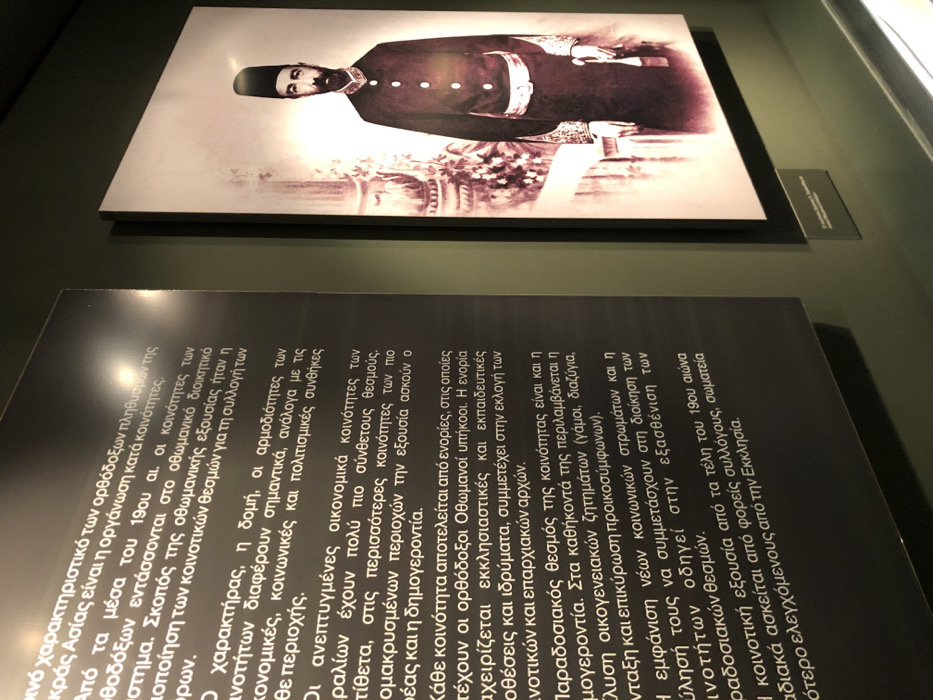
A historical portrait and an informational plaque are displayed in what appears to be a museum or exhibition setting. The portrait, positioned above the plaque, features a man in formal Ottoman-era attire, including a fez and a dark, long-sleeved coat with buttons and a ceremonial sash. He has a beard and mustache, and his gaze is directed slightly towards the viewer. The background of the portrait is faded, hinting at architectural details.

Below the portrait, a black rectangular plaque with white Greek text provides historical context. The text discusses the organization of Orthodox populations in Asia Minor into communities, their integration into the Ottoman administrative system from the mid-19th century, and the Ottoman authorities' goal of standardizing communal institutions, partly for tax collection. It details how the structure and responsibilities of these communities varied based on economic, social, and cultural conditions. The text mentions that economically developed coastal communities had complex institutions, while remote areas were governed by elders or headmen (δημογεροντία). It further explains that each community consisted of parishes responsible for ecclesiastical and educational matters, and the role of the headman in family affairs. The plaque concludes by noting that by the late 19th century, new social strata led to the weakening of traditional institutions, with communal authority gradually shifting to associations and societies increasingly controlled by the Church.

The overall scene is dimly lit, with reflections visible on both the portrait and the text plaque, indicating an indoor display. The image is taken from an angle, making the displayed items appear tilted. The subjects, particularly the man's attire and the historical information on the plaque, suggest a focus on the late 19th to early 20th century Ottoman period, specifically concerning Orthodox communities in Asia Minor.
FM-nSho83

Jan 10, 2025

Nea Filadelfia, Greece

Stake attention in this memory

A historical portrait and an informational plaque are displayed in what appears to be a museum or exhibition setting. The portrait, positioned above the plaque, features a man in formal Ottoman-era attire, including a fez and a dark, long-sleeved coat with buttons and a ceremonial sash. He has a beard and mustache, and his gaze is directed slightly towards the viewer. The background of the portrait is faded, hinting at architectural details. Below the portrait, a black rectangular plaque with white Greek text provides historical context. The text discusses the organization of Orthodox populations in Asia Minor into communities, their integration into the Ottoman administrative system from the mid-19th century, and the Ottoman authorities' goal of standardizing communal institutions, partly for tax collection. It details how the structure and responsibilities of these communities varied based on economic, social, and cultural conditions. The text mentions that economically developed coastal communities had complex institutions, while remote areas were governed by elders or headmen (δημογεροντία). It further explains that each community consisted of parishes responsible for ecclesiastical and educational matters, and the role of the headman in family affairs. The plaque concludes by noting that by the late 19th century, new social strata led to the weakening of traditional institutions, with communal authority gradually shifting to associations and societies increasingly controlled by the Church. The overall scene is dimly lit, with reflections visible on both the portrait and the text plaque, indicating an indoor display. The image is taken from an angle, making the displayed items appear tilted. The subjects, particularly the man's attire and the historical information on the plaque, suggest a focus on the late 19th to early 20th century Ottoman period, specifically concerning Orthodox communities in Asia Minor.

transactions
revenues
stakers
Earliest
Latest
Highest stake

No transactions found

More from this user

More from Nea Filadelfia

FM-nSho83

Jan 10, 2025

Nea Filadelfia, Greece

Licensed under Creative Commons Attribution 4.0 International License. You are free to share and adapt this content with proper attribution.