Sign in
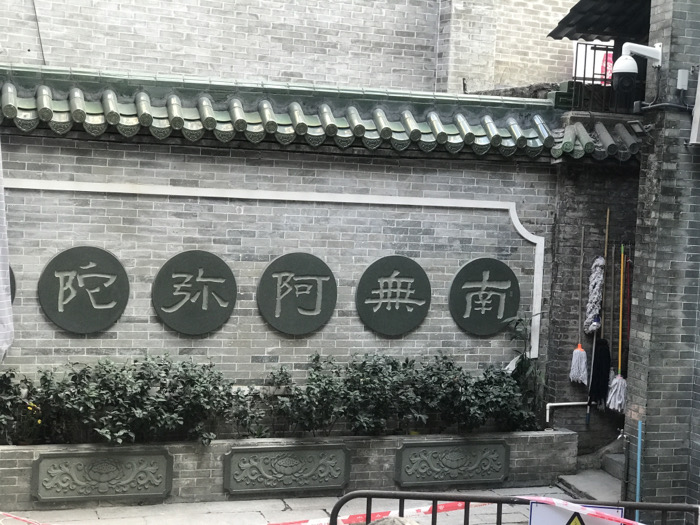
The image captures a segment of an outdoor wall in Guangzhou, China, showcasing traditional architectural elements and a Buddhist inscription. The wall is constructed from light grey bricks, topped with a distinctive green tiled roof featuring semicircular eaves.

At the center of the wall, five dark grey circular panels are mounted horizontally. Each panel features a single Chinese character carved into its surface, appearing lighter than the panel itself. Reading from right to left, the characters are 南 (nán), 無 (wú), 阿 (ā), 彌 (mí), and 陀 (tuó). Together, these form "Námó Āmítuó" (南無阿彌陀), which is a shortened form of the Buddhist chant "Námó Āmítuófó," meaning "Homage to Amitābha Buddha" or "I take refuge in Amitābha Buddha."

Below the inscription, a line of green shrubs is planted in two rectangular planters. These planters are adorned with intricately carved, traditional patterns, adding to the cultural aesthetic of the scene. To the right, a narrow, darker alcove or passageway reveals several cleaning tools, including mops and brooms, stored upright against the wall. A white security camera is mounted high on the building's corner, providing surveillance.

The lighting suggests an overcast daytime, casting soft, diffused illumination across the scene, with no harsh shadows. No people are visible, and there is no direct activity taking place. The overall impression is one of a well-maintained, tranquil, and culturally significant outdoor space.
F
FM-qn0Jb2

Dec 11, 2024

Guangzhou, China

Stake attention in this memory

The image captures a segment of an outdoor wall in Guangzhou, China, showcasing traditional architectural elements and a Buddhist inscription. The wall is constructed from light grey bricks, topped with a distinctive green tiled roof featuring semicircular eaves. At the center of the wall, five dark grey circular panels are mounted horizontally. Each panel features a single Chinese character carved into its surface, appearing lighter than the panel itself. Reading from right to left, the characters are 南 (nán), 無 (wú), 阿 (ā), 彌 (mí), and 陀 (tuó). Together, these form "Námó Āmítuó" (南無阿彌陀), which is a shortened form of the Buddhist chant "Námó Āmítuófó," meaning "Homage to Amitābha Buddha" or "I take refuge in Amitābha Buddha." Below the inscription, a line of green shrubs is planted in two rectangular planters. These planters are adorned with intricately carved, traditional patterns, adding to the cultural aesthetic of the scene. To the right, a narrow, darker alcove or passageway reveals several cleaning tools, including mops and brooms, stored upright against the wall. A white security camera is mounted high on the building's corner, providing surveillance. The lighting suggests an overcast daytime, casting soft, diffused illumination across the scene, with no harsh shadows. No people are visible, and there is no direct activity taking place. The overall impression is one of a well-maintained, tranquil, and culturally significant outdoor space.

transactions
revenues
stakers
Earliest
Latest
Highest stake

No transactions found

More from this user

More from Guangzhou

FFM-qn0Jb2

Dec 11, 2024

Guangzhou, China

Licensed under Creative Commons Attribution 4.0 International License. You are free to share and adapt this content with proper attribution.