Stake attention in this memory
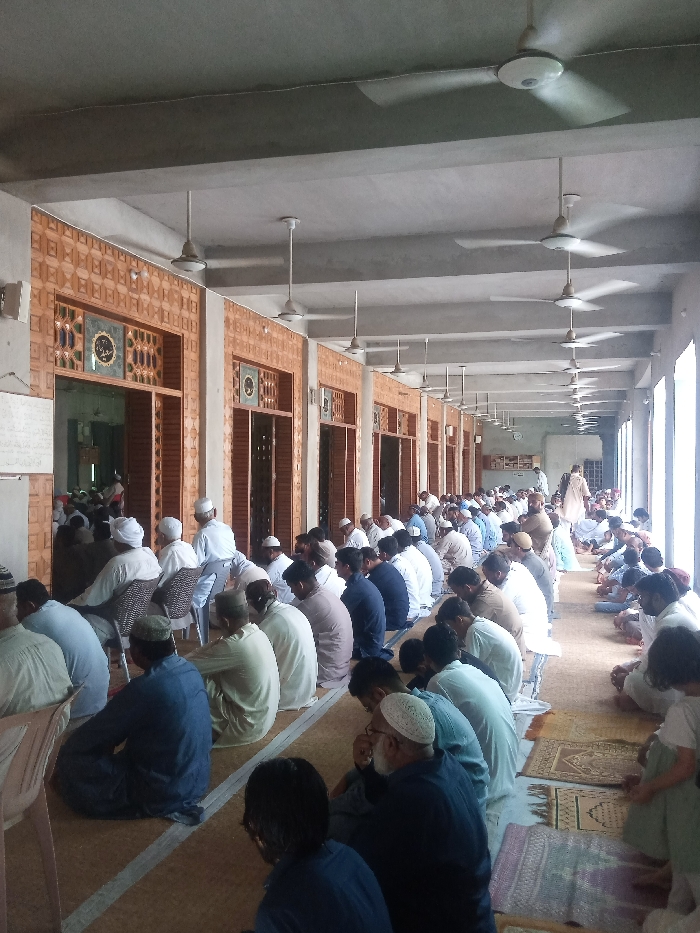
The image depicts a large group of men gathered in what appears to be a spacious prayer hall or a community gathering area, possibly within a mosque or an Islamic center. The setting is indoors, characterized by a long, rectangular room with a concrete ceiling and numerous white ceiling fans suspended at regular intervals, some of which appear to be in motion, indicated by blurred blades. The walls along the left side of the room are constructed with decorative brown, brick-like tiles featuring an intricate geometric pattern. These walls incorporate several recessed sections or open doorways, each topped with a decorative panel. One prominent panel in the foreground displays a circular medallion with intricate calligraphy, likely Arabic or Urdu, possibly a religious inscription, surrounded by blue, green, and golden geometric designs. Similar panels are visible further down the hall. A large number of men are seated on the floor, arranged in rows facing a common direction, with their backs mostly turned towards the camera. They are sitting on prayer mats or woven mats that cover the floor, primarily in shades of brown and beige, with a distinct white line running along the floor that seems to mark a pathway or separation. Most of the men are adults, dressed in traditional South Asian attire, including shalwar kameez and various types of caps, such as kufi hats. Some men are also seen wearing white turbans. Their posture suggests they are engaged in listening, reflection, or waiting. Towards the far right of the image, there are large, open window-like sections or doorways that allow natural light into the space, indicating it is daytime. A few individuals, including a young child in a white top, are visible on the far right, seated among the adults. In the distant background, towards the right, one person appears to be standing, dressed in a light-colored robe. The overall atmosphere seems calm and orderly, suggesting a religious gathering such as a sermon, a prayer session, or a communal event. The visible text is primarily the calligraphy within the decorative medallions on the wall panels, which is not fully decipherable but consistent with Islamic art.
Loading AttnAds…
No transactions found