Stake attention in this memory
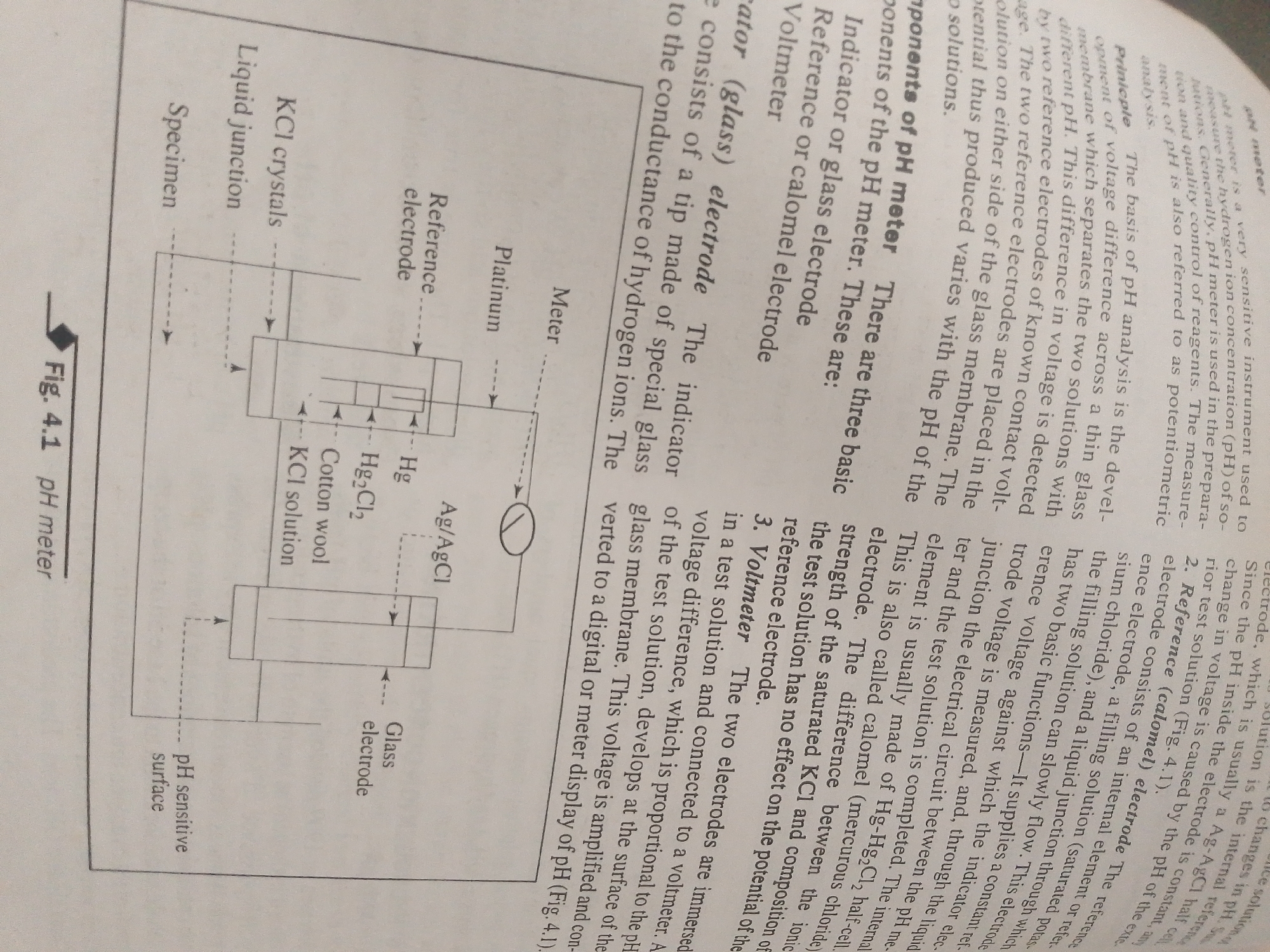
The image is a diagram illustrating the components and working principle of a pH meter. The central focus is a schematic drawing of a pH meter setup, featuring a glass electrode and a reference electrode immersed in a solution labeled "Specimen." Key components illustrated include: - **Glass Electrode:** Depicted with a "pH sensitive surface," a "Glass electrode" label, and internal elements like "Hg," "Hg2Cl2," "Cotton wool," and "KCl solution." - **Reference Electrode:** Shown with internal "KCI crystals" and a "Liquid junction." - **Meter:** A voltmeter is indicated, connected to the electrodes. The diagram also includes textual explanations of the pH meter's principle, components, and how it works. The text describes the basis of pH analysis, the function of the indicator (glass) electrode and the reference (calomel) electrode, and how the voltmeter measures the voltage difference proportional to the pH. The overall scene is a technical illustration from a textbook or scientific document, designed to explain the operation of a pH meter. There are no people, specific locations, or environmental details visible, as it is a purely scientific diagram. The text clearly labels all parts and explains the process.
Loading AttnAds…
No transactions found