
Sign in
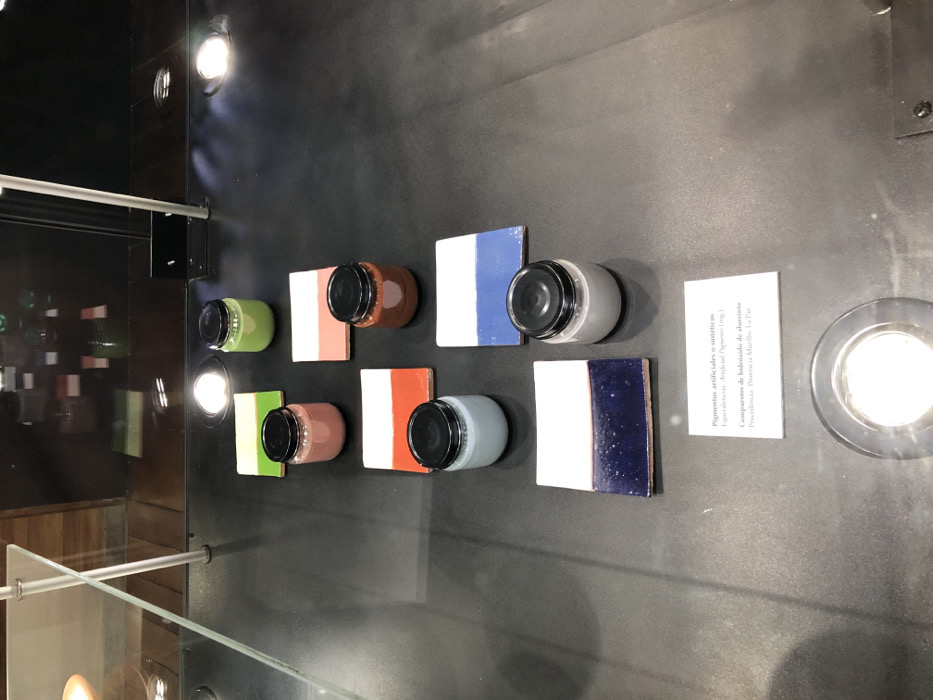
An indoor display features a collection of six jars containing artificial or synthetic pigments, each paired with a matching ceramic tile, arranged in two rows of three on a dark, reflective surface. The jars have black lids and contain pigments in various hues: vibrant green, light pinkish-brown, dark reddish-brown, light grey, and dark grey. Each jar is placed next to a rectangular ceramic tile, which is partially glazed or painted with a color corresponding to the pigment in the adjacent jar. Some tiles also feature a distinct blue pigment, indicating variations.

Bright spotlights illuminate the display from above and the right, creating strong reflections on the dark surface and a glass partition in the foreground. The reflections suggest the presence of other display elements or visitors in the environment.

To the right of the display, a white informational plaque provides details in Spanish. The visible text reads "Pigmentos artificiales o sintéticos" (Artificial or synthetic pigments), followed by "Equivalencias: Arcilla / Pigmento (ing.)" (Equivalences: Clay / Pigment (English)), suggesting a comparative display. It also states "Compuestos de hidróxido de aluminio" (Aluminum hydroxide compounds) and specifies the origin as "Procedencia: Provincia Murillo La Paz," indicating the pigments' source or inspiration is from Murillo Province in La Paz, Bolivia. The setting appears to be a museum or educational exhibition.
MNela

Jan 9, 2025, 8:35 PM

La Paz, Bolivia

Stake attention in this memory

An indoor display features a collection of six jars containing artificial or synthetic pigments, each paired with a matching ceramic tile, arranged in two rows of three on a dark, reflective surface. The jars have black lids and contain pigments in various hues: vibrant green, light pinkish-brown, dark reddish-brown, light grey, and dark grey. Each jar is placed next to a rectangular ceramic tile, which is partially glazed or painted with a color corresponding to the pigment in the adjacent jar. Some tiles also feature a distinct blue pigment, indicating variations. Bright spotlights illuminate the display from above and the right, creating strong reflections on the dark surface and a glass partition in the foreground. The reflections suggest the presence of other display elements or visitors in the environment. To the right of the display, a white informational plaque provides details in Spanish. The visible text reads "Pigmentos artificiales o sintéticos" (Artificial or synthetic pigments), followed by "Equivalencias: Arcilla / Pigmento (ing.)" (Equivalences: Clay / Pigment (English)), suggesting a comparative display. It also states "Compuestos de hidróxido de aluminio" (Aluminum hydroxide compounds) and specifies the origin as "Procedencia: Provincia Murillo La Paz," indicating the pigments' source or inspiration is from Murillo Province in La Paz, Bolivia. The setting appears to be a museum or educational exhibition.

Loading AttnAds…

transactions
revenues
stakers
Earliest
Latest
Highest stake

No transactions found

More from this user

More from La Paz

MNela

Jan 9, 2025, 8:35 PM

La Paz, Bolivia

Licensed under Creative Commons Attribution 4.0 International License. You are free to share and adapt this content with proper attribution.