
Sign in
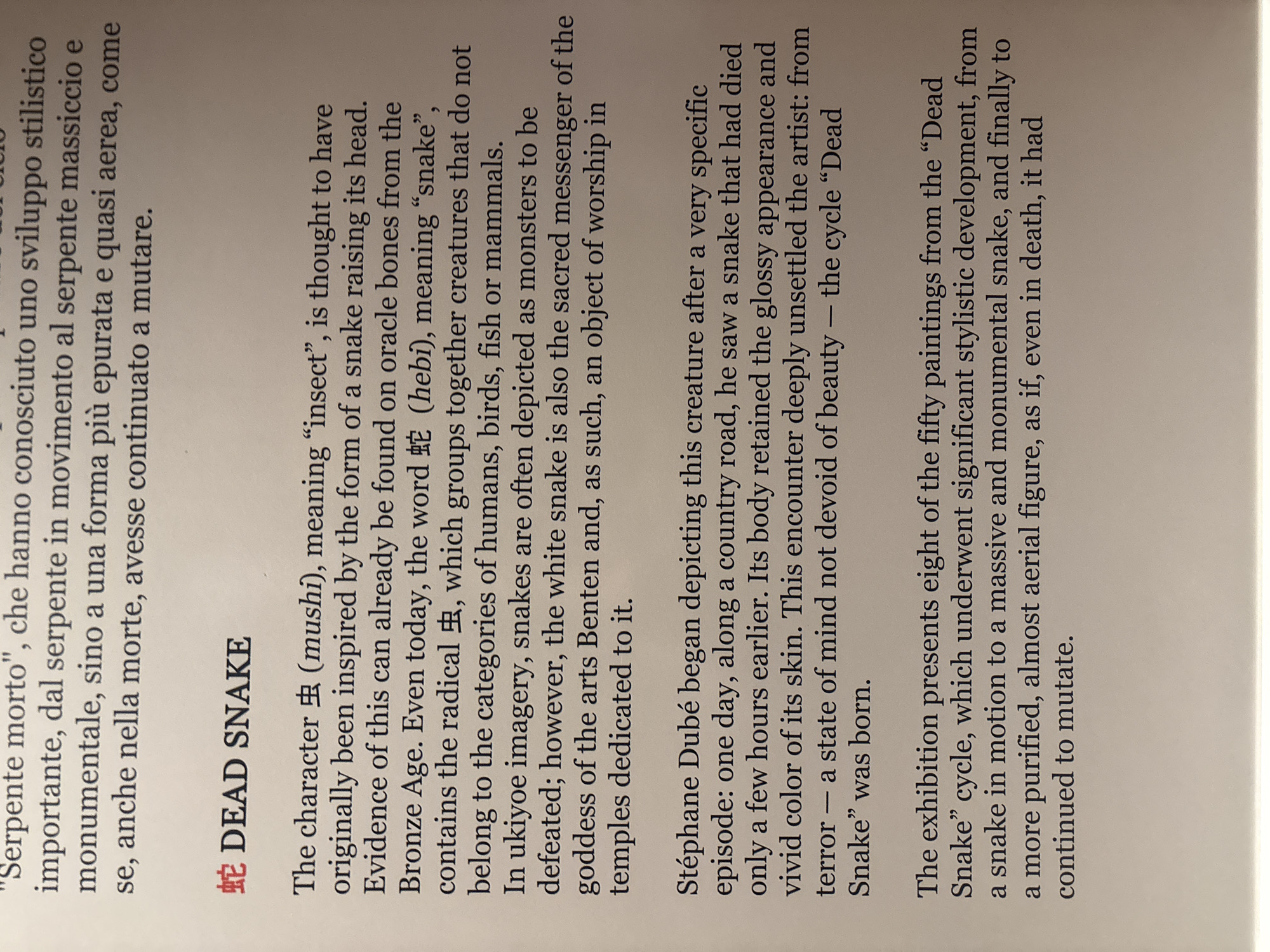
The image displays a printed page featuring text in both Italian and English, primarily discussing the artistic theme of "Dead Snake" and an exhibition related to it.

The Italian paragraph at the top refers to "Serpente morto" (Dead Snake) and its stylistic evolution, moving from a snake in motion to a massive and monumental form, then to a more purified and almost aerial figure, implying continuous mutation even in death.

Below this, the title "DEAD SNAKE" is prominently displayed, accompanied by the Japanese character 蛇. The English text further elaborates on the character 虫 (mushi), meaning "insect," which is thought to have been inspired by a snake raising its head, with evidence from Bronze Age oracle bones. The word 蛇 (hebi), meaning "snake," contains this radical, grouping creatures outside human, bird, fish, or mammal categories. Culturally, while ukiyoe often depicts snakes as monsters, the white snake is revered as the sacred messenger of Benten, the goddess of arts, and is an object of worship.

The origin of the "Dead Snake" art cycle is attributed to Stéphane Dubé, who was deeply affected after encountering a recently deceased snake on a country road. Its preserved glossy appearance and vivid color unsettled him, leading to the creation of the cycle, born from a feeling of terror not devoid of beauty.

The exhibition presents eight of the fifty paintings from this "Dead Snake" cycle, showcasing a significant stylistic development. This progression moves from a snake in motion to a massive and monumental form, culminating in a purified, almost aerial figure, as if it continued to mutate even after death.
FM-r2byf2

Jun 5, 2026

Venice, Italy

Stake attention in this memory

curiosity
intrigue
contemplation
foreboding
fascination

The image displays a printed page featuring text in both Italian and English, primarily discussing the artistic theme of "Dead Snake" and an exhibition related to it. The Italian paragraph at the top refers to "Serpente morto" (Dead Snake) and its stylistic evolution, moving from a snake in motion to a massive and monumental form, then to a more purified and almost aerial figure, implying continuous mutation even in death. Below this, the title "DEAD SNAKE" is prominently displayed, accompanied by the Japanese character 蛇. The English text further elaborates on the character 虫 (mushi), meaning "insect," which is thought to have been inspired by a snake raising its head, with evidence from Bronze Age oracle bones. The word 蛇 (hebi), meaning "snake," contains this radical, grouping creatures outside human, bird, fish, or mammal categories. Culturally, while ukiyoe often depicts snakes as monsters, the white snake is revered as the sacred messenger of Benten, the goddess of arts, and is an object of worship. The origin of the "Dead Snake" art cycle is attributed to Stéphane Dubé, who was deeply affected after encountering a recently deceased snake on a country road. Its preserved glossy appearance and vivid color unsettled him, leading to the creation of the cycle, born from a feeling of terror not devoid of beauty. The exhibition presents eight of the fifty paintings from this "Dead Snake" cycle, showcasing a significant stylistic development. This progression moves from a snake in motion to a massive and monumental form, culminating in a purified, almost aerial figure, as if it continued to mutate even after death.

transactions
revenues
stakers
Earliest
Latest
Highest stake

No transactions found

More from this user

More from Venice

FM-r2byf2

Jun 5, 2026

Venice, Italy

Licensed under Creative Commons Attribution 4.0 International License. You are free to share and adapt this content with proper attribution.