
Sign in
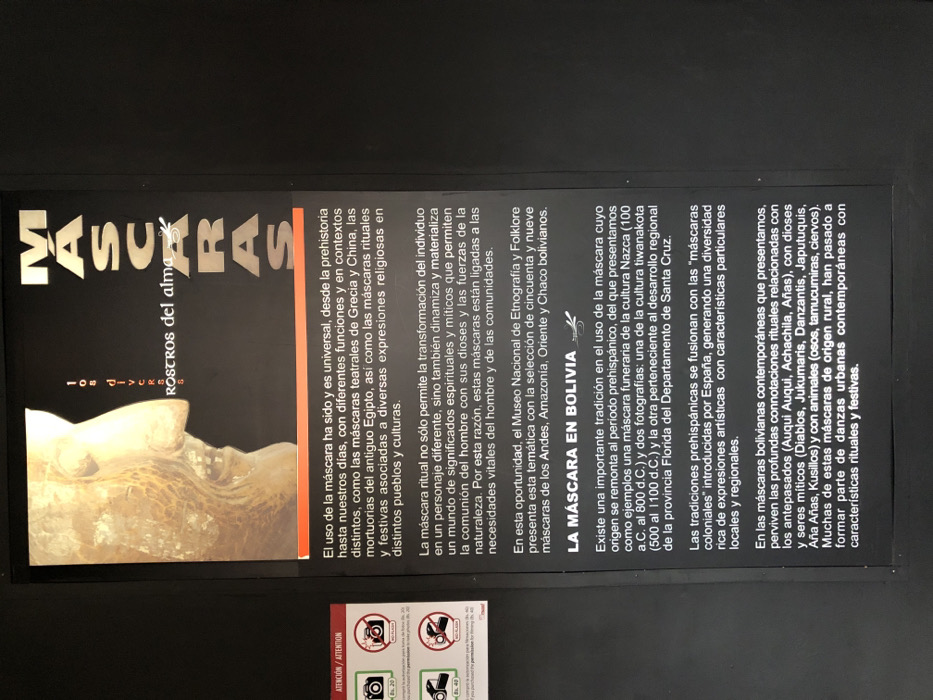
The image displays an informational panel, likely from a museum or exhibition in La Paz, Bolivia. The dominant element is a large, dark rectangular sign with white and gold text, featuring the exhibition title "MÁSCARAS: ROSTROS del alma" (MASKS: FACES of the soul). Adjacent to the title is a light-colored, abstract image, appearing to be a fragment of a stone or wooden mask, depicting a forehead and eye area.

The text, written in Spanish, provides a comprehensive overview of masks. It begins by stating that the use of masks is universal, dating back to prehistory, serving various functions from theatrical performances in Greece and China to funerary rites in ancient Egypt, and diverse religious and festive expressions across cultures.

It further explains the significance of ritual masks, noting they not only transform an individual into a different character but also energize and materialize spiritual and mythical meanings, allowing for communion between humans, deities, and natural forces. Consequently, masks are considered vital for human and community needs.

The panel specifies that the Museo Nacional de Etnografía y Folklore is presenting this theme with a selection of fifty-nine masks from the Bolivian Andes, Amazonia, Oriente, and Chaco regions. Under the subtitle "LA MÁSCARA EN BOLIVIA," the text details the important pre-Hispanic tradition of masks in Bolivia, citing examples from the Nazca and Tiwanaku cultures. It mentions how these traditions merged with "colonial masks" introduced by Spain, creating a rich diversity of artistic expressions. Contemporary Bolivian masks still carry profound ritual connotations, representing ancestors (Auqui Auqui, Achachila), gods and mythical beings (Diablos, Jukumaris, Kusillos), and animals. Many rural masks have evolved to be incorporated into urban dances, retaining their ritual and festive attributes.

At the bottom left, smaller icons indicate museum regulations, specifically prohibiting flash photography and video recording, suggesting a curated environment. The overall scene indicates an educational display in a cultural institution.
MNela

Jan 9, 2025, 8:13 PM

La Paz, Bolivia

Stake attention in this memory

The image displays an informational panel, likely from a museum or exhibition in La Paz, Bolivia. The dominant element is a large, dark rectangular sign with white and gold text, featuring the exhibition title "MÁSCARAS: ROSTROS del alma" (MASKS: FACES of the soul). Adjacent to the title is a light-colored, abstract image, appearing to be a fragment of a stone or wooden mask, depicting a forehead and eye area. The text, written in Spanish, provides a comprehensive overview of masks. It begins by stating that the use of masks is universal, dating back to prehistory, serving various functions from theatrical performances in Greece and China to funerary rites in ancient Egypt, and diverse religious and festive expressions across cultures. It further explains the significance of ritual masks, noting they not only transform an individual into a different character but also energize and materialize spiritual and mythical meanings, allowing for communion between humans, deities, and natural forces. Consequently, masks are considered vital for human and community needs. The panel specifies that the Museo Nacional de Etnografía y Folklore is presenting this theme with a selection of fifty-nine masks from the Bolivian Andes, Amazonia, Oriente, and Chaco regions. Under the subtitle "LA MÁSCARA EN BOLIVIA," the text details the important pre-Hispanic tradition of masks in Bolivia, citing examples from the Nazca and Tiwanaku cultures. It mentions how these traditions merged with "colonial masks" introduced by Spain, creating a rich diversity of artistic expressions. Contemporary Bolivian masks still carry profound ritual connotations, representing ancestors (Auqui Auqui, Achachila), gods and mythical beings (Diablos, Jukumaris, Kusillos), and animals. Many rural masks have evolved to be incorporated into urban dances, retaining their ritual and festive attributes. At the bottom left, smaller icons indicate museum regulations, specifically prohibiting flash photography and video recording, suggesting a curated environment. The overall scene indicates an educational display in a cultural institution.

Loading AttnAds…

transactions
revenues
stakers
Earliest
Latest
Highest stake

No transactions found

More from this user

More from La Paz

MNela

Jan 9, 2025, 8:13 PM

La Paz, Bolivia

Licensed under Creative Commons Attribution 4.0 International License. You are free to share and adapt this content with proper attribution.