Stake attention in this memory
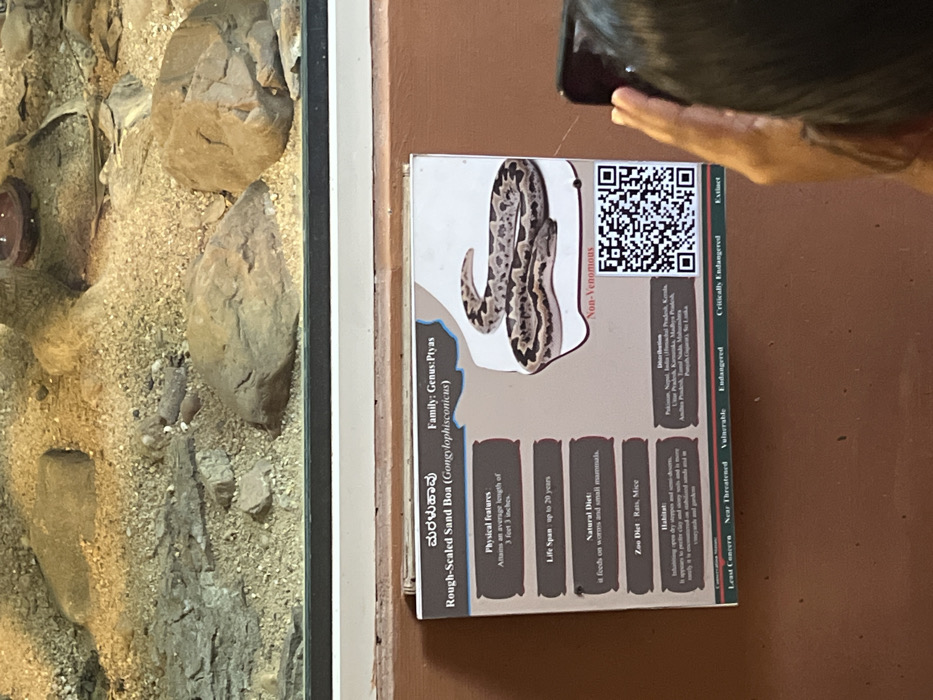
An exhibit display sign, rotated on its side, is visible on a brown wall, adjacent to a glass enclosure containing a sandy and rocky habitat, likely for a snake. A person's hand holding a dark-colored smartphone hovers over the top right portion of the sign, possibly scanning a QR code or taking a picture. The sign details information about the "Rough-Scaled Sand Boa," identified by the scientific name "Gongylophisconicus," with "మరಳುహావు" (Maraluhāvu) in Kannada. It mistakenly lists "Family: Genus: Ptyas". Key facts presented include: * **Physical features:** Attains an average length of 3 feet 3 inches. * **Life Span:** Up to 20 years. * **Natural Diet:** Feeds on worms and small mammals. * **Zoo Diet:** Rats, Mice. * **Habitat:** Inhabits open dry steppes and semi-deserts, preferring coarse, sandy soils, and is found in cultivated lands, vineyards, and gardens. * **Venomous status:** Clearly labeled "Non-Venomous." * **Distribution:** Found in Pakistan, Nepal, India (Himachal Pradesh, Kerala, Uttar Pradesh, Karnataka, Madhya Pradesh, Andhra Pradesh, Punjab, Gujarat), and Sri Lanka. A QR code is prominently displayed on the sign. Conservation status categories like "Least Concern," "Near Threatened," "Vulnerable," "Endangered," "Critically Endangered," and "Extinct" are listed along the right edge. The exhibit is located in Mysuru, India.
No transactions found