
Stake attention in this memory
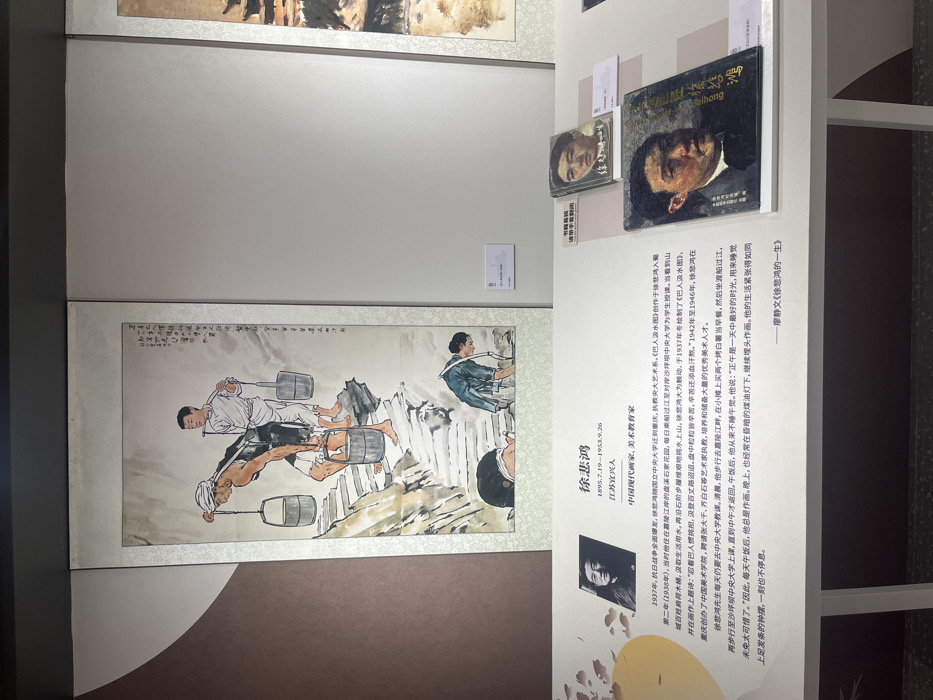
The image depicts a museum exhibit in Chongqing, China, located at the coordinates 29.581 latitude and 106.443 longitude. The exhibit features two paintings, both of which are framed and hung on a white wall. The left painting depicts three people carrying buckets up a hill, while the right painting depicts a mountainous landscape. Both paintings are in black and white. The exhibit also features a framed portrait of a man, located on a table in the foreground. This table is also covered in white and is in the foreground of the image. The exhibit also features a plaque with the text "徐悲鸿 (1895.7.19 – 1953.9.26) 中国现代画家,美术教育家". A text plaque with an excerpt of a biographical essay on the artist is located below the exhibit. The text reads: "1937年,日军全面侵华战争爆发,徐悲鸿在国立中央大学 (国立中央大学前身是中央大学) 担任的教授和校长,第一至第二 (1938到1939年),战争的摧残使学校几经迁徙,但徐悲鸿始终坚持教学和创作。他带领中央大学师生学生到湖南、贵州、广西等地避难,克服了种种困难,坚持教学,在战火纷飞的年代,坚持着美术教育,以艺术抗敌。1937年1942年 (包括他在香港) 他创作了大量作品,展现抗战的人民,反映了中国人民的爱国情怀和不屈精神,为抗战的胜利做出了贡献。1942年1946年 (包括他在重庆) 他在重庆继续了中央大学的教学,并开设了艺术研究所,培养艺术人才,继续进行艺术创作。在那个战火纷飞的年代,徐悲鸿的艺术,为全国人民带来力量和希望,也为中国美术界留下宝贵的艺术遗产,他用自己独特的艺术风格,展现了中国人民的坚韧和力量。他的艺术创作,也为中国美术界留下宝贵的艺术遗产,他用自己独特的艺术风格,展现了中国人民的坚韧和力量。他的艺术创作,也为中国美术界留下宝贵的艺术遗产,他用自己独特的艺术风格,展现了中国人民的坚韧和力量。他创作了大量作品,反映了中国人民的爱国情怀和不屈精神,为抗战的胜利做出了贡献。他用自己独特的艺术风格,展现了中国人民的坚韧和力量。他创作了大量作品,反映了中国人民的爱国情怀和不屈精神,为抗战的胜利做出了贡献。".
Loading AttnAds…
No transactions found