Sign in
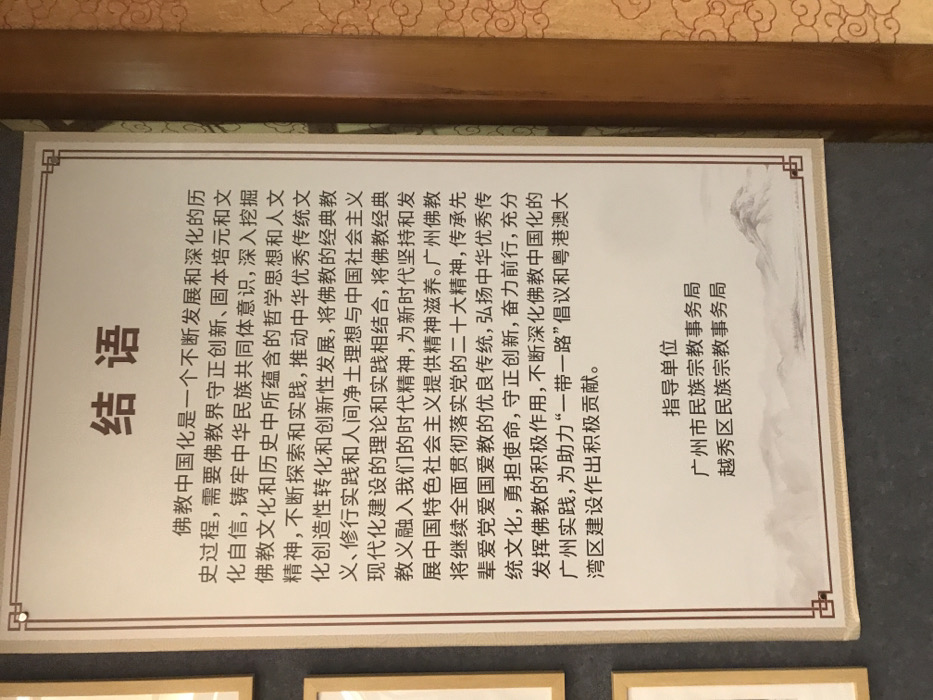
The image displays a framed document with Chinese text, presented as an exhibit in what appears to be an indoor setting, possibly a museum, cultural center, or temple in Guang Zhou Shi, China. The document is mounted on a brown wall or wooden panel, with a wooden beam visible at the top and the tops of other framed items at the bottom.

The document features a decorative border in a traditional Chinese style, with subtle cloud patterns and a monochromatic landscape drawing in the bottom right corner. The text, titled "结语" (Conclusion/Concluding Remarks), is written in vertical columns, though read from left to right, and is entirely in simplified Chinese.

The content of the text focuses on the "Sinicization of Buddhism" (佛教中国化) as a historical process that requires innovation, cultural confidence, and integration with Chinese national identity. It discusses exploring the philosophical and humanistic spirit within Buddhist culture, promoting the creative transformation of traditional Chinese culture, and aligning Buddhist doctrines and practices with the theories of socialist modernization in China. The text states that Guangzhou Buddhism will continue to uphold the spirit of the Communist Party's 20th National Congress, inherit patriotic traditions, promote excellent Chinese culture, and actively contribute to national initiatives like the "Belt and Road" (一带一路) and the Guangdong-Hong Kong-Macao Greater Bay Area (粤港澳大湾区).

At the bottom right, the "指导单位" (Guiding Units) are listed as the 广州市民族宗教事务局 (Guangzhou Municipal Bureau of Ethnic and Religious Affairs) and the 越秀区民族宗教事务局 (Yuexiu District Bureau of Ethnic and Religious Affairs). The image captures the document slightly from an angle.
F
FM-qn0Jb2

Dec 9, 2024, 12:23 PM

Guang Zhou Shi, China

Stake attention in this memory

The image displays a framed document with Chinese text, presented as an exhibit in what appears to be an indoor setting, possibly a museum, cultural center, or temple in Guang Zhou Shi, China. The document is mounted on a brown wall or wooden panel, with a wooden beam visible at the top and the tops of other framed items at the bottom. The document features a decorative border in a traditional Chinese style, with subtle cloud patterns and a monochromatic landscape drawing in the bottom right corner. The text, titled "结语" (Conclusion/Concluding Remarks), is written in vertical columns, though read from left to right, and is entirely in simplified Chinese. The content of the text focuses on the "Sinicization of Buddhism" (佛教中国化) as a historical process that requires innovation, cultural confidence, and integration with Chinese national identity. It discusses exploring the philosophical and humanistic spirit within Buddhist culture, promoting the creative transformation of traditional Chinese culture, and aligning Buddhist doctrines and practices with the theories of socialist modernization in China. The text states that Guangzhou Buddhism will continue to uphold the spirit of the Communist Party's 20th National Congress, inherit patriotic traditions, promote excellent Chinese culture, and actively contribute to national initiatives like the "Belt and Road" (一带一路) and the Guangdong-Hong Kong-Macao Greater Bay Area (粤港澳大湾区). At the bottom right, the "指导单位" (Guiding Units) are listed as the 广州市民族宗教事务局 (Guangzhou Municipal Bureau of Ethnic and Religious Affairs) and the 越秀区民族宗教事务局 (Yuexiu District Bureau of Ethnic and Religious Affairs). The image captures the document slightly from an angle.

Loading AttnAds…

transactions
revenues
stakers
Earliest
Latest
Highest stake

No transactions found

More from this user

More from Guang Zhou Shi

FFM-qn0Jb2

Dec 9, 2024, 12:23 PM

Guang Zhou Shi, China

Licensed under Creative Commons Attribution 4.0 International License. You are free to share and adapt this content with proper attribution.