
Sign in
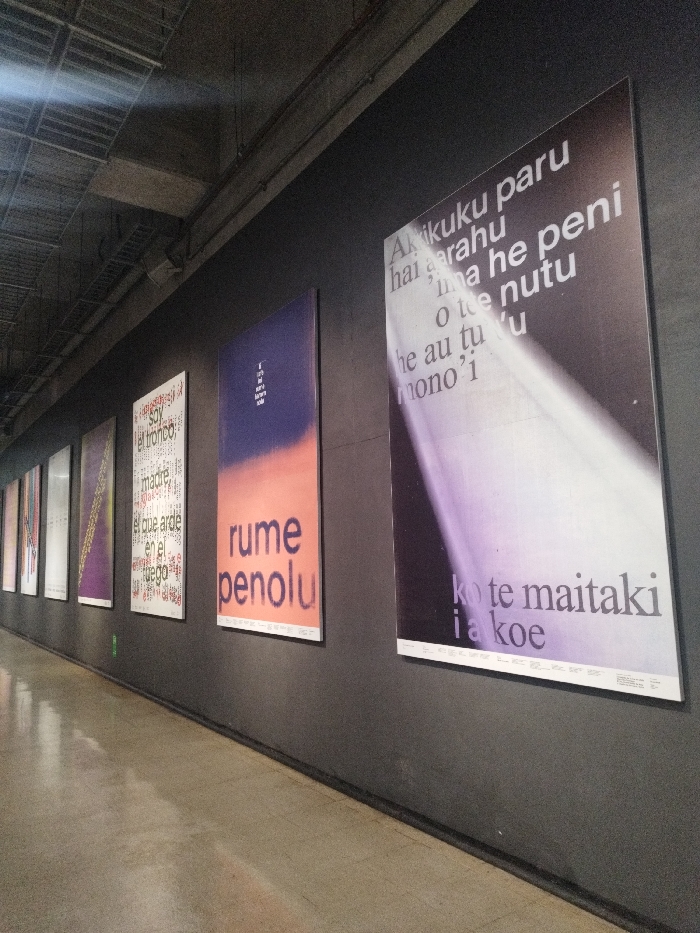
The image captures a contemporary indoor hallway or gallery space in Ñuñoa, Chile, showcasing a series of large, vertical posters mounted on a dark grey wall. The hallway recedes into the distance, revealing a succession of these art pieces. No people are visible.

The nearest poster on the right features white typography against a dark background, intersected by a prominent diagonal light purple gradient or beam. Visible text includes "Akikuku paru", "hai aarahu", "ma he peni", "o te nutu", "he au tu u", "mono'i", and "te maitaki ia koe," suggesting an indigenous or Polynesian language, possibly Rapa Nui. Adjacent to it, a poster displays the words "rume penolu" in large white letters set against a striking vertical color gradient transitioning from dark blue-purple at the top to orange-red at the bottom. The third prominent poster to the left has Spanish text, including "el tronco", "madre", "el que arde", and "en el fuego," printed in black and red on a white background. Other posters further down the hall are less distinct but follow a similar graphic and textual design theme.

The setting features a light-colored, reflective floor, possibly concrete or polished stone, and a dark, industrial-style ceiling with visible beams, ducts, and artificial light fixtures. The lighting is exclusively artificial, casting reflections on the floor and creating a lens flare in the upper left corner of the image. The scene conveys a clean, minimalist aesthetic, typical of a modern exhibition space dedicated to typography or graphic design.
Melani

Dec 20, 2024, 9:29 PM

Ñuñoa, Chile

Stake attention in this memory

The image captures a contemporary indoor hallway or gallery space in Ñuñoa, Chile, showcasing a series of large, vertical posters mounted on a dark grey wall. The hallway recedes into the distance, revealing a succession of these art pieces. No people are visible. The nearest poster on the right features white typography against a dark background, intersected by a prominent diagonal light purple gradient or beam. Visible text includes "Akikuku paru", "hai aarahu", "ma he peni", "o te nutu", "he au tu u", "mono'i", and "te maitaki ia koe," suggesting an indigenous or Polynesian language, possibly Rapa Nui. Adjacent to it, a poster displays the words "rume penolu" in large white letters set against a striking vertical color gradient transitioning from dark blue-purple at the top to orange-red at the bottom. The third prominent poster to the left has Spanish text, including "el tronco", "madre", "el que arde", and "en el fuego," printed in black and red on a white background. Other posters further down the hall are less distinct but follow a similar graphic and textual design theme. The setting features a light-colored, reflective floor, possibly concrete or polished stone, and a dark, industrial-style ceiling with visible beams, ducts, and artificial light fixtures. The lighting is exclusively artificial, casting reflections on the floor and creating a lens flare in the upper left corner of the image. The scene conveys a clean, minimalist aesthetic, typical of a modern exhibition space dedicated to typography or graphic design.

transactions
revenues
stakers
Earliest
Latest
Highest stake

No transactions found

More from this user

More from Ñuñoa

Melani

Dec 20, 2024, 9:29 PM

Ñuñoa, Chile

Licensed under Creative Commons Attribution 4.0 International License. You are free to share and adapt this content with proper attribution.