Sign in
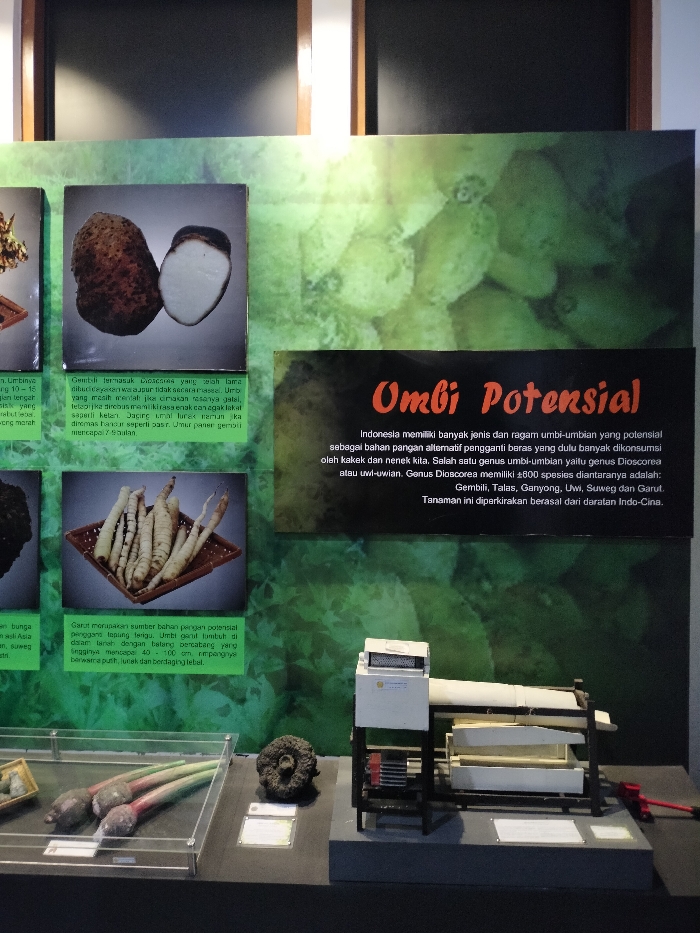
This image captures an indoor exhibition display in Bogor, Indonesia, focusing on various "Ombi Potensial" (Potential Tubers). The central feature is a large panel titled "Ombi Potensial" in orange script. The text on this panel explains that Indonesia has many types of tubers that could serve as alternative rice substitutes, widely consumed by past generations. It highlights the *Dioscorea* genus, which includes approximately 600 species such as Gembili, Talas, Ganyong, Uwi, Suweg, and Garut, noting their probable origin in Indo-China.

To the left of the main panel, two smaller square panels are visible. The upper one displays an image of a dark brown tuber, with a portion sliced open to reveal its white interior. The accompanying Indonesian text identifies this as "Gembili," a *Dioscorea* species, mentioning that raw tubers can be itchy but are tasty and sticky when boiled, with a harvest period of about 7 months. Below it, another panel shows numerous long, white, root-like tubers arranged in a woven basket. Its text describes "Garut" as a potential food source for flour substitution, detailing its underground growth from stems 40-100 cm tall, and its white, soft, and thick flesh.

Below these panels, physical examples of tubers are displayed in clear cases. On the left, several reddish-purple tubers with green tops are showcased. To their right, a dark, irregularly shaped, knobby tuber is exhibited. Adjacent to these, a small white and black machine, possibly a processing or drying unit for tubers, stands on a dark pedestal. The background features a green, textured wall, suggesting a natural or organic theme. The overall scene is brightly lit, indicating an educational or museum setting.
F
FM-4WE6C2

Dec 19, 2024

Bogor, Indonesia

Stake attention in this memory

This image captures an indoor exhibition display in Bogor, Indonesia, focusing on various "Ombi Potensial" (Potential Tubers). The central feature is a large panel titled "Ombi Potensial" in orange script. The text on this panel explains that Indonesia has many types of tubers that could serve as alternative rice substitutes, widely consumed by past generations. It highlights the *Dioscorea* genus, which includes approximately 600 species such as Gembili, Talas, Ganyong, Uwi, Suweg, and Garut, noting their probable origin in Indo-China. To the left of the main panel, two smaller square panels are visible. The upper one displays an image of a dark brown tuber, with a portion sliced open to reveal its white interior. The accompanying Indonesian text identifies this as "Gembili," a *Dioscorea* species, mentioning that raw tubers can be itchy but are tasty and sticky when boiled, with a harvest period of about 7 months. Below it, another panel shows numerous long, white, root-like tubers arranged in a woven basket. Its text describes "Garut" as a potential food source for flour substitution, detailing its underground growth from stems 40-100 cm tall, and its white, soft, and thick flesh. Below these panels, physical examples of tubers are displayed in clear cases. On the left, several reddish-purple tubers with green tops are showcased. To their right, a dark, irregularly shaped, knobby tuber is exhibited. Adjacent to these, a small white and black machine, possibly a processing or drying unit for tubers, stands on a dark pedestal. The background features a green, textured wall, suggesting a natural or organic theme. The overall scene is brightly lit, indicating an educational or museum setting.

transactions
revenues
stakers
Earliest
Latest
Highest stake

No transactions found

More from this user

More from Bogor

FFM-4WE6C2

Dec 19, 2024

Bogor, Indonesia

Licensed under Creative Commons Attribution 4.0 International License. You are free to share and adapt this content with proper attribution.