Sign in
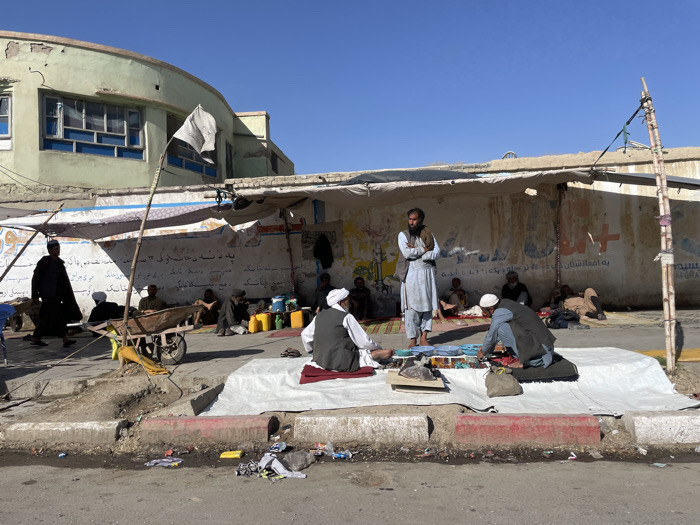
This image captures a daytime street scene in Kandahar, Afghanistan, under a clear blue sky. The foreground shows a worn asphalt road littered with refuse, including plastic bags and debris. A raised concrete curb separates the street from a sidewalk.

On the sidewalk, a large white tarp is spread, serving as an informal market stall or resting area. On this tarp, a man wearing a white cap and a dark vest over a light tunic is seated on a dark mat, leaning forward to arrange or inspect a collection of small, colorful objects displayed before him. To his left, another individual is partially visible, also seated on the tarp.

Behind them, a man in a light blue shalwar kameez stands with his arms crossed, observing the scene. Further back, under a makeshift fabric awning supported by wooden poles, several men are seated or reclining on the ground or on mats. One individual on the far right is covered by a blanket or shawl. Near the center, a wooden wheelbarrow is parked among seated individuals, and several yellow plastic jerry cans are visible.

The awning is attached to a low, single-story building or wall which displays faded yellow-brown paint, partially obscured script in Dari or Pashto, and faded graphics, including a red cross-like symbol. To the left, a man in dark traditional clothing and a white cap walks from left to right past a wooden pole from which a white flag with a black symbol, likely the Shahada, is flying.

In the background, a two-story building with a rounded corner is visible, painted in a faded light green or pale yellow hue. It features multiple rectangular windows with blue frames and shows signs of weathering and chipped paint. The overall scene depicts an active, informal urban environment with elements of commerce, social gathering, and a degree of disrepair.
Mohammad

Nov 11, 2025, 9:18 AM

Kandahar, Afghanistan

Stake attention in this memory

Resignation
Poverty
Somber
Resilience
Hardship

This image captures a daytime street scene in Kandahar, Afghanistan, under a clear blue sky. The foreground shows a worn asphalt road littered with refuse, including plastic bags and debris. A raised concrete curb separates the street from a sidewalk. On the sidewalk, a large white tarp is spread, serving as an informal market stall or resting area. On this tarp, a man wearing a white cap and a dark vest over a light tunic is seated on a dark mat, leaning forward to arrange or inspect a collection of small, colorful objects displayed before him. To his left, another individual is partially visible, also seated on the tarp. Behind them, a man in a light blue shalwar kameez stands with his arms crossed, observing the scene. Further back, under a makeshift fabric awning supported by wooden poles, several men are seated or reclining on the ground or on mats. One individual on the far right is covered by a blanket or shawl. Near the center, a wooden wheelbarrow is parked among seated individuals, and several yellow plastic jerry cans are visible. The awning is attached to a low, single-story building or wall which displays faded yellow-brown paint, partially obscured script in Dari or Pashto, and faded graphics, including a red cross-like symbol. To the left, a man in dark traditional clothing and a white cap walks from left to right past a wooden pole from which a white flag with a black symbol, likely the Shahada, is flying. In the background, a two-story building with a rounded corner is visible, painted in a faded light green or pale yellow hue. It features multiple rectangular windows with blue frames and shows signs of weathering and chipped paint. The overall scene depicts an active, informal urban environment with elements of commerce, social gathering, and a degree of disrepair.

Loading AttnAds…

transactions
revenues
stakers
Earliest
Latest
Highest stake

No transactions found

More from this user

More from Kandahar

Mohammad

Nov 11, 2025, 9:18 AM

Kandahar, Afghanistan

Licensed under Creative Commons Attribution 4.0 International License. You are free to share and adapt this content with proper attribution.