
Sign in
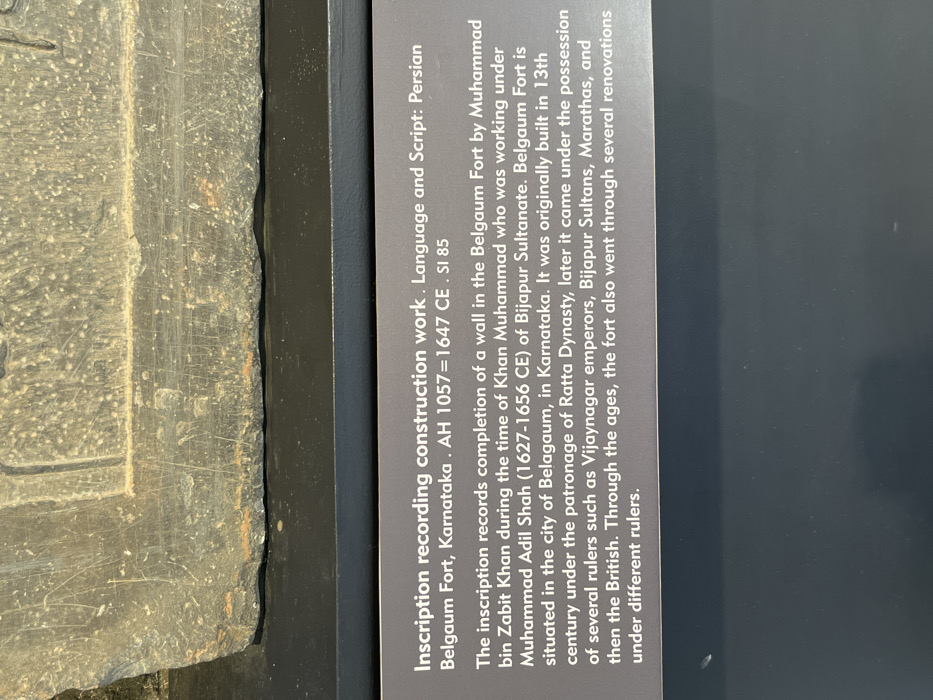
This image captures a museum or exhibition display, likely in Mumbai, India, featuring a historical artifact and an informative plaque. On the left, partially visible, is an ancient stone tablet, dark gray in color, with a textured and weathered surface. Faint lines and possible remnants of carved script are visible on its uneven surface, suggesting it is an inscription or part of a larger structure. The right side of the image is dominated by a descriptive plaque with white text against a dark gray background, presented in a clear, vertical orientation.

The plaque provides detailed information about the inscription and the associated historical context. The visible text reads: "Inscription recording construction work. Language and Script: Persian Belgaum Fort, Karnataka. AH 1057=1647 CE. SI 85. The inscription records completion of a wall in the Belgaum Fort by Muhammad bin Zabit Khan during the time of Khan Muhammad who was working under Muhammad Adil Shah (1627-1656 CE) of Bijapur Sultanate. Belgaum Fort is situated in the city of Belagaum, in Karnataka. It was originally built in 13th century under the patronage of Ratta Dynasty, later it came under the possession of several rulers such as Vijaynagar emperors, Bijapur Sultans, Marathas, and then the British. Through the ages, the fort also went through several renovations under different rulers."

The scene is indoors, well-lit, and professionally presented, indicating a formal exhibition setting for historical artifacts. The dark frame around the plaque and the stone tablet contributes to the exhibit's clean and structured appearance. The overall impression is one of historical preservation and education.
FM-OhtiC3

Dec 10, 2024

Mumbai, India

Stake attention in this memory

This image captures a museum or exhibition display, likely in Mumbai, India, featuring a historical artifact and an informative plaque. On the left, partially visible, is an ancient stone tablet, dark gray in color, with a textured and weathered surface. Faint lines and possible remnants of carved script are visible on its uneven surface, suggesting it is an inscription or part of a larger structure. The right side of the image is dominated by a descriptive plaque with white text against a dark gray background, presented in a clear, vertical orientation. The plaque provides detailed information about the inscription and the associated historical context. The visible text reads: "Inscription recording construction work. Language and Script: Persian Belgaum Fort, Karnataka. AH 1057=1647 CE. SI 85. The inscription records completion of a wall in the Belgaum Fort by Muhammad bin Zabit Khan during the time of Khan Muhammad who was working under Muhammad Adil Shah (1627-1656 CE) of Bijapur Sultanate. Belgaum Fort is situated in the city of Belagaum, in Karnataka. It was originally built in 13th century under the patronage of Ratta Dynasty, later it came under the possession of several rulers such as Vijaynagar emperors, Bijapur Sultans, Marathas, and then the British. Through the ages, the fort also went through several renovations under different rulers." The scene is indoors, well-lit, and professionally presented, indicating a formal exhibition setting for historical artifacts. The dark frame around the plaque and the stone tablet contributes to the exhibit's clean and structured appearance. The overall impression is one of historical preservation and education.

transactions
revenues
stakers
Earliest
Latest
Highest stake

No transactions found

More from this user

More from Mumbai

FM-OhtiC3

Dec 10, 2024

Mumbai, India

Licensed under Creative Commons Attribution 4.0 International License. You are free to share and adapt this content with proper attribution.