
Sign in
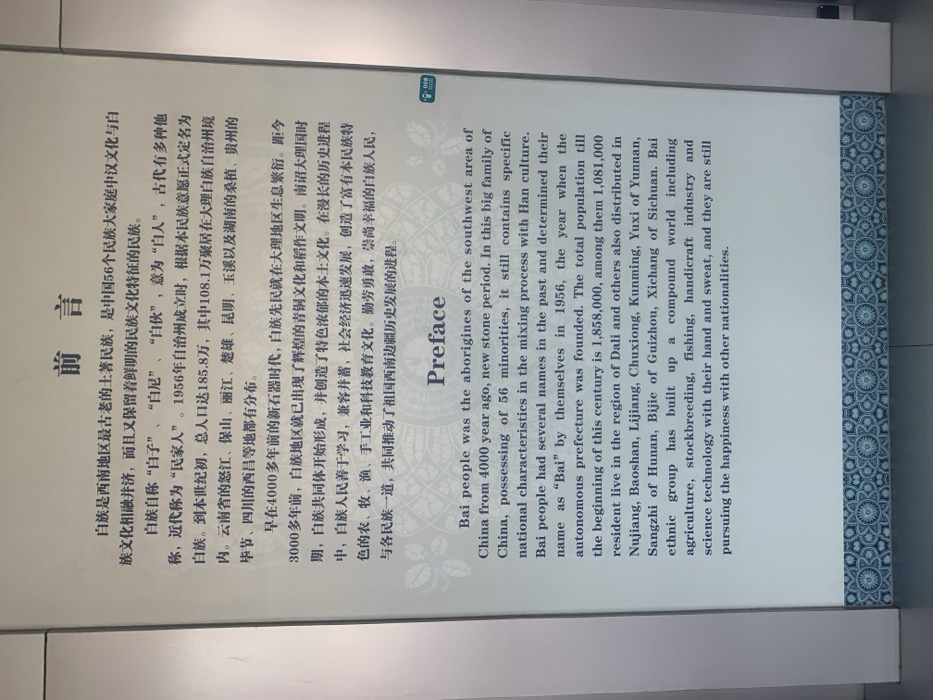
An indoor shot captures a brightly lit display board, likely part of an exhibition or museum, presenting information about the Bai ethnic group. The board features a "Preface" in both Chinese and English, detailing the history, culture, and demographics of the Bai people.

The Chinese text, titled "前言" (Preface), describes the Bai as ancient aboriginals of Southwest China, part of the country's 56 ethnic groups, maintaining distinct cultural characteristics while integrating with Han culture. It mentions their self-designations and the official naming as "Bai" in 1956. The text states their total population was 1.858 million at the beginning of the century, with 1.081 million residing in the Dali Bai Autonomous Prefecture, and others distributed across Yunnan, Hunan, Guizhou, and Sichuan. It outlines their origins 4000 years ago in Dali, the emergence of bronze culture and rice cultivation 3000 years ago, and their contributions to agriculture, animal husbandry, fishing, handicrafts, and education.

The English "Preface" provides a concise summary of the same information, noting the Bai as aboriginals from 4000 years ago, their specific national characteristics, their self-determination of the name "Bai" in 1956 coinciding with the founding of their autonomous prefecture. It specifies the total population at 1,858,000, with 1,081,000 in Dali and others in Nujiang, Baoshan, Lijiang, Chuxiong, Kunming, Yuxi (Yunnan), Sangzhi (Hunan), Bijie (Guizhou), and Xichang (Sichuan). It also highlights their development of a complex society including agriculture, stockbreeding, fishing, handicraft industry, and science technology, and their pursuit of happiness alongside other nationalities.

The display board is adorned with a decorative patterned border at the bottom, contributing to its formal exhibit appearance.
Emma🇨🇳💕

Feb 1, 2025

Dali, China

Stake attention in this memory

An indoor shot captures a brightly lit display board, likely part of an exhibition or museum, presenting information about the Bai ethnic group. The board features a "Preface" in both Chinese and English, detailing the history, culture, and demographics of the Bai people. The Chinese text, titled "前言" (Preface), describes the Bai as ancient aboriginals of Southwest China, part of the country's 56 ethnic groups, maintaining distinct cultural characteristics while integrating with Han culture. It mentions their self-designations and the official naming as "Bai" in 1956. The text states their total population was 1.858 million at the beginning of the century, with 1.081 million residing in the Dali Bai Autonomous Prefecture, and others distributed across Yunnan, Hunan, Guizhou, and Sichuan. It outlines their origins 4000 years ago in Dali, the emergence of bronze culture and rice cultivation 3000 years ago, and their contributions to agriculture, animal husbandry, fishing, handicrafts, and education. The English "Preface" provides a concise summary of the same information, noting the Bai as aboriginals from 4000 years ago, their specific national characteristics, their self-determination of the name "Bai" in 1956 coinciding with the founding of their autonomous prefecture. It specifies the total population at 1,858,000, with 1,081,000 in Dali and others in Nujiang, Baoshan, Lijiang, Chuxiong, Kunming, Yuxi (Yunnan), Sangzhi (Hunan), Bijie (Guizhou), and Xichang (Sichuan). It also highlights their development of a complex society including agriculture, stockbreeding, fishing, handicraft industry, and science technology, and their pursuit of happiness alongside other nationalities. The display board is adorned with a decorative patterned border at the bottom, contributing to its formal exhibit appearance.

transactions
revenues
stakers
Earliest
Latest
Highest stake

No transactions found

More from this user

More from Dali

Emma🇨🇳💕

Feb 1, 2025

Dali, China

Licensed under Creative Commons Attribution 4.0 International License. You are free to share and adapt this content with proper attribution.