
Stake attention in this memory
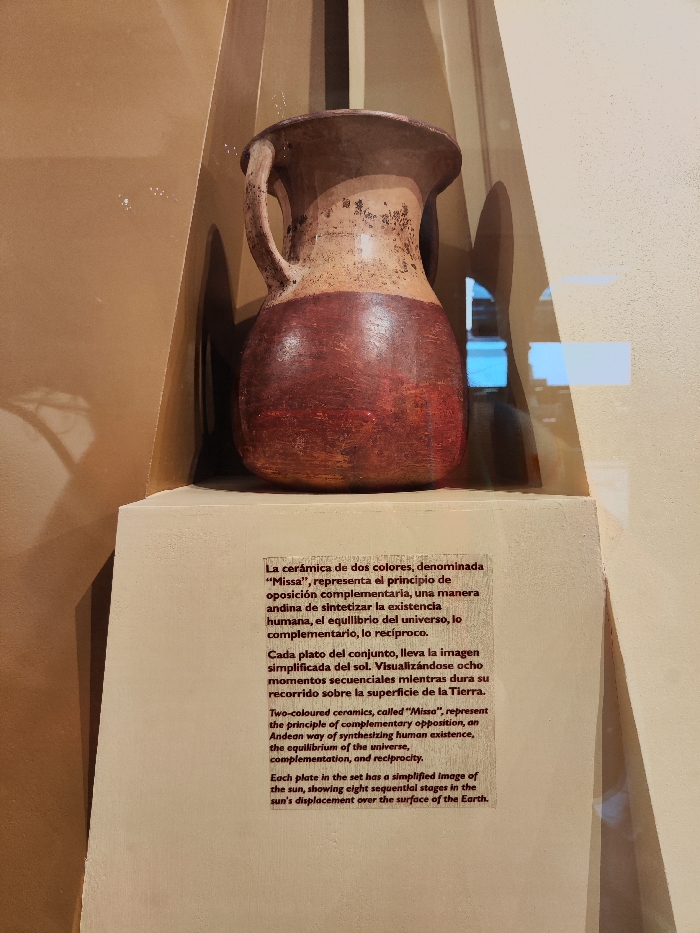
An interior digital photograph, oriented vertically, captures a two-toned ceramic jar displayed within a glass case, likely in a museum or cultural center in Pisac, Peru. The central subject is an earthen jar, approximately 30-40 cm tall, with a flared rim and a single, loop handle on its left side. Its upper two-thirds are light beige to light brown, exhibiting a mottled, weathered texture with visible speckles. The lower third is a distinct, darker reddish-brown, also textured and appearing somewhat aged. The jar rests on a light beige, rectangular pedestal. Below the jar, affixed to the front of the pedestal, is a white informational plaque containing text in both Spanish and English. The English portion describes "Two-coloured ceramics, called 'Missu'," as representing "the principle of complementary opposition, an Andean way of synthesizing human existence, the equilibrium of the universe, complementation, and reciprocity." It further states that "Each plate in the set has a simplified image of the sun, showing eight sequential stages in the sun's displacement over the surface of the Earth," though only a single jar is visible. The ceramic object and its immediate surroundings are encased in a transparent barrier, indicated by reflections of ambient light and distant architectural features. These reflections include indistinct blue and light-colored rectangular shapes, possibly from windows or light sources, and faint, curved shadows of an archway behind the display. The background consists of warm, light-brown, possibly stuccoed walls with subtle architectural angles, suggesting a structured indoor environment. No individuals are present in the frame.
No transactions found