
Stake attention in this memory
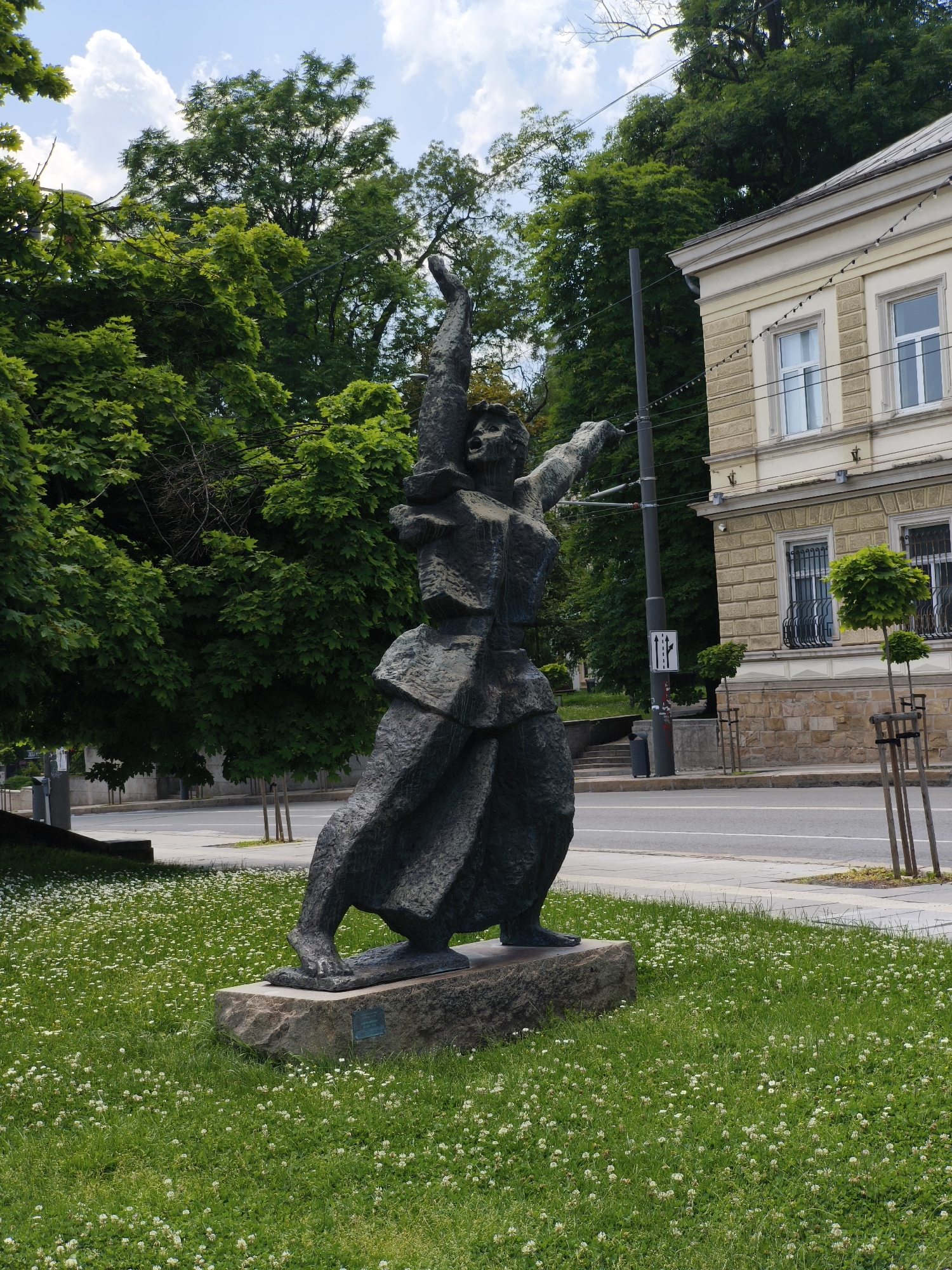
The image displays a detailed view of the "Monument to the Bulgarian Revolutionaries" (also known as "The Call" or "The Uprising") by Georgi Chapkanov, erected in 1976, located in Sofia, Bulgaria, specifically on the green strip along Tsar Osvoboditel Boulevard, near the intersection with Georgi S. Rakovski Street, in proximity to the Doctor's Garden. The primary subject is a dark-patinated bronze or metal sculpture of a human figure, rendered in a dynamic, expressive, and somewhat fragmented style. The figure appears to be stepping forward or ascending, with its left arm raised high, holding an indistinct object, and its mouth open as if in a shout or call. The right arm is extended outwards to the right. The sculpture rests on a rough-hewn stone plinth, on which a small identification plaque is affixed. The sculpture is positioned on a vibrant green lawn densely populated with small white clover flowers. Behind the lawn, a grey concrete sidewalk borders an asphalt road with two visible lanes. To the immediate left of the sculpture, a dense mass of deciduous trees with bright green foliage fills the midground, with branches extending into the upper left of the frame. Above the trees, a bright blue sky with scattered white cumulus clouds is visible. To the right of the sculpture and across the road, a multi-story building with a light-colored facade is present. The building exhibits classical architectural elements, including a defined cornice, rectangular windows with white frames, and decorative black iron grilles on the lower-level windows. The ground floor features a rusticated stone texture, while the upper floor appears to be smooth plaster. Several strings of small, white decorative lights are strung horizontally across the building's facade. In front of the building, a row of slender, newly planted trees with wooden support stakes lines the sidewalk. A tall, dark grey utility pole with multiple overhead wires stands between the sculpture and the building. Attached to this pole is a white rectangular traffic sign depicting three vertical arrows: two pointing straight ahead and one pointing to the left. A grey waste receptacle is partially visible near the base of the utility pole. The scene is illuminated by clear daylight, casting minimal shadows directly observable.
Symbol
5CE55
Volume
10,073
Creator
+$0.02
Revenue
+$0.00
TVL
$2.01
Loading AttnAds…