
Sign in
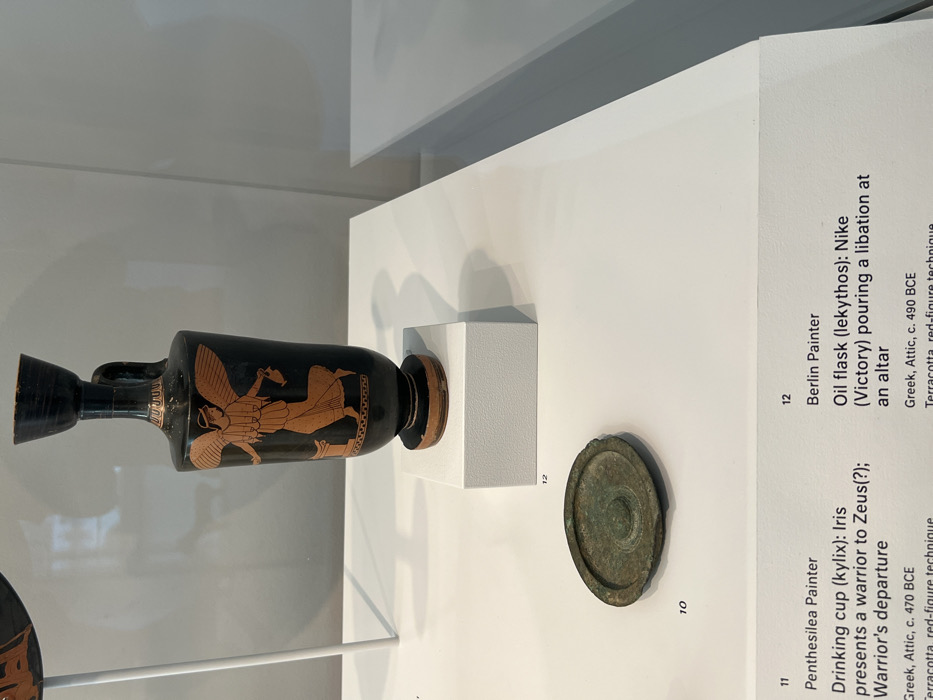
The image displays a museum exhibit at the Harvard Art Museums in Cambridge, Massachusetts. The central focus is an ancient Greek Attic terracotta oil flask (lekythos) dated approximately 490 BCE, attributed to the Berlin Painter. This black-ground vessel, featuring a red-figure technique, depicts a winged figure identified as Nike (Victory) pouring a libation at an altar. The lekythos rests on a small, white rectangular pedestal situated on a larger white display surface. Below and to the left of this pedestal, a circular, patinated bronze object with a central raised boss, possibly a mirror or dish, lies directly on the white surface. At the upper left, the curved rim of another ancient Greek artifact, identified by an adjacent label as a red-figure terracotta drinking cup (kylix) by the Penthesilea Painter (c. 470 BCE), is partially visible. The background consists of plain light gray walls and white display structures, with a thin white vertical support rod visible on the left. Item numbers "10", "11", and "12" are printed on the lower white display surface, identifying the artifacts.
FM-qZdll1

Aug 22, 2025

Cambridge, USA

Stake attention in this memory

Respect
Veneration
Nostalgia
Awe
Serenity

The image displays a museum exhibit at the Harvard Art Museums in Cambridge, Massachusetts. The central focus is an ancient Greek Attic terracotta oil flask (lekythos) dated approximately 490 BCE, attributed to the Berlin Painter. This black-ground vessel, featuring a red-figure technique, depicts a winged figure identified as Nike (Victory) pouring a libation at an altar. The lekythos rests on a small, white rectangular pedestal situated on a larger white display surface. Below and to the left of this pedestal, a circular, patinated bronze object with a central raised boss, possibly a mirror or dish, lies directly on the white surface. At the upper left, the curved rim of another ancient Greek artifact, identified by an adjacent label as a red-figure terracotta drinking cup (kylix) by the Penthesilea Painter (c. 470 BCE), is partially visible. The background consists of plain light gray walls and white display structures, with a thin white vertical support rod visible on the left. Item numbers "10", "11", and "12" are printed on the lower white display surface, identifying the artifacts.

transactions
revenues
stakers
Earliest
Latest
Highest stake

No transactions found

More from this user

More from Cambridge

FM-qZdll1

Aug 22, 2025

Cambridge, USA

Licensed under Creative Commons Attribution 4.0 International License. You are free to share and adapt this content with proper attribution.