Sign in
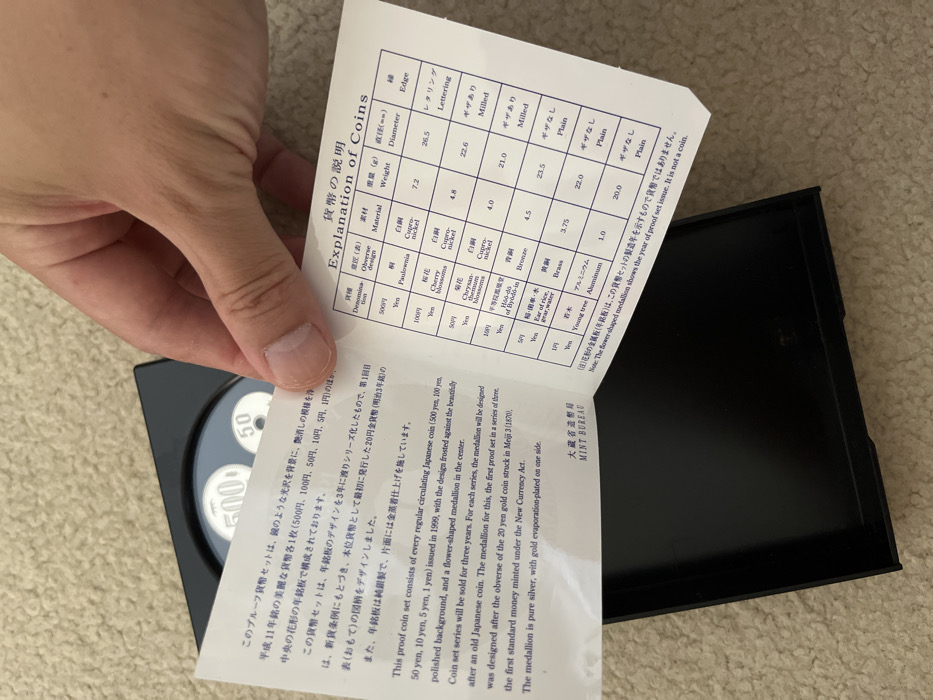
A close-up, overhead shot captures a person's hand holding an open document above a black presentation case containing a Japanese coin set. The scene is indoors, likely on a light-colored surface, and is located in Middle Park, Australia.

The hand, with fair skin and visible fingernails, holds the document at an angle in the upper left of the frame. The document, titled "Explanation of Coins" in both Japanese and English, features a detailed table. This table outlines specifications for various coin denominations, including their obverse design, material, weight (g), diameter (mm), and edge features. For instance, the 500 Yen coin is described as featuring Paulownia, made of Cupro-nickel, weighing 7.2g, with a diameter of 26.5mm, and having a "Lettering" edge. The 100 Yen coin features Cherry blossoms, also Cupro-nickel, weighing 4.8g, with a diameter of 22.6mm, and a "Milled" edge. Other denominations like 50 Yen, 10 Yen, 5 Yen, and 1 Yen are also listed, with corresponding details such as "Chrysan" (Chrysanthemum blossoms), "Hoo-do of Byodo-in," "Ear of rice, gear,water," and "Young tree" for their designs, and materials like Bronze, Brass, and Aluminum. A note at the bottom clarifies that a flower-shaped medallion (年銘板) is shown for the year of proof set issue and is not a coin.

Below the table, text in both Japanese and English describes the proof coin set. It states the set comprises regular circulating Japanese coins (500 yen, 100 yen, 50 yen, 10 yen, 5 yen, 1 yen) issued in 1999, with a frosted design against a polished background. The set also includes a flower-shaped medallion, which for this first proof set in a series of three, was designed after the obverse of the 20 yen gold coin struck in Meiji 3 (1870), the first standard money under the New Currency Act. The medallion is pure silver with gold evaporation-plating on one side. The document also identifies the issuer as "大蔵省造幣局 MINT BUREAU."

Partially visible within the black case are at least two coins, including a 50 Yen coin, recessed into circular compartments. The overall impression is one of a collector's item with accompanying official documentation.
FM-VfnHd2

Jan 25, 2025

Middle Park, Australia

Stake attention in this memory

A close-up, overhead shot captures a person's hand holding an open document above a black presentation case containing a Japanese coin set. The scene is indoors, likely on a light-colored surface, and is located in Middle Park, Australia. The hand, with fair skin and visible fingernails, holds the document at an angle in the upper left of the frame. The document, titled "Explanation of Coins" in both Japanese and English, features a detailed table. This table outlines specifications for various coin denominations, including their obverse design, material, weight (g), diameter (mm), and edge features. For instance, the 500 Yen coin is described as featuring Paulownia, made of Cupro-nickel, weighing 7.2g, with a diameter of 26.5mm, and having a "Lettering" edge. The 100 Yen coin features Cherry blossoms, also Cupro-nickel, weighing 4.8g, with a diameter of 22.6mm, and a "Milled" edge. Other denominations like 50 Yen, 10 Yen, 5 Yen, and 1 Yen are also listed, with corresponding details such as "Chrysan" (Chrysanthemum blossoms), "Hoo-do of Byodo-in," "Ear of rice, gear,water," and "Young tree" for their designs, and materials like Bronze, Brass, and Aluminum. A note at the bottom clarifies that a flower-shaped medallion (年銘板) is shown for the year of proof set issue and is not a coin. Below the table, text in both Japanese and English describes the proof coin set. It states the set comprises regular circulating Japanese coins (500 yen, 100 yen, 50 yen, 10 yen, 5 yen, 1 yen) issued in 1999, with a frosted design against a polished background. The set also includes a flower-shaped medallion, which for this first proof set in a series of three, was designed after the obverse of the 20 yen gold coin struck in Meiji 3 (1870), the first standard money under the New Currency Act. The medallion is pure silver with gold evaporation-plating on one side. The document also identifies the issuer as "大蔵省造幣局 MINT BUREAU." Partially visible within the black case are at least two coins, including a 50 Yen coin, recessed into circular compartments. The overall impression is one of a collector's item with accompanying official documentation.

transactions
revenues
stakers
Earliest
Latest
Highest stake

No transactions found

More from this user

More from Middle Park

FM-VfnHd2

Jan 25, 2025

Middle Park, Australia

Licensed under Creative Commons Attribution 4.0 International License. You are free to share and adapt this content with proper attribution.