
Sign in
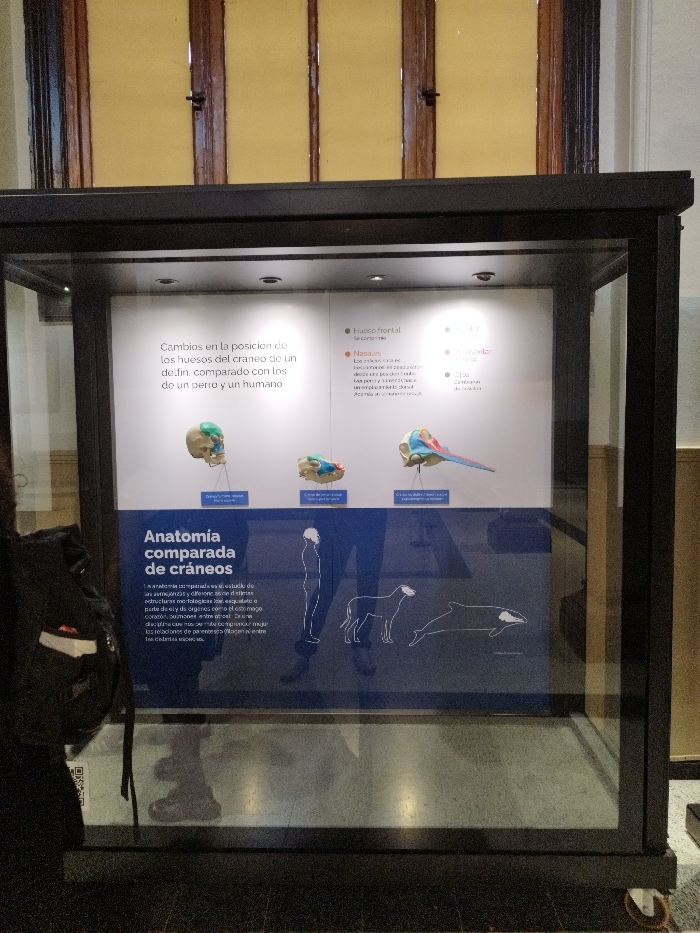
The image captures an educational display case, likely within a museum or similar institution in Santiago, Chile. The exhibit focuses on comparative anatomy, specifically of skulls.

Inside the glass case, the main title on a blue panel reads "Anatomía comparada de cráneos" (Comparative anatomy of skulls). Above this, a white panel features the heading "Cambios en la posicion de los huesos del craneo de un delfin, comparado con los de un perro y un humano" (Changes in the position of the bones of the skull of a dolphin, compared with those of a dog and a human). Below this text, three colored anatomical skull models are displayed: a human skull with green highlights, a dog skull with blue highlights, and a dolphin skull with blue and red highlights. Labels point to features like "Hueso frontal" (Frontal bone) and "Nasales" (Nasals) on the dolphin skull.

The lower blue panel provides a detailed explanation of comparative anatomy, describing it as "el estudio de las semejanzas y diferencias en las estructuras morfológicas" (the study of similarities and differences in morphological structures). The text also mentions organs such as the "estómago" (stomach), "corazón" (heart), and "pulmones" (lungs), and discusses "las relaciones de parentesco filogenético" (phylogenetic kinship relationships) among different species. Below this text, simplified line drawings illustrate the silhouettes of a human, a dog, and a dolphin/whale, providing a visual comparison of their overall forms.

Reflections of a person, identifiable by dark clothing and a backpack, are prominent on the glass of the display case, indicating a viewer. Other indistinct reflections are also visible. The background above the exhibit consists of yellow walls with dark wooden window frames. The overall scene suggests an indoor, educational setting.
Mrv

Jan 7, 2025

Santiago, Chile

Stake attention in this memory

The image captures an educational display case, likely within a museum or similar institution in Santiago, Chile. The exhibit focuses on comparative anatomy, specifically of skulls. Inside the glass case, the main title on a blue panel reads "Anatomía comparada de cráneos" (Comparative anatomy of skulls). Above this, a white panel features the heading "Cambios en la posicion de los huesos del craneo de un delfin, comparado con los de un perro y un humano" (Changes in the position of the bones of the skull of a dolphin, compared with those of a dog and a human). Below this text, three colored anatomical skull models are displayed: a human skull with green highlights, a dog skull with blue highlights, and a dolphin skull with blue and red highlights. Labels point to features like "Hueso frontal" (Frontal bone) and "Nasales" (Nasals) on the dolphin skull. The lower blue panel provides a detailed explanation of comparative anatomy, describing it as "el estudio de las semejanzas y diferencias en las estructuras morfológicas" (the study of similarities and differences in morphological structures). The text also mentions organs such as the "estómago" (stomach), "corazón" (heart), and "pulmones" (lungs), and discusses "las relaciones de parentesco filogenético" (phylogenetic kinship relationships) among different species. Below this text, simplified line drawings illustrate the silhouettes of a human, a dog, and a dolphin/whale, providing a visual comparison of their overall forms. Reflections of a person, identifiable by dark clothing and a backpack, are prominent on the glass of the display case, indicating a viewer. Other indistinct reflections are also visible. The background above the exhibit consists of yellow walls with dark wooden window frames. The overall scene suggests an indoor, educational setting.

transactions
revenues
stakers
Earliest
Latest
Highest stake

No transactions found

More from this user

More from Santiago

Mrv

Jan 7, 2025

Santiago, Chile

Licensed under Creative Commons Attribution 4.0 International License. You are free to share and adapt this content with proper attribution.