
Stake attention in this memory
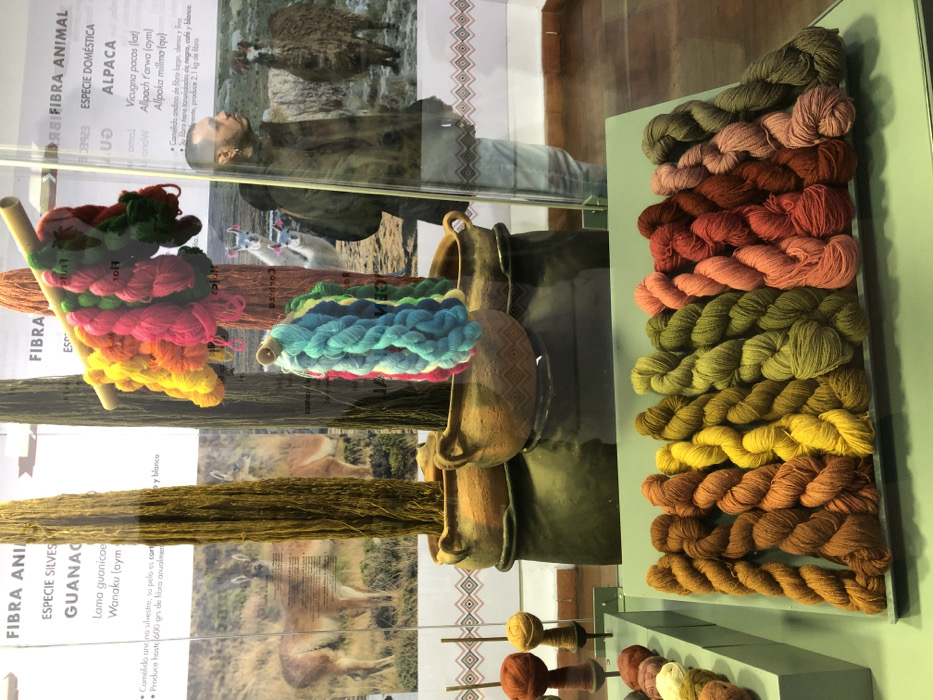
An indoor shot, likely taken in a museum or cultural center in La Paz, Bolivia, displays an exhibit featuring various animal fibers and related information. The image is oriented vertically, showing the contents of a glass display case. The main subjects are numerous skeins and samples of yarn and raw fiber. To the left, vibrant, multi-colored yarn is wrapped around a wooden stick, showcasing a gradient of reds, oranges, yellows, greens, and pinks. Below this, a sample of long, dark green or olive-colored raw fiber hangs vertically. On the right, a prominent display board holds dozens of smaller skeins of yarn arranged in rows, exhibiting a rich palette of earthy tones including various shades of green, brown, red, pink, and yellow. Another small braided sample of blue and green yarn rests on a spool within the case, near two traditional-looking brown pottery vessels. In the lower right, additional small spools of yarn in natural colors are visible. The scene depicts an educational exhibit focused on animal fibers, particularly from Andean camelids. The background behind the glass case features large informational panels with images of animals like llamas, alpacas, and guanacos, along with descriptive text. A man's reflection is visible in the glass, suggesting he is viewing the exhibit. Notable details include the wide array of yarn colors, indicating both natural fiber hues and dyed products. The presence of traditional pottery hints at the cultural context of fiber production in the Andes. Visible text on the display panels, partially obscured by reflections, includes: * "FIBRA ANIMAL" (Animal Fiber) * "ESPECIE SILVESTRE GUANACO" (Wild Species Guanaco) with "Lama guanicoe" (Latin) and "Wanaku (aym)" (Aymara). It mentions the animal is an "Andean wild camelid, its hair is short" and "Produces up to 600 grs of fiber annually." * "ESPECIE DOMÉSTICA ALPACA" (Domestic Species Alpaca) with "Vicugna pacos (lat)" (Latin), "Allpach r'arwa (aym)" (Aymara), and "Allpaka millma (qu)" (Quechua). It describes the alpaca as an "Andean camelid with long, dense, and fine fiber" and notes its fiber has "shades of black, brown, and white," producing "2.1 kg of fiber" annually.
Loading AttnAds…
No transactions found