
Stake attention in this memory
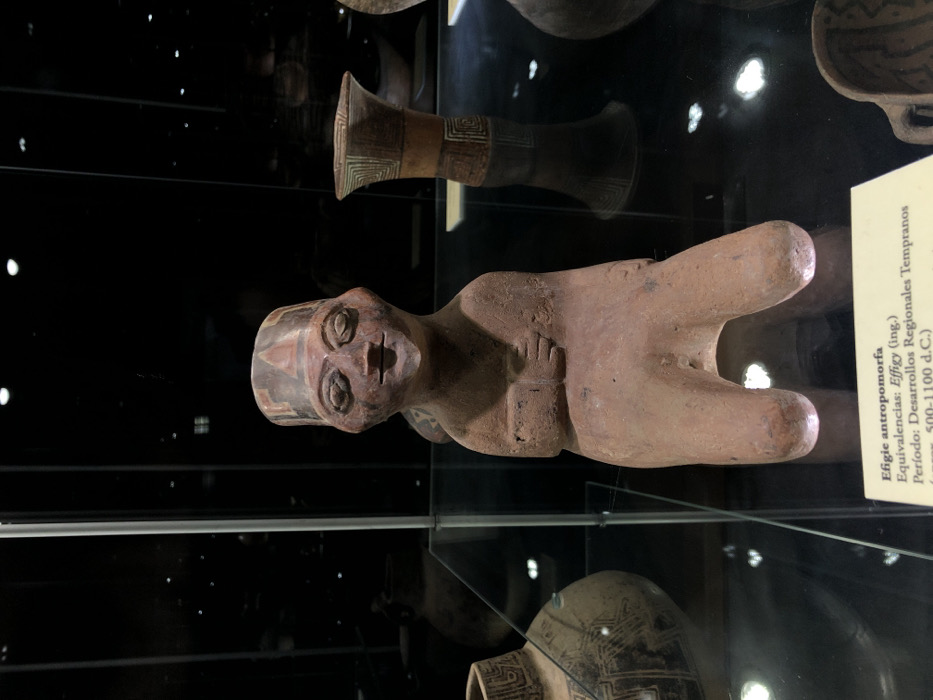
This media file captures an anthropomorphic effigy made of terracotta, displayed within a museum setting in La Paz, Bolivia. The effigy, likely an ancient artifact, is lying horizontally in the image, positioned on a dark, reflective surface within a glass display case. The primary subject is a human-shaped figure with distinct facial features, including large, almond-shaped eyes, a defined nose, and a small mouth. Its head is adorned with what appears to be a painted headdress or cap, featuring geometric patterns in reddish-brown and black tones. The body of the effigy is unadorned, showcasing the natural reddish-brown color and texture of the clay, with one arm subtly bent, resting across its torso. In the background, two other ceramic artifacts are partially visible through the glass. One is a tall, slender vase with a flared top, decorated with geometric designs in lighter colors, visible in the upper part of the frame. Another rounded, patterned ceramic object is partially seen in the lower section. The dark background and reflections suggest a controlled museum environment, possibly with spotlights illuminating the exhibits. A white informational label is visible in the lower right, partially obscured. The legible text includes: - "Efigie antropomorfa" (Anthropomorphic effigy) - "Equivalencias: Effigy (ing.)" (Equivalences: Effigy (eng.)) - "Período: Desarrollos Regionales Tempranos" (Period: Early Regional Developments) - "500-1100 d.C.)" (500-1100 A.D.) The image depicts a static display, highlighting the cultural significance and age of the artifacts from the "Early Regional Developments" period, dating between 500 and 1100 A.D.
Loading AttnAds…
No transactions found