
Sign in
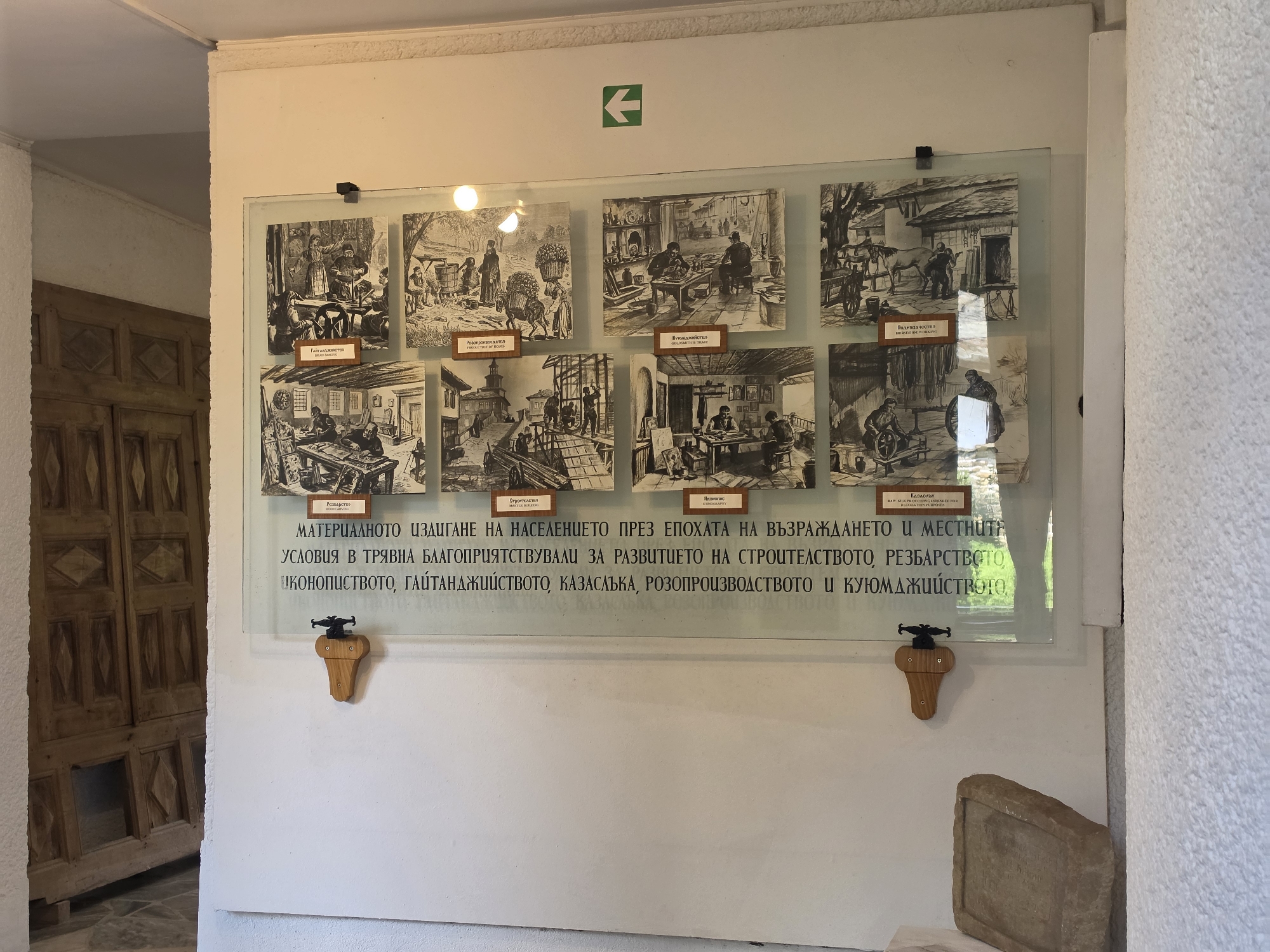
This is a photograph of an indoor exhibit, likely in a museum, dedicated to the historical crafts and economic development of Tryavna, Bulgaria, during the National Revival period. The central element is a large glass panel displaying a grid of nine black and white illustrations, each depicting a different craft or trade. Below the illustrations, a block of text in Bulgarian provides further information.

The illustrations depict various scenes: people engaged in rose production, weaving and textile work (gaitandjiystvo), goldsmithing (kuyumdzhiystvo), horseshoeing (podkovachestvo), woodworking and carving (rezbarstvo), construction (stroytelstvo), and icon painting (ikonopis). Some images show individuals working with tools and materials, while others capture street scenes with people and buildings, hinting at the bustling economic activity of the era.

The text below the images reads: "The material development of the population during the Revival period and the local conditions favored the development of construction, carving, icon painting, gaitandjiystvo, kazaslak, rose production, and kuyumdzhiystvo." The word "Kazaslak" likely refers to a specific type of craft or trade associated with the region.

Two wooden sconces with decorative eagle motifs are mounted on the wall below the glass panel. In the background to the left, a tall, ornate wooden cabinet or wardrobe with intricate carvings and a textured surface is visible. To the right, a rough-hewn stone tablet with visible inscription rests on a surface. The lighting appears to be artificial, with some reflections on the glass panel. The overall setting is clean and well-lit, designed to educate visitors about the historical significance of these trades in Tryavna.

A green directional arrow pointing left is affixed to the wall above the glass panel.
tisho

Jun 25, 2026

Tryavna, Bulgaria

Stake attention in this memory

historical
educational
informative
nostalgic
cultural

This is a photograph of an indoor exhibit, likely in a museum, dedicated to the historical crafts and economic development of Tryavna, Bulgaria, during the National Revival period. The central element is a large glass panel displaying a grid of nine black and white illustrations, each depicting a different craft or trade. Below the illustrations, a block of text in Bulgarian provides further information. The illustrations depict various scenes: people engaged in rose production, weaving and textile work (gaitandjiystvo), goldsmithing (kuyumdzhiystvo), horseshoeing (podkovachestvo), woodworking and carving (rezbarstvo), construction (stroytelstvo), and icon painting (ikonopis). Some images show individuals working with tools and materials, while others capture street scenes with people and buildings, hinting at the bustling economic activity of the era. The text below the images reads: "The material development of the population during the Revival period and the local conditions favored the development of construction, carving, icon painting, gaitandjiystvo, kazaslak, rose production, and kuyumdzhiystvo." The word "Kazaslak" likely refers to a specific type of craft or trade associated with the region. Two wooden sconces with decorative eagle motifs are mounted on the wall below the glass panel. In the background to the left, a tall, ornate wooden cabinet or wardrobe with intricate carvings and a textured surface is visible. To the right, a rough-hewn stone tablet with visible inscription rests on a surface. The lighting appears to be artificial, with some reflections on the glass panel. The overall setting is clean and well-lit, designed to educate visitors about the historical significance of these trades in Tryavna. A green directional arrow pointing left is affixed to the wall above the glass panel.

transactions
revenues
stakers
Earliest
Latest
Highest stake

No transactions found

More from this user

More from Tryavna

tisho

Jun 25, 2026

Tryavna, Bulgaria

Licensed under Creative Commons Attribution 4.0 International License. You are free to share and adapt this content with proper attribution.