
Stake attention in this memory
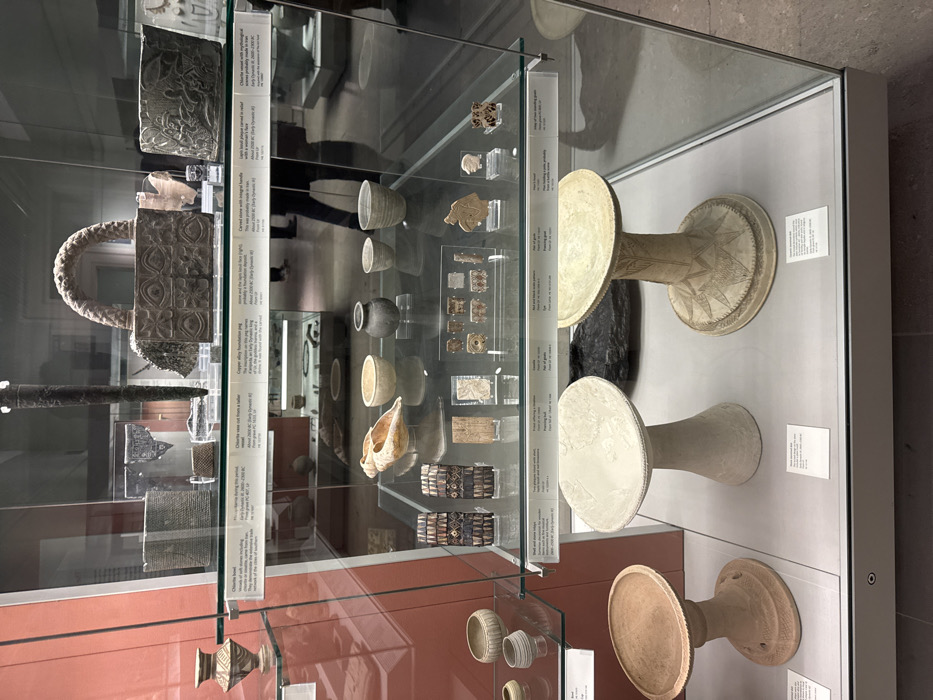
This image captures a display case within a museum, likely located in London, United Kingdom, given the context. The scene is dominated by various ancient artifacts, primarily from the Early Dynastic periods of Mesopotamia and Iran, arranged on multiple shelves behind glass. On the upper shelves, a prominent rectangular stone slab with a large looped handle, possibly a carved stone with an integral handle from Susa, Iran (c. 2700-2600 BC), is visible. Nearby is a dark, intricately patterned rectangular object, potentially a foundation plaque or a similar item, and a long copper alloy foundation peg inscribed with cuneiform, originating from Mesopotamia (c. 2100 BC). Other smaller items include ceramic pots and vessels, a large conch shell, and tiny carved plaques or seals, some described as lapis lazuli with a woman's face (c. 2700 BC). Some labels refer to "Charite" objects and a "network of trade of northern Iran." The lower shelf prominently features three large, light-colored pedestal-like objects, possibly ritual stands or offering tables. One of these exhibits an elaborate star-like pattern carved into its base. Further left on the lower shelf are smaller ceramic vessels, some with subtle painted designs. Informational labels, attached to the glass shelves, provide details about the artifacts, including their origin (Iran, Susa, Mesopotamia, Sumer), approximate dates (around 3000-2100 BC, Early Dynastic II and III periods), and materials. Reflections of the museum environment, including indistinct shapes of people, are visible on the glass, indicating that visitors are present in the exhibition hall. The background consists of a reddish-brown wall. The overall impression is one of a well-curated historical exhibit.
Loading AttnAds…
No transactions found