
Sign in
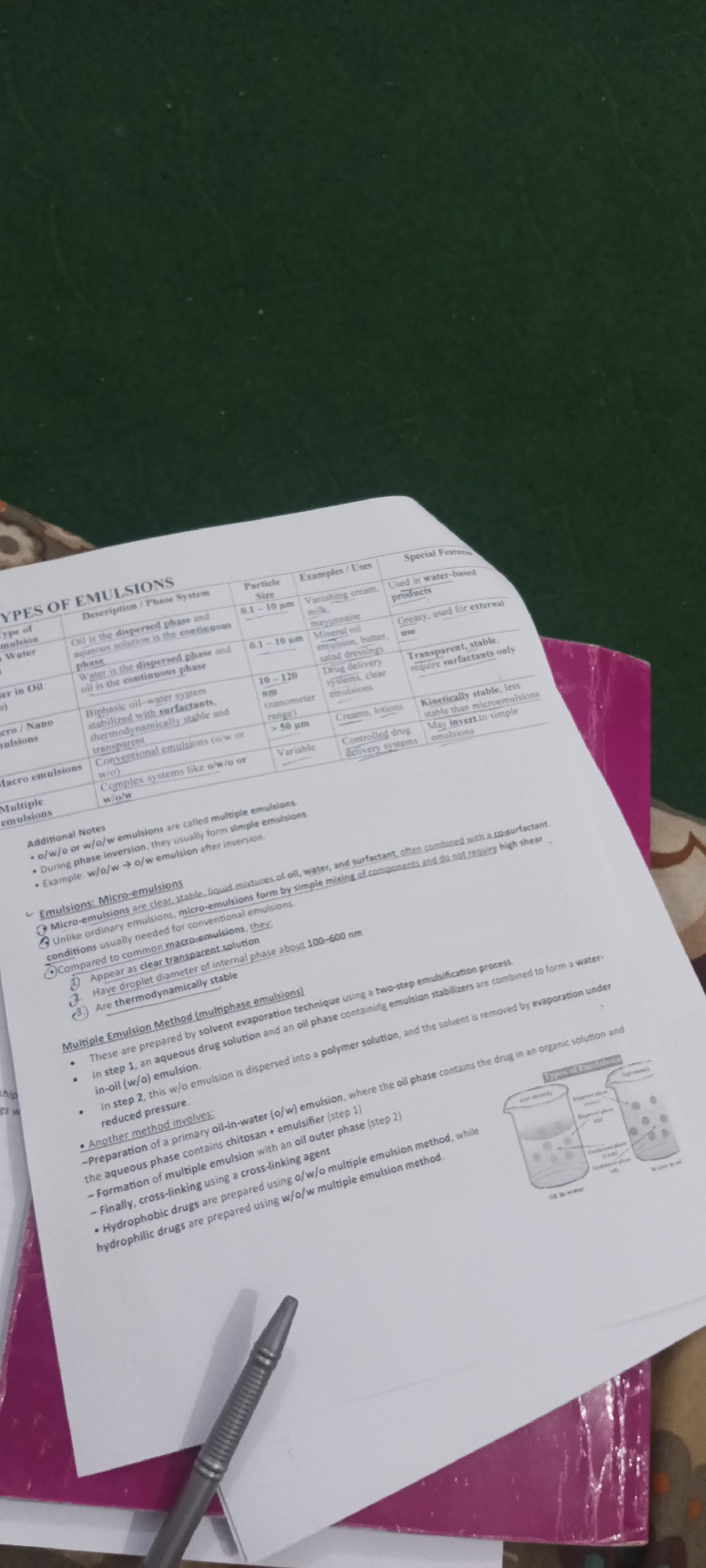
The image displays an overhead, slightly angled view of a white document, likely an academic or scientific printout, resting on a dark green surface. A silver-colored metallic pen with a ridged grip lies diagonally across the bottom right section of the document.

The document is titled "TYPES OF EMULSIONS" and features a table classifying different emulsion types (Oil in Water, Water in Oil, Macro/Nano emulsions, Micro emulsions, Multiple emulsions) based on their description/phase system, particle size, examples/uses, and special features. Visible entries in the table include:
*   **Oil in Water (O/W):** Oil is the dispersed phase, aqueous solution is the continuous phase. Particle size 0.1-10 µm. Examples: vanishing cream, milk, mayonnaise. Used in water-based products.
*   **Water in Oil (W/O):** Water is the dispersed phase, oil is the continuous phase. Particle size 0.1-10 µm. Examples: mineral oil emulsion, butter, salad dressings. Greasy, used for external use.
*   **Micro emulsions:** Biphasic oil-water system, stabilized with surfactants, thermodynamically stable, transparent. Particle size 10-120 nm (nanometer range) or >50 µm. Examples: drug delivery systems, clear emulsions. Special features: Transparent, stable, require surfactants only.
*   **Macro emulsions:** Conventional emulsions (o/w or w/o). Special features: Kinetically stable, less stable than microemulsions, may invert to simple emulsions.
*   **Multiple emulsions:** Complex systems like o/w/o or w/o/w. Variable particle size. Examples: controlled drug delivery systems.

Below the table, sections detailing "Additional Notes," "Emulsions: Micro-emulsions," and "Multiple Emulsion Method (multiphase emulsions)" are visible. The "Micro-emulsions" section describes them as clear, stable, liquid mixtures of oil, water, and surfactant, formed by simple mixing, and notes their appearance as clear transparent solutions, droplet diameter (100-600 nm), and thermodynamic stability compared to macro-emulsions. The "Multiple Emulsion Method" outlines preparation via a two-step solvent evaporation technique and another method involving primary o/w emulsion, multiple emulsion formation with an oil outer phase, and cross-linking.

Two small diagrams depicting "Oil in water" and "Water in oil" emulsions are partially visible at the bottom right of the document, underneath the pen. The document is generally well-lit, suggesting an indoor setting. A reddish-pink object, possibly a binder or book, is partially visible beneath the document at the bottom right. No people are visible in the image. The image itself provides no visual information about its geographic location in Peshawar City Tehsil, Pakistan.
Manoos

Jun 7, 2026

Peshawar City Tehsil, Pakistan

Moment

Stake attention in this memory

informative
academic
scientific
educational
technical

The image displays an overhead, slightly angled view of a white document, likely an academic or scientific printout, resting on a dark green surface. A silver-colored metallic pen with a ridged grip lies diagonally across the bottom right section of the document. The document is titled "TYPES OF EMULSIONS" and features a table classifying different emulsion types (Oil in Water, Water in Oil, Macro/Nano emulsions, Micro emulsions, Multiple emulsions) based on their description/phase system, particle size, examples/uses, and special features. Visible entries in the table include: * **Oil in Water (O/W):** Oil is the dispersed phase, aqueous solution is the continuous phase. Particle size 0.1-10 µm. Examples: vanishing cream, milk, mayonnaise. Used in water-based products. * **Water in Oil (W/O):** Water is the dispersed phase, oil is the continuous phase. Particle size 0.1-10 µm. Examples: mineral oil emulsion, butter, salad dressings. Greasy, used for external use. * **Micro emulsions:** Biphasic oil-water system, stabilized with surfactants, thermodynamically stable, transparent. Particle size 10-120 nm (nanometer range) or >50 µm. Examples: drug delivery systems, clear emulsions. Special features: Transparent, stable, require surfactants only. * **Macro emulsions:** Conventional emulsions (o/w or w/o). Special features: Kinetically stable, less stable than microemulsions, may invert to simple emulsions. * **Multiple emulsions:** Complex systems like o/w/o or w/o/w. Variable particle size. Examples: controlled drug delivery systems. Below the table, sections detailing "Additional Notes," "Emulsions: Micro-emulsions," and "Multiple Emulsion Method (multiphase emulsions)" are visible. The "Micro-emulsions" section describes them as clear, stable, liquid mixtures of oil, water, and surfactant, formed by simple mixing, and notes their appearance as clear transparent solutions, droplet diameter (100-600 nm), and thermodynamic stability compared to macro-emulsions. The "Multiple Emulsion Method" outlines preparation via a two-step solvent evaporation technique and another method involving primary o/w emulsion, multiple emulsion formation with an oil outer phase, and cross-linking. Two small diagrams depicting "Oil in water" and "Water in oil" emulsions are partially visible at the bottom right of the document, underneath the pen. The document is generally well-lit, suggesting an indoor setting. A reddish-pink object, possibly a binder or book, is partially visible beneath the document at the bottom right. No people are visible in the image. The image itself provides no visual information about its geographic location in Peshawar City Tehsil, Pakistan.

Symbol

616BD

Volume

11,550

Creator

+$0.14

Revenue

+$0.00

TVL

$13.92

1D
1W
1M
All
transactions
revenues
stakers
Earliest
Latest
Highest stake

1

spring

Staked 22d ago

$14.06 USD

-$0.14 USD

-1%

More from this user

More from Peshawar City Tehsil

Manoos

Jun 7, 2026

Peshawar City Tehsil, Pakistan

Licensed under Creative Commons Attribution 4.0 International License. You are free to share and adapt this content with proper attribution.