
Sign in
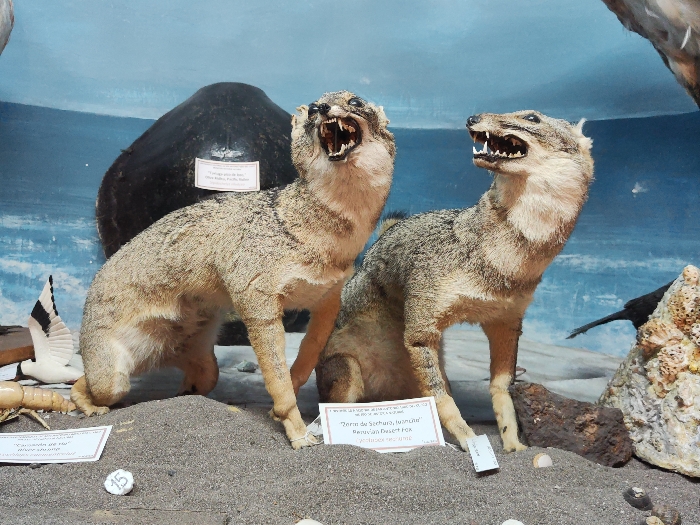
This media file captures an indoor museum diorama featuring taxidermied animals, likely depicting a desert ecosystem. The scene is dominated by two taxidermied desert foxes, positioned on a sandy-textured ground against a painted blue background simulating a distant landscape.

The two foxes are light brown to sandy-grey in color, with pointed ears and slender bodies. Both are posed with their mouths open, teeth bared, conveying an impression of snarling, barking, or active vocalization. The fox on the left is standing on all fours, while the one on the right appears to be in a slightly lower, more crouched stance.

Around the foxes, several other subjects are visible. To the far left, a white bird-like figure with black-striped wings is partially seen, alongside a light-colored, segmented object resembling a crustacean or fossilized shrimp. A large, dark, rounded object, possibly another display element or a rock formation, occupies the background behind the left fox. To the right, various smaller rocks and shells are scattered on the sandy ground.

Several identification cards are placed within the display. One prominently identifies the main subjects as "Zorro de Sechura, tuco tuco" or "Peruvian Desert Fox," with the scientific name "Lycalopex sechurae." Another card near the crustacean identifies it as "Crustaceo de rio" or "River shrimp," with the scientific name "Atya scabra." A blurry card on the large dark object in the background identifies it as an "Ostrich egg" or "Huevo de Avestruz." A small circular tag with the number "15" is also visible on the ground.

The overall impression is a natural history exhibit in Cuzco, Peru, showcasing regional fauna in a simulated desert habitat.
Milu 🌸

Nov 19, 2025

Cuzco, Peru

Stake attention in this memory

taxidermied animals
foxes
display
museum exhibit
wildlife

This media file captures an indoor museum diorama featuring taxidermied animals, likely depicting a desert ecosystem. The scene is dominated by two taxidermied desert foxes, positioned on a sandy-textured ground against a painted blue background simulating a distant landscape. The two foxes are light brown to sandy-grey in color, with pointed ears and slender bodies. Both are posed with their mouths open, teeth bared, conveying an impression of snarling, barking, or active vocalization. The fox on the left is standing on all fours, while the one on the right appears to be in a slightly lower, more crouched stance. Around the foxes, several other subjects are visible. To the far left, a white bird-like figure with black-striped wings is partially seen, alongside a light-colored, segmented object resembling a crustacean or fossilized shrimp. A large, dark, rounded object, possibly another display element or a rock formation, occupies the background behind the left fox. To the right, various smaller rocks and shells are scattered on the sandy ground. Several identification cards are placed within the display. One prominently identifies the main subjects as "Zorro de Sechura, tuco tuco" or "Peruvian Desert Fox," with the scientific name "Lycalopex sechurae." Another card near the crustacean identifies it as "Crustaceo de rio" or "River shrimp," with the scientific name "Atya scabra." A blurry card on the large dark object in the background identifies it as an "Ostrich egg" or "Huevo de Avestruz." A small circular tag with the number "15" is also visible on the ground. The overall impression is a natural history exhibit in Cuzco, Peru, showcasing regional fauna in a simulated desert habitat.

transactions
revenues
stakers
Earliest
Latest
Highest stake

No transactions found

More from this user

More from Cuzco

Milu 🌸

Nov 19, 2025

Cuzco, Peru

Licensed under Creative Commons Attribution 4.0 International License. You are free to share and adapt this content with proper attribution.