
Sign in
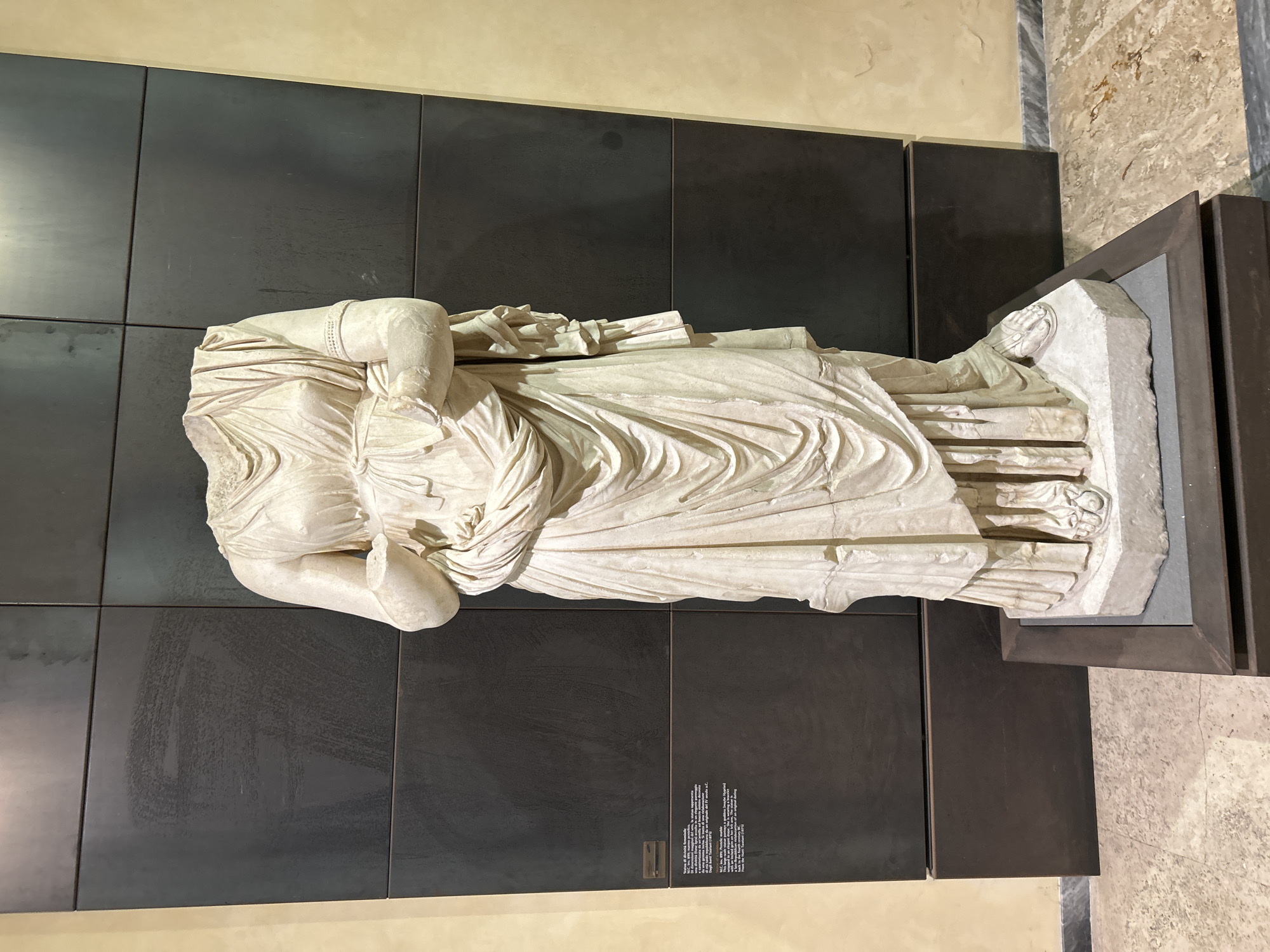
The image displays a full-body, headless marble statue of a draped female figure situated in a museum gallery. The statue, identified by an accompanying plaque as a Roman copy of a 4th century B.C. female divinity, is composed of Proconnesian marble (M.C. inv. 995) and stands approximately life-size. It depicts a figure clad in a long chiton and himation, characterized by intricate, flowing drapery. The statue is missing its head, and portions of both forearms are absent, with the remaining parts of the arms holding the fabric close to the body. The feet, clad in sandals, are visible beneath the extensive drapery.

The statue rests on a light-colored, octagonal plinth, which is mounted on a dark, rectangular display base. The immediate background consists of dark, matte, rectangular panels arranged in a grid pattern. To the left of the statue, on these dark panels, an informative plaque written in both Italian and English provides details about the artifact, including its origin from the Fanti-Ruspoli excavations in 1871. The walls flanking and above the dark panels are a uniform light beige or pale yellow. The floor is covered in mottled, light-toned stone or marble tiles with visible grout lines. The scene is illuminated by overhead lighting, casting subtle reflections on the dark wall panels.

The location is identified by the plaque as the Museo Nazionale Romano, specifically Palazzo Massimo alle Terme, in Rome, Italy.
TheHelleR

Mar 27, 2026, 2:56 PM

Rome, Italy

Stake attention in this memory

Awe
Melancholy
Respect
Serenity
Intrigue

The image displays a full-body, headless marble statue of a draped female figure situated in a museum gallery. The statue, identified by an accompanying plaque as a Roman copy of a 4th century B.C. female divinity, is composed of Proconnesian marble (M.C. inv. 995) and stands approximately life-size. It depicts a figure clad in a long chiton and himation, characterized by intricate, flowing drapery. The statue is missing its head, and portions of both forearms are absent, with the remaining parts of the arms holding the fabric close to the body. The feet, clad in sandals, are visible beneath the extensive drapery. The statue rests on a light-colored, octagonal plinth, which is mounted on a dark, rectangular display base. The immediate background consists of dark, matte, rectangular panels arranged in a grid pattern. To the left of the statue, on these dark panels, an informative plaque written in both Italian and English provides details about the artifact, including its origin from the Fanti-Ruspoli excavations in 1871. The walls flanking and above the dark panels are a uniform light beige or pale yellow. The floor is covered in mottled, light-toned stone or marble tiles with visible grout lines. The scene is illuminated by overhead lighting, casting subtle reflections on the dark wall panels. The location is identified by the plaque as the Museo Nazionale Romano, specifically Palazzo Massimo alle Terme, in Rome, Italy.

Loading AttnAds…

transactions
revenues
stakers
Earliest
Latest
Highest stake

No transactions found

More from this user

More from Rome

TheHelleR

Mar 27, 2026, 2:56 PM

Rome, Italy

Licensed under Creative Commons Attribution 4.0 International License. You are free to share and adapt this content with proper attribution.