
Sign in
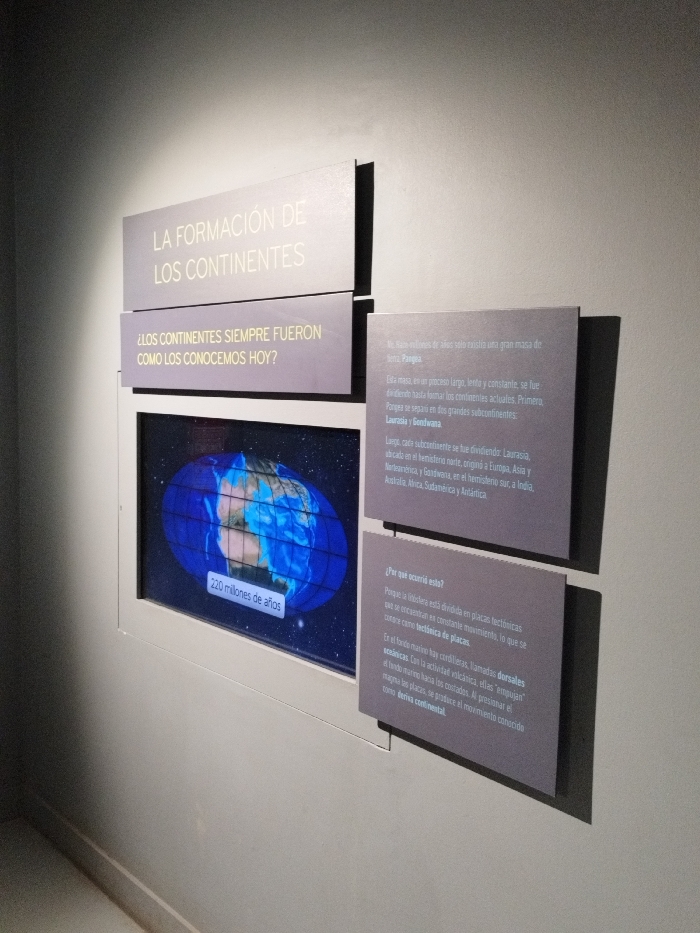
An informational display in an exhibition or museum, likely in Santiago, Chile, illustrates the formation of the continents and the theory of plate tectonics. The exhibit features several grey panels with text in Spanish and a recessed screen displaying a map of ancient landmasses, specifically Pangea, with the text "220 millones de años" (220 million years).

The main title panel at the top reads: "LA FORMACIÓN DE LOS CONTINENTES" (The Formation of the Continents). Below it, a question panel asks: "¿LOS CONTINENTES SIEMPRE FUERON COMO LOS CONOCEMOS HOY?" (Were the continents always as we know them today?).

To the right, a large text panel explains that millions of years ago, only one great landmass called Pangea existed. It details how Pangea slowly divided into two major subcontinents, Laurasia and Gondwana, which then further split to form the current continents like Europe, Asia, North America (from Laurasia) and India, Australia, Africa, South America, and Antarctica (from Gondwana).

Below this, another panel addresses "Why did this happen?" It explains that the lithosphere is divided into constantly moving tectonic plates, a process known as plate tectonics. The text describes how oceanic ridges in the seabed, through volcanic activity, "push" the seafloor outwards. This pressure from magma causes the plates to move, a phenomenon known as continental drift. The overall setting is simple, with light grey walls focusing attention on the informative panels.
Mrv

Jan 7, 2025

Santiago, Chile

Stake attention in this memory

An informational display in an exhibition or museum, likely in Santiago, Chile, illustrates the formation of the continents and the theory of plate tectonics. The exhibit features several grey panels with text in Spanish and a recessed screen displaying a map of ancient landmasses, specifically Pangea, with the text "220 millones de años" (220 million years). The main title panel at the top reads: "LA FORMACIÓN DE LOS CONTINENTES" (The Formation of the Continents). Below it, a question panel asks: "¿LOS CONTINENTES SIEMPRE FUERON COMO LOS CONOCEMOS HOY?" (Were the continents always as we know them today?). To the right, a large text panel explains that millions of years ago, only one great landmass called Pangea existed. It details how Pangea slowly divided into two major subcontinents, Laurasia and Gondwana, which then further split to form the current continents like Europe, Asia, North America (from Laurasia) and India, Australia, Africa, South America, and Antarctica (from Gondwana). Below this, another panel addresses "Why did this happen?" It explains that the lithosphere is divided into constantly moving tectonic plates, a process known as plate tectonics. The text describes how oceanic ridges in the seabed, through volcanic activity, "push" the seafloor outwards. This pressure from magma causes the plates to move, a phenomenon known as continental drift. The overall setting is simple, with light grey walls focusing attention on the informative panels.

transactions
revenues
stakers
Earliest
Latest
Highest stake

No transactions found

More from this user

More from Santiago

Mrv

Jan 7, 2025

Santiago, Chile

Licensed under Creative Commons Attribution 4.0 International License. You are free to share and adapt this content with proper attribution.