
Sign in
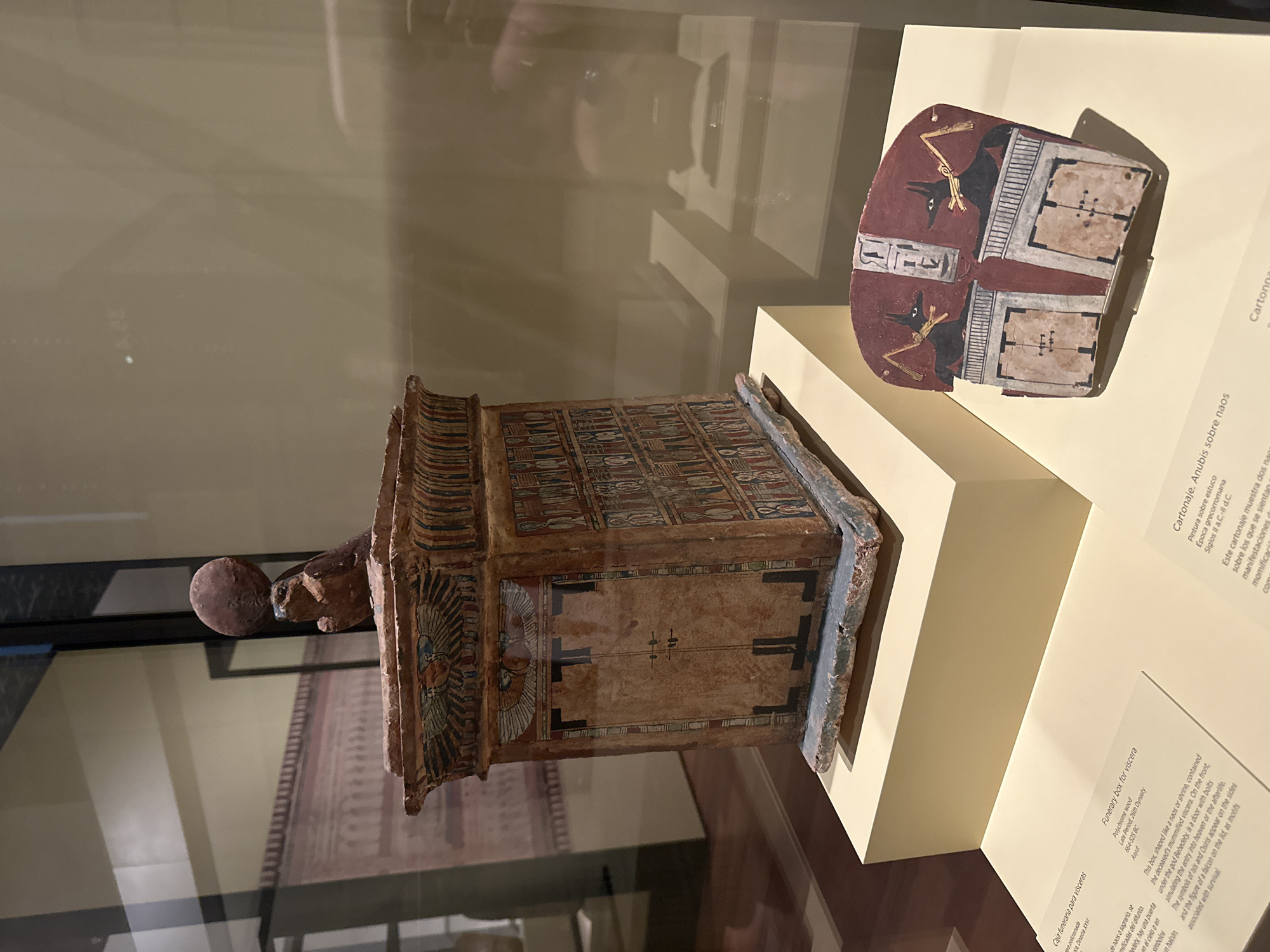
This is a photograph of an ancient Egyptian artifact, likely a funerary box, displayed in a museum setting. The box, made of polychrome wood, is rectangular with decorative elements painted on its sides and lid. The sides are adorned with colorful hieroglyphs and figures, including what appears to be a winged deity with a falcon head on the front. The lid is decorated with registers of human figures and possibly deities, all rendered in a somewhat faded, aged palette of reds, blues, and yellows.

In the background, to the right of the box, is another smaller artifact, possibly a lid or a shield, also decorated with figures and hieroglyphs, including depictions of jackal-headed figures, likely representing Anubis. This object is presented on a pale yellow display stand. The museum setting is indicated by the glass enclosure the artifact is behind, with reflections visible on the glass. The text accompanying the artifact, partially visible and identified as "Caja funeraria para visceras" and "Funerary box for viscera," confirms its purpose and origin. The text also provides a date range of "Late Period, 26th Dynasty, 664-525 BC" and a location of "Asyut." The overall lighting is warm and artificial, typical of museum exhibition lighting. The photograph is oriented vertically.
Tati

Jun 30, 2026

Madrid, Spain

Stake attention in this memory

solemn
mysterious
reverent
ancient
melancholic

This is a photograph of an ancient Egyptian artifact, likely a funerary box, displayed in a museum setting. The box, made of polychrome wood, is rectangular with decorative elements painted on its sides and lid. The sides are adorned with colorful hieroglyphs and figures, including what appears to be a winged deity with a falcon head on the front. The lid is decorated with registers of human figures and possibly deities, all rendered in a somewhat faded, aged palette of reds, blues, and yellows. In the background, to the right of the box, is another smaller artifact, possibly a lid or a shield, also decorated with figures and hieroglyphs, including depictions of jackal-headed figures, likely representing Anubis. This object is presented on a pale yellow display stand. The museum setting is indicated by the glass enclosure the artifact is behind, with reflections visible on the glass. The text accompanying the artifact, partially visible and identified as "Caja funeraria para visceras" and "Funerary box for viscera," confirms its purpose and origin. The text also provides a date range of "Late Period, 26th Dynasty, 664-525 BC" and a location of "Asyut." The overall lighting is warm and artificial, typical of museum exhibition lighting. The photograph is oriented vertically.

transactions
revenues
stakers
Earliest
Latest
Highest stake

No transactions found

More from this user

More from Madrid

Tati

Jun 30, 2026

Madrid, Spain

Licensed under Creative Commons Attribution 4.0 International License. You are free to share and adapt this content with proper attribution.