
Sign in
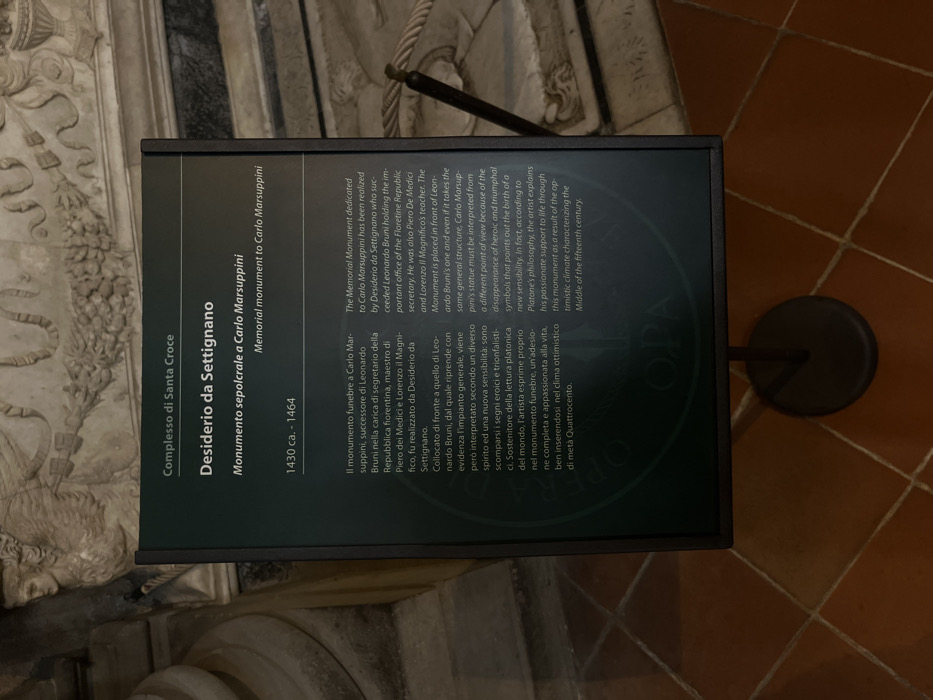
An indoor scene features a dark, rectangular informational plaque prominently displayed in the foreground, supported by a black stand with a round, weighted base. The plaque presents text in both Italian and English, describing the "Monumento sepolcrale a Carlo Marsuppini" (Memorial monument to Carlo Marsuppini) created by Desiderio da Settignano, dating approximately from 1430 to 1464.

The Italian text explains that Carlo Marsuppini was Leonardo Bruni's successor as secretary of the Florentine Republic and a teacher to Piero de Medici and Lorenzo il Magnifico. The monument, located opposite Bruni's, shares its general structure but expresses a "new sensibility," lacking heroic and triumphal symbols. It reflects a passionate adherence to life, rooted in Platonic philosophy, and epitomizes the optimistic climate of the mid-15th century. The English translation conveys the same information. The title also specifies the location as "Complesso di Santa Croce."

In the background, out of focus, intricate carved stone architectural elements are visible, suggesting a monumental tomb or a section of a church wall. The floor is covered with reddish-brown terracotta tiles. The lighting indicates an interior space, likely a historical building or museum within the Complesso di Santa Croce in Florence, Italy.
FM-oNt2k1

Feb 9, 2025

Firenze, Italy

Stake attention in this memory

An indoor scene features a dark, rectangular informational plaque prominently displayed in the foreground, supported by a black stand with a round, weighted base. The plaque presents text in both Italian and English, describing the "Monumento sepolcrale a Carlo Marsuppini" (Memorial monument to Carlo Marsuppini) created by Desiderio da Settignano, dating approximately from 1430 to 1464. The Italian text explains that Carlo Marsuppini was Leonardo Bruni's successor as secretary of the Florentine Republic and a teacher to Piero de Medici and Lorenzo il Magnifico. The monument, located opposite Bruni's, shares its general structure but expresses a "new sensibility," lacking heroic and triumphal symbols. It reflects a passionate adherence to life, rooted in Platonic philosophy, and epitomizes the optimistic climate of the mid-15th century. The English translation conveys the same information. The title also specifies the location as "Complesso di Santa Croce." In the background, out of focus, intricate carved stone architectural elements are visible, suggesting a monumental tomb or a section of a church wall. The floor is covered with reddish-brown terracotta tiles. The lighting indicates an interior space, likely a historical building or museum within the Complesso di Santa Croce in Florence, Italy.

transactions
revenues
stakers
Earliest
Latest
Highest stake

No transactions found

More from this user

More from Firenze

FM-oNt2k1

Feb 9, 2025

Firenze, Italy

Licensed under Creative Commons Attribution 4.0 International License. You are free to share and adapt this content with proper attribution.