
Sign in
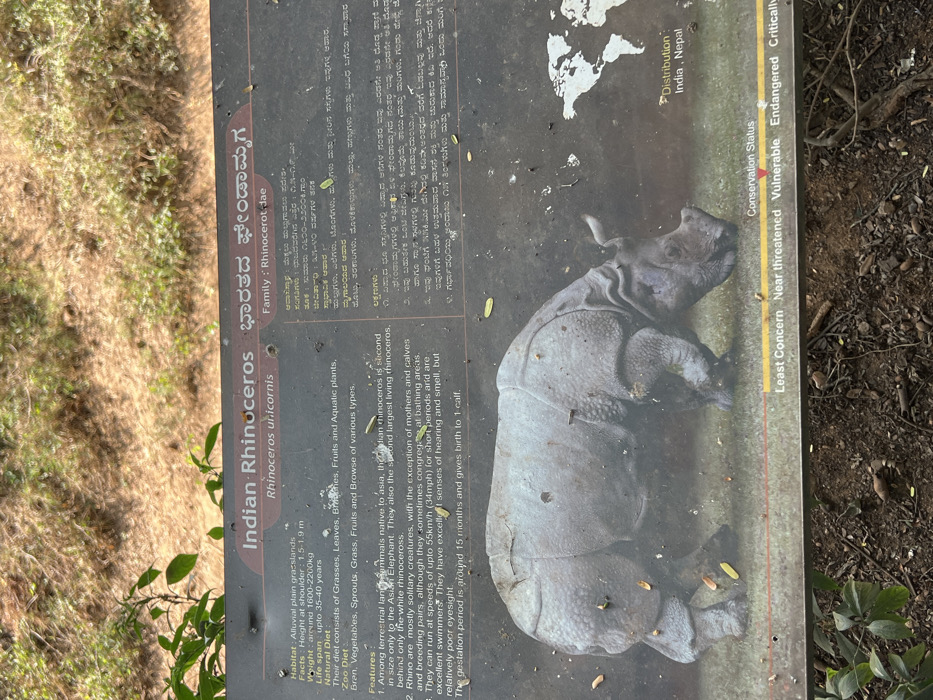
The image displays an informational sign about the Indian Rhinoceros (Rhinoceros unicornis), likely situated in an outdoor educational exhibit such as a zoo or wildlife park in Mysuru, India. The sign, which appears somewhat worn and is speckled with small plant debris, is captured with a vertical orientation.

The right side of the sign features a large, realistic depiction of an Indian Rhinoceros lying down. The left side is dedicated to text, provided in both English and Kannada, outlining various facts about the animal. The title reads "Indian Rhinoceros" and "Rhinoceros unicornis."

Key details extracted from the text include:
- **Habitat:** Alluvial plain grasslands.
- **Facts:** Height at shoulder 1.5-1.9 m, weight 1600-2200 kg, life span up to 35-40 years.
- **Diet:** Natural diet consists of grasses, leaves, branches, fruits, and aquatic plants. A "Zoo Diet" of bran, vegetables, sprouts, grass, fruits, and browse is also listed.
- **Features:** The Indian Rhinoceros is noted as the second-largest terrestrial mammal in Asia (after the Asian Elephant) and the second-largest living rhinoceros (after the white rhinoceros). They are mostly solitary, can run up to 55 km/h, are excellent swimmers, possess good hearing and smell but poor eyesight. The gestation period is around 15 months, resulting in one calf.
- **Distribution:** India and Nepal.
- **Conservation Status:** The sign clearly indicates a "Vulnerable" conservation status, highlighted on a scale that ranges from "Least Concern" to "Critically Endangered."

The background to the left of the sign shows dry, sparse grass and foliage, while the ground to the right of the sign appears to be dark soil with scattered organic matter. The lighting suggests it is daytime.
FM-7y8Ft1

Jan 12, 2025

Mysuru, India

Stake attention in this memory

The image displays an informational sign about the Indian Rhinoceros (Rhinoceros unicornis), likely situated in an outdoor educational exhibit such as a zoo or wildlife park in Mysuru, India. The sign, which appears somewhat worn and is speckled with small plant debris, is captured with a vertical orientation. The right side of the sign features a large, realistic depiction of an Indian Rhinoceros lying down. The left side is dedicated to text, provided in both English and Kannada, outlining various facts about the animal. The title reads "Indian Rhinoceros" and "Rhinoceros unicornis." Key details extracted from the text include: - **Habitat:** Alluvial plain grasslands. - **Facts:** Height at shoulder 1.5-1.9 m, weight 1600-2200 kg, life span up to 35-40 years. - **Diet:** Natural diet consists of grasses, leaves, branches, fruits, and aquatic plants. A "Zoo Diet" of bran, vegetables, sprouts, grass, fruits, and browse is also listed. - **Features:** The Indian Rhinoceros is noted as the second-largest terrestrial mammal in Asia (after the Asian Elephant) and the second-largest living rhinoceros (after the white rhinoceros). They are mostly solitary, can run up to 55 km/h, are excellent swimmers, possess good hearing and smell but poor eyesight. The gestation period is around 15 months, resulting in one calf. - **Distribution:** India and Nepal. - **Conservation Status:** The sign clearly indicates a "Vulnerable" conservation status, highlighted on a scale that ranges from "Least Concern" to "Critically Endangered." The background to the left of the sign shows dry, sparse grass and foliage, while the ground to the right of the sign appears to be dark soil with scattered organic matter. The lighting suggests it is daytime.

transactions
revenues
stakers
Earliest
Latest
Highest stake

No transactions found

More from this user

More from Mysuru

FM-7y8Ft1

Jan 12, 2025

Mysuru, India

Licensed under Creative Commons Attribution 4.0 International License. You are free to share and adapt this content with proper attribution.