
Sign in
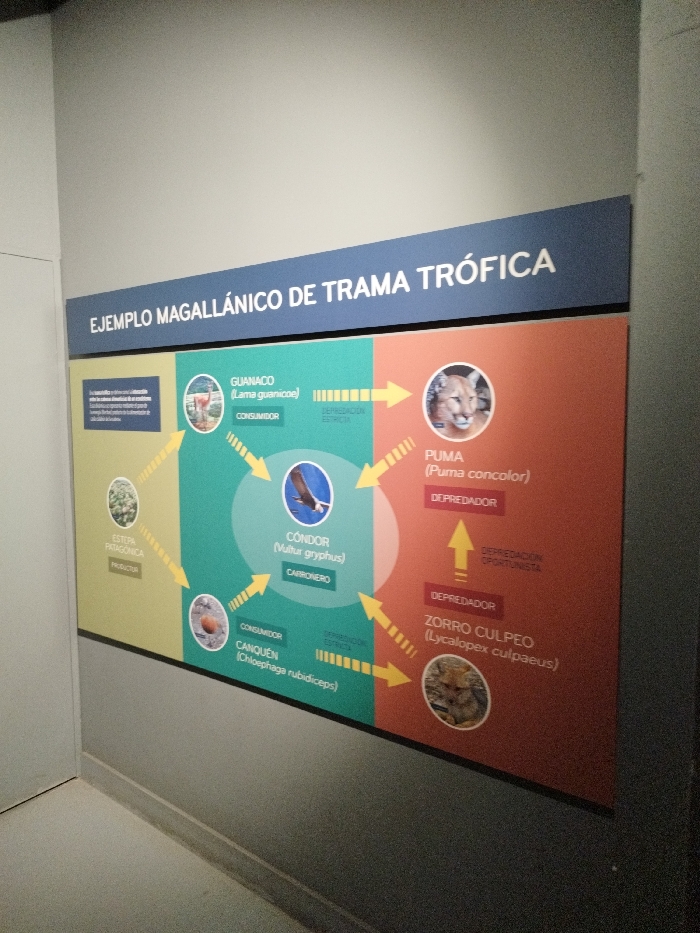
The image captures an educational exhibit board showcasing a "Magellanic Example of Food Web" (EJEMPLO MAGALLÁNICO DE TRAMA TRÓFICA) inside what appears to be a museum or exhibition space. The large, colorful board is mounted on a plain light gray wall, with a light-colored floor visible to the left.

The central feature is a diagram illustrating the trophic levels and feeding relationships among species indigenous to the Patagonian region. The diagram is divided into yellow, green, and orange sections, with arrows indicating the flow of energy. Organisms depicted, each with a small circular image, scientific name, and ecological role, include:
- **Producer:** Patagonian Steppe (ESTEPA PATAGONICA).
- **Consumers:** Guanaco (Lama guanicoe) and Upland Goose (Canquén, Chloephaga rubidiceps), both herbivores.
- **Predators:** Puma (Puma concolor) and Culpeo Fox (Zorro Culpeo, Lycalopex culpaeus).
- **Scavenger:** Andean Condor (Cóndor, Vultur gryphus).

Arrows on the board signify interactions like "DEPREDACIÓN DIRECTA" (Direct Predation), "DEPREDACIÓN ESPECÍFICA" (Specific Predation), and "DEPREDACIÓN OPORTUNISTA" (Opportunistic Predation). For instance, the Puma preys on the Guanaco, and the Culpeo Fox preys on the Upland Goose. The Condor is shown scavenging on the remains of multiple animals, while the Puma also exhibits opportunistic predation on the Culpeo Fox. A small, unreadable text block on the far left likely provides additional context. The indoor setting is illuminated by artificial light, and no people are present in the frame.
Mrv

Jan 7, 2025

Santiago, Chile

Stake attention in this memory

The image captures an educational exhibit board showcasing a "Magellanic Example of Food Web" (EJEMPLO MAGALLÁNICO DE TRAMA TRÓFICA) inside what appears to be a museum or exhibition space. The large, colorful board is mounted on a plain light gray wall, with a light-colored floor visible to the left. The central feature is a diagram illustrating the trophic levels and feeding relationships among species indigenous to the Patagonian region. The diagram is divided into yellow, green, and orange sections, with arrows indicating the flow of energy. Organisms depicted, each with a small circular image, scientific name, and ecological role, include: - **Producer:** Patagonian Steppe (ESTEPA PATAGONICA). - **Consumers:** Guanaco (Lama guanicoe) and Upland Goose (Canquén, Chloephaga rubidiceps), both herbivores. - **Predators:** Puma (Puma concolor) and Culpeo Fox (Zorro Culpeo, Lycalopex culpaeus). - **Scavenger:** Andean Condor (Cóndor, Vultur gryphus). Arrows on the board signify interactions like "DEPREDACIÓN DIRECTA" (Direct Predation), "DEPREDACIÓN ESPECÍFICA" (Specific Predation), and "DEPREDACIÓN OPORTUNISTA" (Opportunistic Predation). For instance, the Puma preys on the Guanaco, and the Culpeo Fox preys on the Upland Goose. The Condor is shown scavenging on the remains of multiple animals, while the Puma also exhibits opportunistic predation on the Culpeo Fox. A small, unreadable text block on the far left likely provides additional context. The indoor setting is illuminated by artificial light, and no people are present in the frame.

transactions
revenues
stakers
Earliest
Latest
Highest stake

No transactions found

More from this user

More from Santiago

Mrv

Jan 7, 2025

Santiago, Chile

Licensed under Creative Commons Attribution 4.0 International License. You are free to share and adapt this content with proper attribution.