
Stake attention in this memory
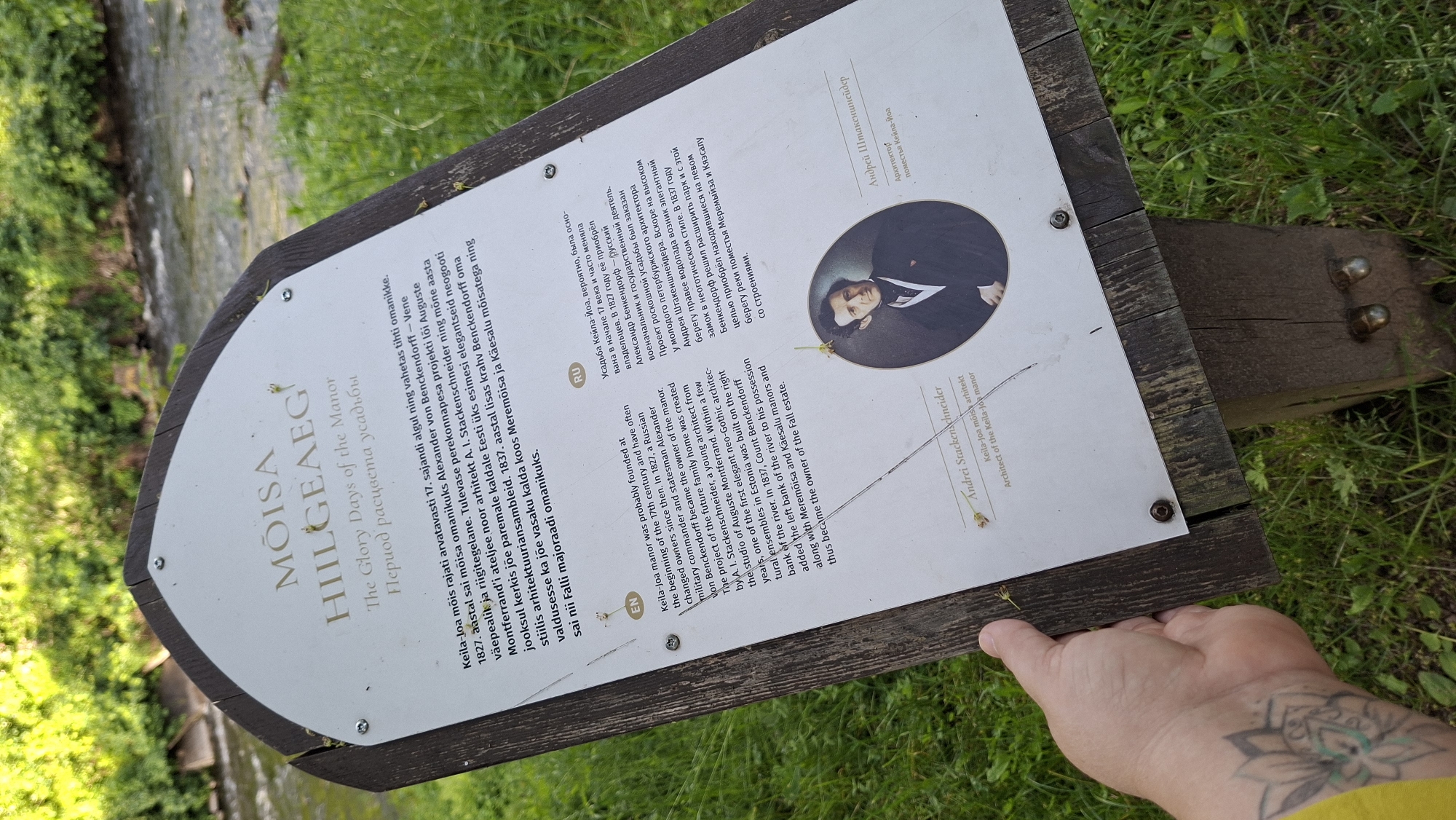
The image shows a wooden sign with white text and images, located outdoors in a grassy area with a stream in the background. The sign is positioned at an angle, with a person's hand and arm visible on the left side, partially obscuring the sign. The sign has text in multiple languages, including Estonian, English, and Russian. The Estonian text at the top reads "MÕISA HIILGEAEG" which translates to "Manor's Glorious Age". Below this, in English, it says "The Glory Days of the Manor" and in Russian, "Период расцвета усадьбы" (Period of the manor's flourishing). The main body of the sign contains historical information about the Keila-Joa manor. The English text states that the Keila-Joa manor was likely founded at the beginning of the 17th century and had several owners. It mentions the project of the future family home was created by A. I. Stackenschneider, a young architect from the studio of Auguste Montferrand. It also notes that in 1837, Count Benckendorff added the first elegant neo-Gothic architectural ensembles in Estonia. The Russian text provides similar historical details. Below the main text, there is a portrait of a man in a circular frame, identified in both Estonian and Russian as Andrei Stackenschneider, an architect of the Keila-Joa manor. He is depicted wearing a dark suit and a white shirt with a cravat. The environment appears to be a park or natural setting, with lush green grass surrounding the sign. A stream or small river flows to the left of the sign, with trees and foliage visible on the opposite bank. The lighting suggests it is daytime, possibly with sunlight filtering through the trees. The sign itself shows some wear and tear, with visible cracks and dirt.
Loading AttnAds…
No transactions found