
Stake attention in this memory
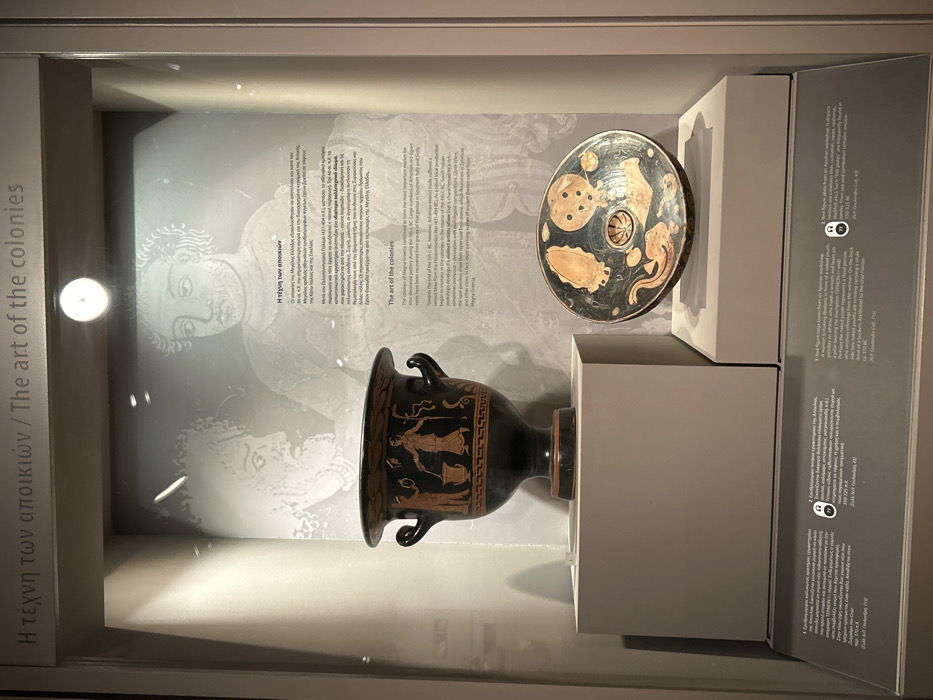
This media file captures an exhibit in a museum, showcasing ancient Greek pottery. Two primary artifacts are displayed within a glass case: a red-figure krater (vase) and a red-figure plate. The krater, positioned on the left, is dark-glazed with figures depicted in the red-figure technique, showing red-orange human forms against the dark background. One visible figure appears to be a woman in a chiton, possibly holding an instrument or object, with another figure partly visible. The plate, placed on the right, also uses the red-figure technique, featuring stylized designs that may include mythological or marine elements. Both items rest on white, rectangular pedestals. The background of the display case features faint, stylized illustrations of human faces or busts, consistent with ancient Greek art, and serves as a backdrop to the artifacts. The scene is brightly lit by artificial lighting, creating reflections on the glass case. Visible text on the display provides information about the exhibit and the objects. A large title on the left reads "Η τέχνη των αποικιών / The art of the colonies" in both Greek and English. An informational panel in the background, also in Greek and English, refers to "The art of the colonies" and "Magna Graecia," mentioning "Attic decorated pottery during the 5th c. BC". Smaller panels next to the objects describe them individually: - For the krater (numbered '1'): "Ερυθρόμορφος κρατήρας από εργαστήριο της Απουλίας" (Red-figure krater from an Apulian workshop), detailing a woman and a young man, dated "350-325 π.Χ." (BC). - For the plate (numbered '2'): "Red-figure plate from an Apulian workshop," describing a woman and a boy, also dated "350-325 BC". The overall scene depicts a well-organized museum exhibit in Athina, Greece, highlighting artistic production from Greek colonies.
No transactions found