
Sign in
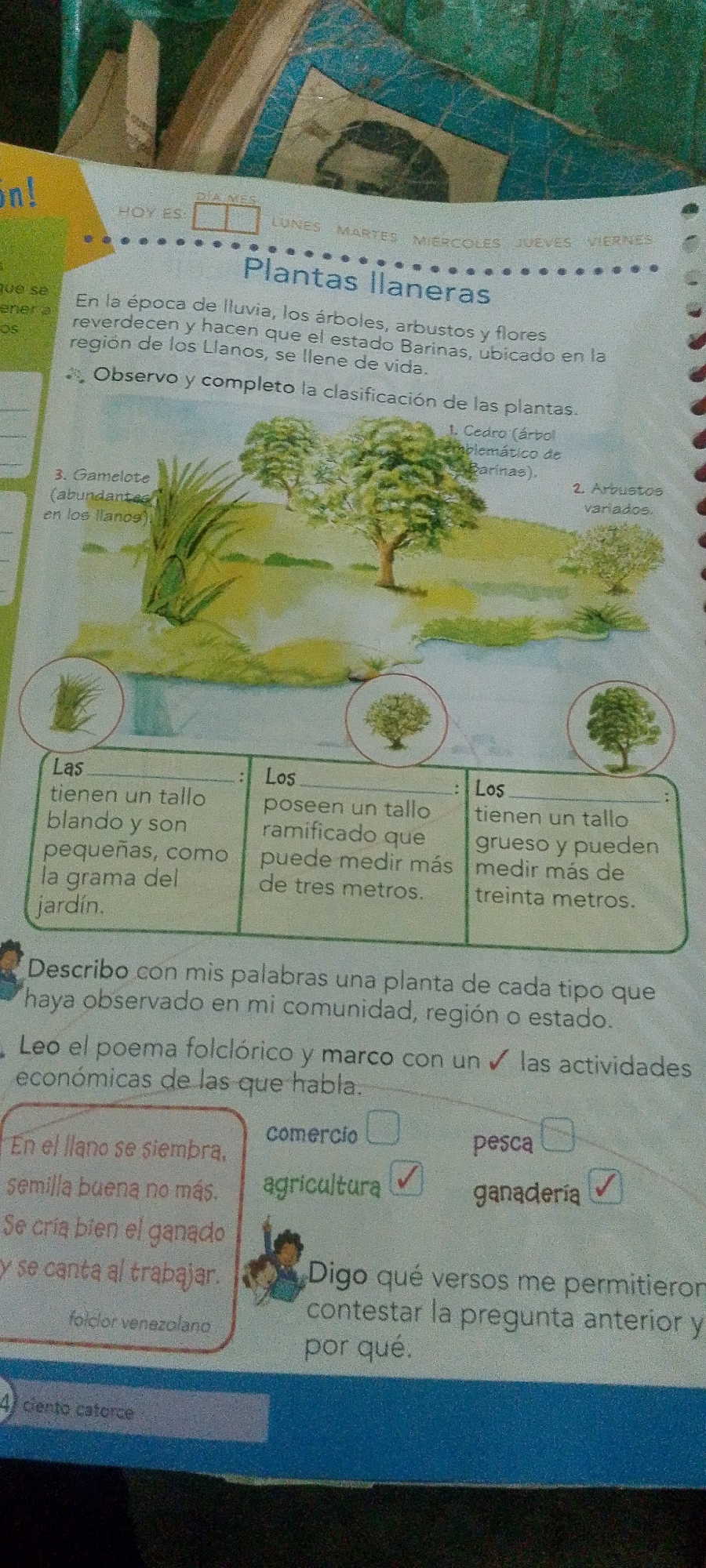
The image is a page from a Spanish-language educational workbook, likely for elementary school children, focused on the flora of the Venezuelan Llanos. The title of the page is "Plantas Llaneras" (Plains Plants). The top section of the page includes a calendar grid with days of the week labeled (LUNES, MARTES, MIERCOLES, JUEVES, VIERNES) and a section for "HOY ES" (Today is), with blank squares for writing the date. Below the calendar, there is a descriptive text about the plants of the Llanos. It states that during the rainy season, trees, shrubs, and flowers in the Barinas state region of the Llanos come to life. It also instructs the student to observe and complete the classification of plants. The central part of the page features an illustration depicting a typical Llanos landscape with trees, shrubs, and grass near a body of water. Three numbered plant categories are presented with their corresponding descriptions: 1. **Cedro (árbol emblemático de Barinas).** (Cedar - emblematic tree of Barinas). 2. **Arbustos variados.** (Various shrubs). 3. **Gamelote (abundantes en los llanos).** (Gamelote - abundant in the plains). Below the illustration, there are three labeled sections, each with a small circular image of a plant and a description: * **Las tienen un tallo blando y son pequeñas, como la grama del jardín.** (They have a soft stem and are small, like garden grass.) - This description corresponds to a small, grass-like plant shown in a circle. * **Los poseen un tallo ramificado que puede medir más de tres metros.** (They have a branched stem that can measure more than three meters.) - This description is associated with a medium-sized tree depicted in a circle. * **Los tienen un tallo grueso y pueden medir más de treinta metros.** (They have a thick stem and can measure more than thirty meters.) - This description is linked to a tall, mature tree shown in a circle. Further down, there are two exercises: * "Describo con mis palabras una planta de cada tipo que haya observado en mi comunidad, región o estado." (I describe in my own words a plant of each type that I have observed in my community, region, or state.) * "Leo el poema folclórico y marco con un ✓ las actividades económicas de las que habla." (I read the folk poem and mark with a ✓ the economic activities it talks about.) A folk poem is presented
cruzaleja

Jun 12, 2026, 1:00 AM

La Tagua, Venezuela

Moment

Stake attention in this memory

educational
informative
natural
observational
cultural

The image is a page from a Spanish-language educational workbook, likely for elementary school children, focused on the flora of the Venezuelan Llanos. The title of the page is "Plantas Llaneras" (Plains Plants). The top section of the page includes a calendar grid with days of the week labeled (LUNES, MARTES, MIERCOLES, JUEVES, VIERNES) and a section for "HOY ES" (Today is), with blank squares for writing the date. Below the calendar, there is a descriptive text about the plants of the Llanos. It states that during the rainy season, trees, shrubs, and flowers in the Barinas state region of the Llanos come to life. It also instructs the student to observe and complete the classification of plants. The central part of the page features an illustration depicting a typical Llanos landscape with trees, shrubs, and grass near a body of water. Three numbered plant categories are presented with their corresponding descriptions: 1. **Cedro (árbol emblemático de Barinas).** (Cedar - emblematic tree of Barinas). 2. **Arbustos variados.** (Various shrubs). 3. **Gamelote (abundantes en los llanos).** (Gamelote - abundant in the plains). Below the illustration, there are three labeled sections, each with a small circular image of a plant and a description: * **Las tienen un tallo blando y son pequeñas, como la grama del jardín.** (They have a soft stem and are small, like garden grass.) - This description corresponds to a small, grass-like plant shown in a circle. * **Los poseen un tallo ramificado que puede medir más de tres metros.** (They have a branched stem that can measure more than three meters.) - This description is associated with a medium-sized tree depicted in a circle. * **Los tienen un tallo grueso y pueden medir más de treinta metros.** (They have a thick stem and can measure more than thirty meters.) - This description is linked to a tall, mature tree shown in a circle. Further down, there are two exercises: * "Describo con mis palabras una planta de cada tipo que haya observado en mi comunidad, región o estado." (I describe in my own words a plant of each type that I have observed in my community, region, or state.) * "Leo el poema folclórico y marco con un ✓ las actividades económicas de las que habla." (I read the folk poem and mark with a ✓ the economic activities it talks about.) A folk poem is presented

Symbol

68310

Volume

0

Creator

+$0.07

Revenue

+$0.00

TVL

$0.00

1D
1W
1M
All

Loading AttnAds…

transactions
revenues
stakers
Earliest
Latest
Highest stake

1

Mariale

Staked 1mo ago
Redeemed 29d ago

$2.80 USD

+$0.02 USD

Fee: $0.03 (1%)

+0.7%

2

Rev Bot 🤖💰

Injected revenue 1mo ago

Revenue bonus for the last stake.

+$0.08 USD

3

Jesús Ferrer

Staked 25d ago
Redeemed 24d ago

$2.80 USD

+$0.01 USD

Fee: $0.03 (1%)

+0.2%

4

Rev Bot 🤖💰

Injected revenue 25d ago

Revenue bonus for the last stake.

+$0.07 USD

More from this user

More from La Tagua

cruzaleja

Jun 12, 2026, 1:00 AM

La Tagua, Venezuela

Licensed under Creative Commons Attribution 4.0 International License. You are free to share and adapt this content with proper attribution.