Sign in
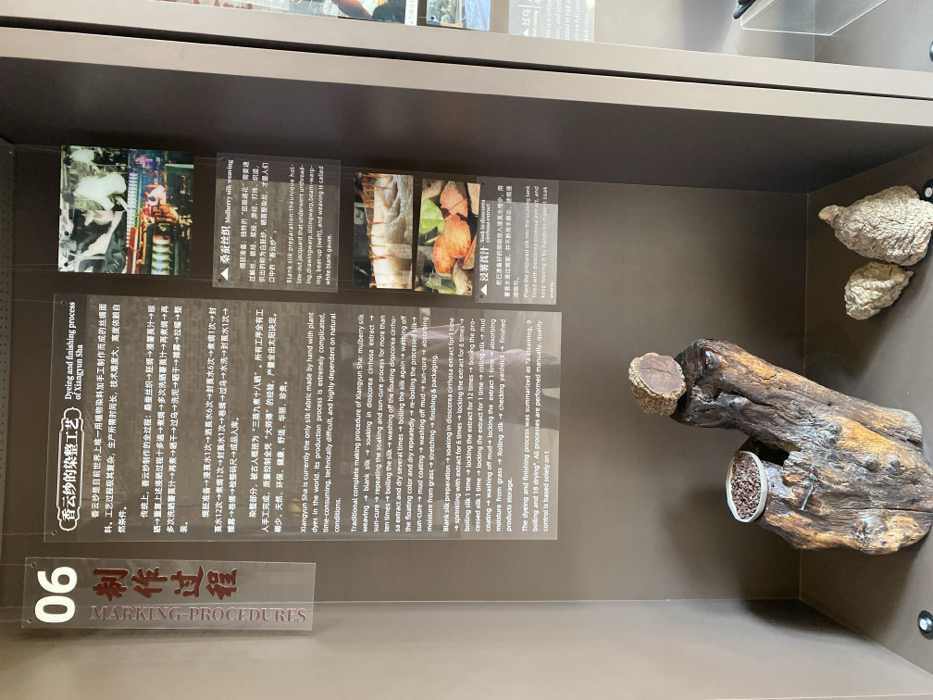
This image captures a section of a museum exhibit detailing the "Dyeing and finishing process of Xiangyun Sha" (a type of silk) in Guangzhou, China. The scene is an indoor display, likely in a museum or cultural center, featuring informational panels alongside physical artifacts.

The primary subjects are several transparent acrylic panels displaying text in both Chinese and English, along with small illustrative photographs. These panels explain the intricate, traditional process of creating Xiangyun Sha, noting its reliance on plant dyes and natural conditions. Key stages mentioned include mulberry silk weaving, soaking in dioscorea cirrhosa extract, sun-curing, boiling, mud coating, and various finishing steps. The process is summarized as "three steaming, nine boiling, and eighteen drying," emphasizing its manual nature and quality control by skilled artisans. One panel is titled "06 MARKING-PROCEDURES."

To the right of the panels, several objects are displayed within the exhibit space. These include dried, irregularly shaped plant roots or tubers, and a substantial piece of weathered wood. One end of the wood is cut, revealing a smooth, dark brown cross-section, while another section has a carved-out depression holding what appears to be dark, dried seeds or beans, possibly representing ingredients used in the dyeing process, such as dioscorea cirrhosa extract.

The setting is well-lit, highlighting the display. The combination of detailed textual explanations, supporting imagery, and relevant physical objects provides a comprehensive look into the traditional craft of Xiangyun Sha production.
F
FM-CaIMM2

Dec 19, 2024, 6:52 AM

Guang Zhou Shi, China

Stake attention in this memory

This image captures a section of a museum exhibit detailing the "Dyeing and finishing process of Xiangyun Sha" (a type of silk) in Guangzhou, China. The scene is an indoor display, likely in a museum or cultural center, featuring informational panels alongside physical artifacts. The primary subjects are several transparent acrylic panels displaying text in both Chinese and English, along with small illustrative photographs. These panels explain the intricate, traditional process of creating Xiangyun Sha, noting its reliance on plant dyes and natural conditions. Key stages mentioned include mulberry silk weaving, soaking in dioscorea cirrhosa extract, sun-curing, boiling, mud coating, and various finishing steps. The process is summarized as "three steaming, nine boiling, and eighteen drying," emphasizing its manual nature and quality control by skilled artisans. One panel is titled "06 MARKING-PROCEDURES." To the right of the panels, several objects are displayed within the exhibit space. These include dried, irregularly shaped plant roots or tubers, and a substantial piece of weathered wood. One end of the wood is cut, revealing a smooth, dark brown cross-section, while another section has a carved-out depression holding what appears to be dark, dried seeds or beans, possibly representing ingredients used in the dyeing process, such as dioscorea cirrhosa extract. The setting is well-lit, highlighting the display. The combination of detailed textual explanations, supporting imagery, and relevant physical objects provides a comprehensive look into the traditional craft of Xiangyun Sha production.

Loading AttnAds…

transactions
revenues
stakers
Earliest
Latest
Highest stake

No transactions found

More from this user

More from Guang Zhou Shi

FFM-CaIMM2

Dec 19, 2024, 6:52 AM

Guang Zhou Shi, China

Licensed under Creative Commons Attribution 4.0 International License. You are free to share and adapt this content with proper attribution.