Sign in
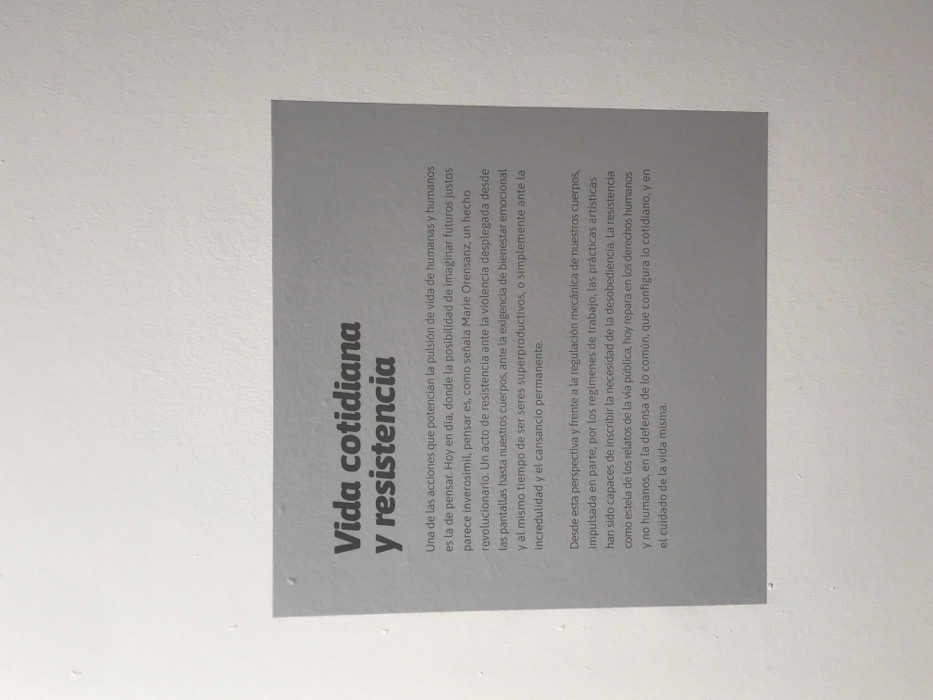
The image displays a grey rectangular sign mounted on a plain white wall, typical of an indoor exhibition or gallery space. The sign is oriented vertically, with the text rotated 90 degrees clockwise relative to the viewer, appearing sideways in the frame.

The visible text, written in Spanish, is titled "Vida cotidiana y resistencia" (Everyday life and resistance). The first paragraph discusses thinking as a vital action for humans, especially when the possibility of imagining just futures seems improbable. It refers to Marie Orensanz, stating that thinking is a revolutionary act of resistance against violence, emotional demands, the pressure to be superproductive, incredulity, and constant exhaustion.

The second paragraph elaborates on this perspective, noting that artistic practices have championed the necessity of disobedience in the face of the mechanical regulation of bodies, often driven by work regimes. It describes resistance as a public narrative that addresses human and non-human rights, advocating for the common good, shaping daily life, and fostering the care of life itself. The location context suggests this sign is displayed in Rosario, Argentina. No people are visible, and the lighting indicates an indoor setting.
F
FM-pWi952

Jan 11, 2025

Rosario, Argentina

Stake attention in this memory

The image displays a grey rectangular sign mounted on a plain white wall, typical of an indoor exhibition or gallery space. The sign is oriented vertically, with the text rotated 90 degrees clockwise relative to the viewer, appearing sideways in the frame. The visible text, written in Spanish, is titled "Vida cotidiana y resistencia" (Everyday life and resistance). The first paragraph discusses thinking as a vital action for humans, especially when the possibility of imagining just futures seems improbable. It refers to Marie Orensanz, stating that thinking is a revolutionary act of resistance against violence, emotional demands, the pressure to be superproductive, incredulity, and constant exhaustion. The second paragraph elaborates on this perspective, noting that artistic practices have championed the necessity of disobedience in the face of the mechanical regulation of bodies, often driven by work regimes. It describes resistance as a public narrative that addresses human and non-human rights, advocating for the common good, shaping daily life, and fostering the care of life itself. The location context suggests this sign is displayed in Rosario, Argentina. No people are visible, and the lighting indicates an indoor setting.

transactions
revenues
stakers
Earliest
Latest
Highest stake

No transactions found

More from this user

More from Rosario

FFM-pWi952

Jan 11, 2025

Rosario, Argentina

Licensed under Creative Commons Attribution 4.0 International License. You are free to share and adapt this content with proper attribution.