
Stake attention in this memory
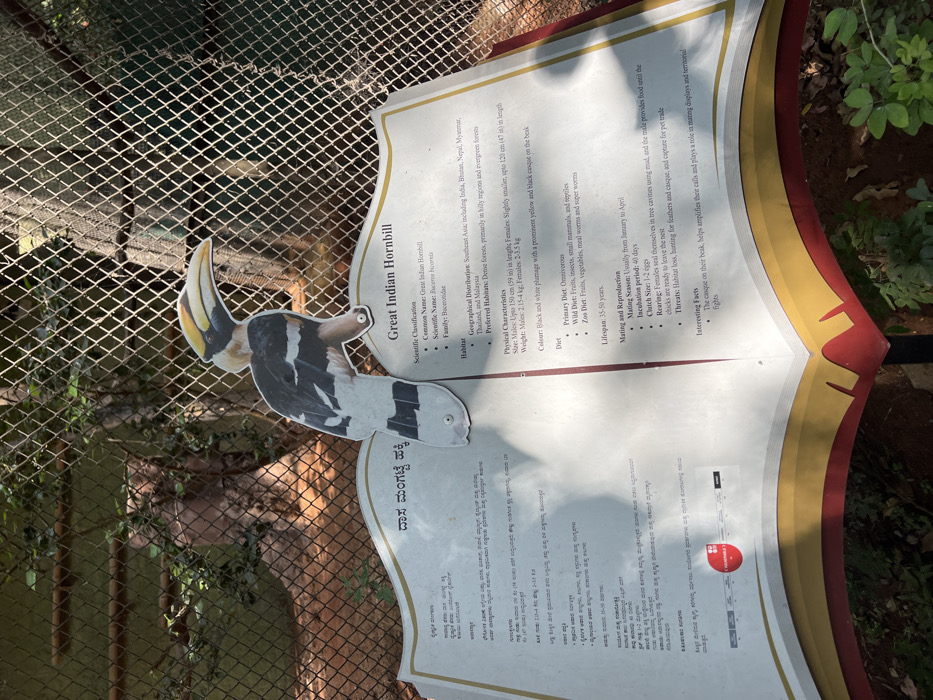
This image captures an educational display sign at what appears to be a zoo or wildlife park in Mysuru, India, given the dual language text. The sign, designed to resemble an open book, is positioned on its side, making the text appear horizontal. A large, illustrative cut-out of a Great Indian Hornbill (Buceros bicornis) is affixed to the left side of the sign, depicting the bird's distinctive large, yellow and black casque on its beak and its black and white plumage. The sign provides detailed information about the Great Indian Hornbill in both English and Kannada. The English text is clearly legible and includes sections on its Scientific Classification (Common Name: Great Indian Hornbill, Scientific Name: Buceros bicornis, Family: Bucerotidae), Habitat (Geographical Distribution across Southeast Asia including India, and Preferred Habitats like dense and evergreen forests), Physical Characteristics (Size, Weight, Colour: black and white plumage with yellow and black casque), Diet (Omnivorous, with wild and zoo diets listed), Lifespan (35-50 years), Mating and Reproduction (Mating Season: January to April, Incubation period: 40 days, Clutch Size: 1-2 eggs, and Rearing behavior), Threats (habitat loss, hunting, capture for pet trade), and Interesting Facts (the casque amplifies calls and plays a role in mating displays). Behind the sign is a wire mesh fence, indicating an enclosure, with green foliage and tree branches visible beyond. The lighting suggests it is daytime, with shadows cast on the sign itself. No people are visible in the frame, and the scene is static, focused entirely on the informative exhibit.
No transactions found